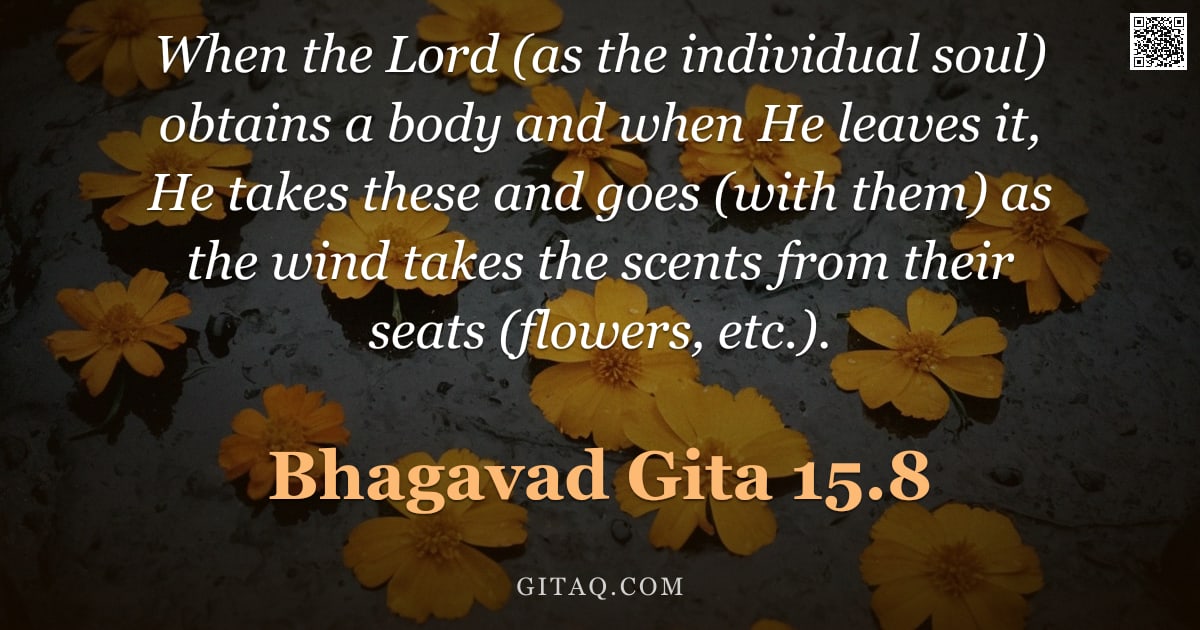
Bhagavad Gita 15.8
Purushottama Yoga · English Translation
शरीरं यदवाप्नोति यच्चाप्युत्क्रामतीश्वरः | गृहीत्वैतानि संयाति वायुर्गन्धानिवाशयात् ||१५-८||
śarīraṃ yadavāpnoti yaccāpyutkrāmatīśvaraḥ . gṛhitvaitāni saṃyāti vāyurgandhānivāśayāt ||15-8||
What Does This Verse Mean?
In this verse, Lord Krishna explains to Arjuna how the individual soul transitions between lives using a simple analogy of wind carrying fragrance. Just as air naturally picks up scents from flowers and moves them elsewhere without leaving the scent behind at its source, the subtle body accompanies the soul when it leaves one physical form for another. The key teaching is that death is not an end but merely a transition where our consciousness and accumulated impressions move on to new experiences while the old body remains behind.
The Teaching Behind It
This teaching belongs primarily to Jnana Yoga (the yoga of knowledge) and Sankhya philosophy, which distinguish between the eternal Self (Atman) and the temporary body. It develops the concept of reincarnation and the subtle body as a vehicle for consciousness that transcends physical death without being destroyed by it.
Word by Word
Classical Commentary
Where This Happens
This verse appears in Chapter 15 during Lord Krishna's discourse with Prince Arjuna on the battlefield of Kurukshetra, shortly after explaining the nature of the material world as an upside-down banyan tree. At this specific moment, Arjuna is still grappling with deep sorrow and confusion about fighting his own relatives and facing death. Krishna has just described how souls are bound by karma and desire, and now he uses this wind analogy to clarify that the physical body perishes while the conscious self moves on unchanged.
Living It Out Today
When you face a difficult career change or move to a new city, it can feel terrifying to leave behind your familiar environment. Instead of viewing this as losing everything, realize that just like the wind carrying scent, your skills, values, and memories travel with you into the unknown. This perspective shifts anxiety from 'I am leaving my safe space' to 'I am taking what matters most to a new chapter,' allowing you to step forward with confidence rather than fear.
Explained for Children
Imagine you have a backpack full of your favorite toys, books, and memories. When it's time to go to a new house or school, you don't leave those things behind; you pack them up in your bag and take them with you! This verse teaches us that when we grow old and pass away, our special 'soul' takes its backpack of good deeds and experiences along for the next adventure. It's like the wind picking up a flower's sweet smell and carrying it to another garden without hurting the original plant.
Daily Reflection
Today, try to see yourself not merely as the physical form that ages or changes, but as the silent witness who enters and leaves these forms with grace. Just as the wind carries fragrance without attachment to any single bloom, you carry your experiences through life's transitions without losing your true nature. Let this understanding bring a gentle release from anxiety about loss, reminding you that while the vessel may change, the traveler within is eternal.
A Practice for Today
Visualize your current body as a vessel that temporarily houses the divine spark, just as a flower holds fragrance without being consumed by it. Sit quietly and observe how you carry your thoughts and sensations through this day like wind carrying scent from one flower to another, knowing the essence within remains untouched.
Key Teachings
- The Invisible Traveler
Just as the wind carries scent without being seen or touched by it, the subtle body of consciousness travels between physical lives carrying impressions. This teaches us that our true identity is not bound to any single temporary form we inhabit. - The Nature of Transitions
Death and birth are natural movements where the soul takes its accumulated experiences with it, much like wind taking fragrance from flowers. This verse reframes departure as a continuous journey rather than an end or a terrifying separation. - Detachment of Essence
The Lord within remains distinct and untouched by the physical changes of entering or leaving a body, just as fragrance exists independently of its source. Recognizing this distinction helps us cultivate inner stability regardless of external bodily circumstances.
Themes
Related Verses
Read This Next
- 2.47 — To learn how performing duty with detachment helps the traveler not cling to results during these transitions.
- 3.30 — For instructions on surrendering all actions and their fruits, ensuring the journey is guided by higher wisdom rather than ego.
- 12.15 — To understand how to become a friend of all beings who are not disturbed by this world and do not fear it during change.
Recommended Reading
GitaQ earns from qualifying purchases as an Amazon Associate.