Bhagavad Gita 14.23
Gunatraya Vibhaga Yoga · English Translation
उदासीनवदासीनो गुणैर्यो न विचाल्यते | गुणा वर्तन्त इत्येवं योऽवतिष्ठति नेङ्गते ||१४-२३||
udāsīnavadāsīno guṇairyo na vicālyate . guṇā vartanta ityevaṃ yo.avatiṣṭhati neṅgate ||14-23||
What Does This Verse Mean?
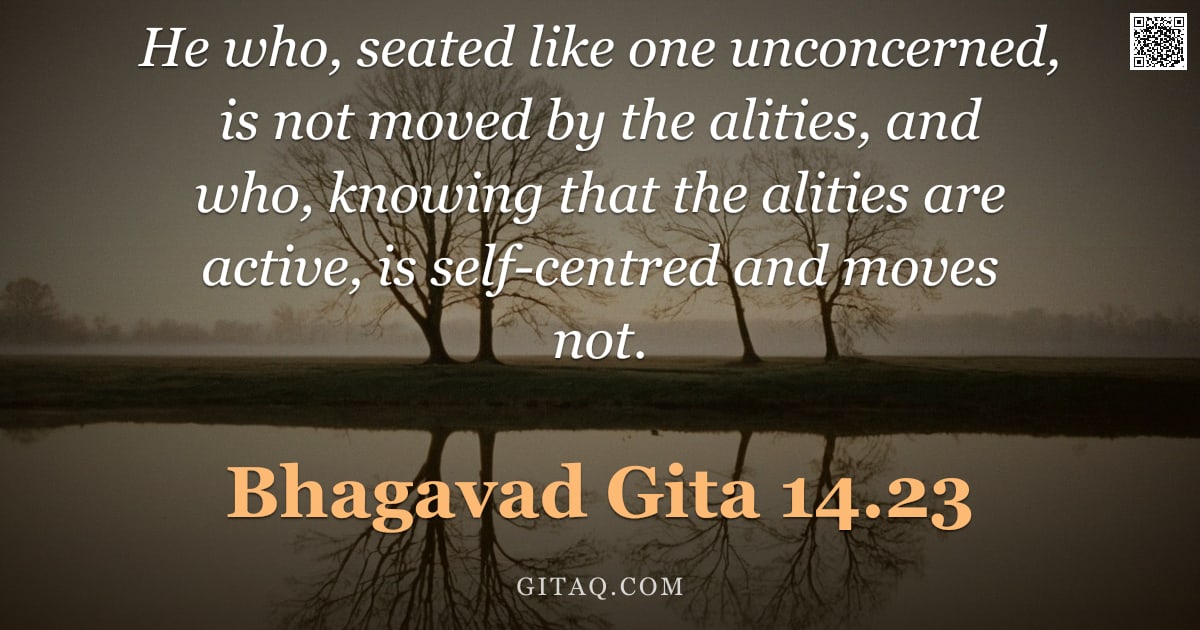
In this verse, Lord Krishna describes the qualities of a person who has transcended the three modes of material nature (goodness, passion, and ignorance). Such an individual remains like a neutral observer, unmoved by pleasure or pain because they understand that these changing states are merely active forces acting upon them. They do not identify with these fluctuations as 'me' or 'mine,' remaining steady in their true self despite external circumstances.
The Teaching Behind It
This verse is a cornerstone of Sankhya philosophy integrated into Karma Yoga and Jnana Yoga, focusing on the distinction between the conscious Self (Atman) and material nature (Prakriti). It develops the concept of 'Gita-samnyasa' or detachment, where one witnesses the interplay of qualities without being entangled by them.
Word by Word
Classical Commentary
Where This Happens
This teaching occurs on the battlefield of Kurukshetra during a critical moment where Prince Arjuna is overwhelmed by grief and confusion about fighting his own relatives. Lord Krishna has just explained the detailed mechanics of how the three Gunas (modes of nature) bind the soul to material existence in Chapter 14. As Krishna concludes this specific section, he points out that true wisdom involves not being swayed by these modes while witnessing their activity.
Living It Out Today
When facing a high-stakes job performance review where feedback swings wildly between excessive praise and harsh criticism, you can practice being 'unconcerned' regarding your self-worth. Instead of letting the manager's mood dictate your confidence or anxiety levels, observe that these reactions are simply temporary professional dynamics (the Gunas) operating in the environment. You maintain a steady internal state by acknowledging the feedback objectively without attaching it to your identity as a person.
Explained for Children
Imagine you are watching your favorite movie on TV while sitting comfortably on a couch. If the characters get angry, fight, or cry on the screen, does it make *you* fall off the sofa? No! You stay right where you are because you know those emotions belong to the actors and the story, not to you. This verse teaches us how to be like that calm viewer: even when life gets crazy with happiness or sadness, we can sit steady inside our hearts and remember that these feelings are just part of the show.
Daily Reflection
You often feel pulled in different directions by praise or blame, success or failure, but today I invite you to remember that you are the silent witness behind it all. When you realize that qualities like passion and inertia are just performing on stage while you remain seated safely off-stage, their power over your peace diminishes significantly.
A Practice for Today
Visualize yourself as a quiet observer sitting on the shore, watching waves of emotions and external events rise and fall without pulling you into them. Acknowledge that these changing conditions are merely the play of nature acting upon itself, not your true identity.
Key Teachings
- The Witness Stance
This verse establishes the ideal of being 'udāsīna,' meaning to sit as a neutral observer who does not get entangled in the fluctuations of the three modes. It teaches that true stability comes from recognizing oneself as distinct from the psychological and physical changes happening around us. - The Autonomy of Nature
The text clarifies that 'gunā vartante'—the modes are active—but they operate independently of the Self. By understanding this mechanism, one stops taking personal credit or blame for circumstances, realizing these are simply natural forces interacting with matter. - Non-Disturbance as Freedom
The ultimate sign of liberation in this context is being 'na vicālyate,' meaning not shaken by the dualities of life. This state of non-disturbance allows a person to remain centered and self-possessed regardless of whether they are experiencing joy, sorrow, or neutrality.
Themes
Related Verses
Read This Next
- 2.47 — Read this next to understand how performing duty without attachment creates a similar state of equanimity described in verse 14.23.
- 3.30 — This verse complements the teaching by instructing one to surrender all actions to the Divine, preventing the ego from being shaken by results.
- 12.15 — Read this to see how a devotee who is not disturbed and does not disturb others embodies the very qualities of detachment mentioned in Chapter 14.
Recommended Reading
GitaQ earns from qualifying purchases as an Amazon Associate.