Bhagavad Gita 13.19
Kshetra Kshetrajna Vibhaga Yoga · English Translation
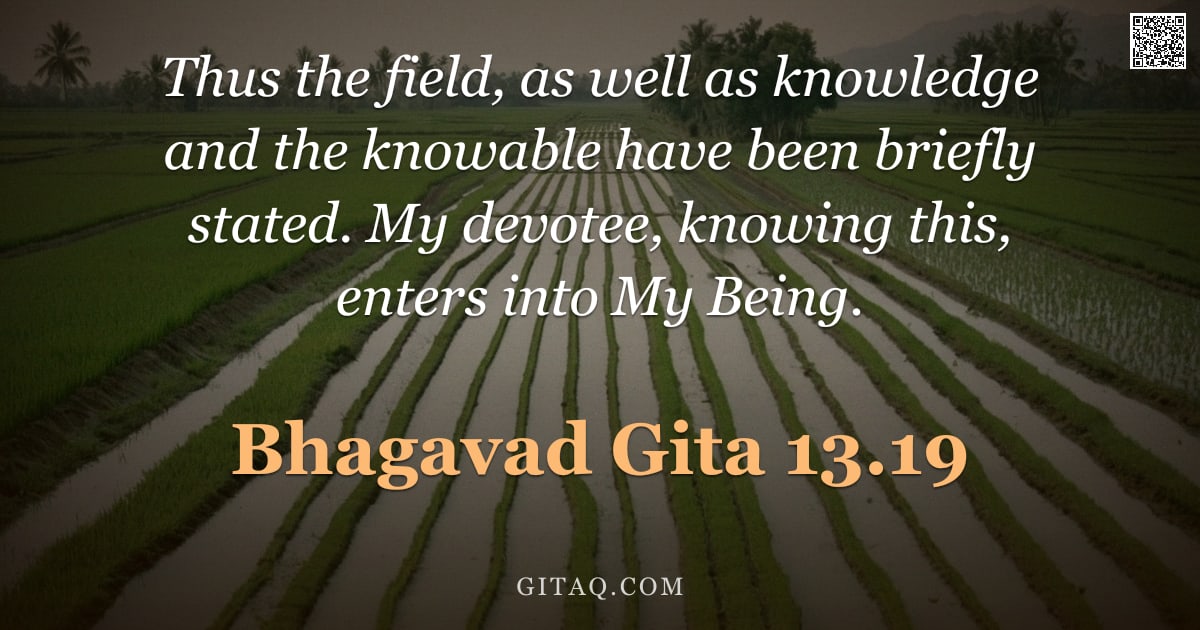
इति क्षेत्रं तथा ज्ञानं ज्ञेयं चोक्तं समासतः | मद्भक्त एतद्विज्ञाय मद्भावायोपपद्यते ||१३-१९||
iti kṣetraṃ tathā jñānaṃ jñeyaṃ coktaṃ samāsataḥ . madbhakta etadvijñāya madbhāvāyopapadyate ||13-19||
What Does This Verse Mean?
In this verse, Lord Krishna summarizes the entire previous discussion by stating that he has briefly explained three things: the physical body as 'the field,' knowledge of how to understand it, and the ultimate truth known as Brahman. He tells Arjuna that once a devotee truly understands these concepts through study and reflection, they naturally attain union with the Divine nature. The core teaching is that intellectual clarity about reality leads directly to spiritual transformation and surrender.
The Teaching Behind It
This verse sits at the intersection of Jnana Yoga (the yoga of knowledge) and Bhakti Yoga (the path of devotion), serving as the bridge between intellectual understanding and spiritual realization. It develops the Sankhya concept of distinguishing matter from spirit, culminating in the realization that true knowledge naturally leads to surrendering one's ego into the Divine.
Word by Word
Classical Commentary
Where This Happens
This verse occurs on the battlefield of Kurukshetra during the Mahabharata, as Lord Krishna concludes his detailed discourse in Chapter 13 to Arjuna. Just before this summary, they have discussed 'Kshetra' (the body and world) and 'Kshetrajna' (the soul), distinguishing between matter and consciousness. Arjuna is listening intently after being overwhelmed by duty and confusion; Krishna offers this concise recap to ensure the profound teachings are clear before moving toward final devotion.
Living It Out Today
Consider a professional facing burnout from overworking on projects that feel meaningless, where they have lost sight of their true self. Instead of just working harder (the field), they pause to reflect on *why* they do what they do and distinguish their identity from the stress (knowledge/knowable). By integrating this wisdom into their daily routine with a spirit of gratitude rather than obligation, they find inner peace and purpose, effectively 'entering' a state of flow that feels aligned with a higher calling.
Explained for Children
Imagine you are looking at a beautiful painting in a museum; first, you need to know what the canvas looks like (the field), then learn how artists use colors and light (knowledge), and finally understand who created it all. Krishna is saying that when we truly 'get' these three things about ourselves and the world, our hearts naturally want to connect with God just like a child wants to hug their parent after understanding they are safe. It's like solving a big puzzle where every piece fits perfectly until you see the whole picture of love.
Daily Reflection
Today, I invite you to pause and ask yourself: where do you feel most separated from peace? The Gita suggests that by understanding the difference between what is changing (the field) and who truly knows it, we can stop struggling against our circumstances. As a devotee of this wisdom, your journey isn't about mastering every detail of life but about surrendering to the source behind them all.
A Practice for Today
Sit quietly and visualize your body as the field, observing how thoughts and sensations arise like crops without claiming them as 'mine.' Then, gently shift your awareness to be the silent observer within, recognizing that true knowledge lies in seeing the Divine presence behind this temporary experience.
Key Teachings
- The Triad of Existence
This verse establishes that reality consists of three interconnected elements: the field (the body and mind), knowledge (understanding this distinction), and the knowable (Brahman or the Supreme). Without grasping all three, one remains trapped in illusion rather than seeing the truth. - The Path to Devotion
True devotion is not merely ritualistic; it arises from intellectual and spiritual clarity regarding these principles. When a seeker truly knows how they relate to the field and the knower, their heart naturally turns toward the Divine. - Union with the Supreme
The ultimate goal of this knowledge is not just theoretical understanding but an existential state where one enters into God's being. This 'entering' signifies a complete merging of individual will and consciousness with the divine nature.
Themes
Related Verses
Read This Next
- 13.2 — To understand Krishna's definition of what constitutes 'the Field' (Kshetra) in greater detail.
- 13.7 — Because this verse lists the specific qualities of knowledge that help distinguish truth from ignorance.
- 9.26 — To see how simple offerings made with love connect to the same principle of devotion and divine acceptance mentioned here.
Recommended Reading
GitaQ earns from qualifying purchases as an Amazon Associate.