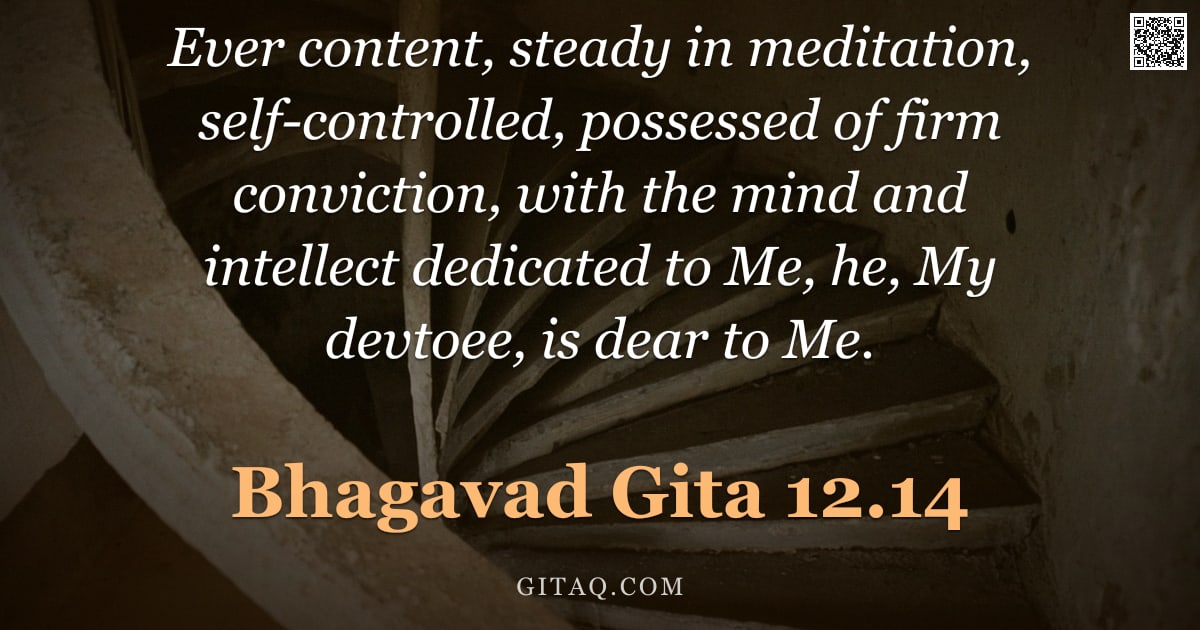
Bhagavad Gita 12.14
Bhakti Yoga · English Translation
सन्तुष्टः सततं योगी यतात्मा दृढनिश्चयः | मय्यर्पितमनोबुद्धिर्यो मद्भक्तः स मे प्रियः ||१२-१४||
santuṣṭaḥ satataṃ yogī yatātmā dṛḍhaniścayaḥ . mayyarpitamanobuddhiryo madbhaktaḥ sa me priyaḥ ||12-14||
What Does This Verse Mean?
In this verse, Lord Krishna describes the qualities of a devotee who is dear to Him: someone who remains always content, controls their mind and senses, holds firm convictions, and dedicates all thoughts and actions to God. Speaking to Arjuna on the battlefield, Krishna emphasizes that true devotion isn't just about rituals but involves an inner state of peace and unwavering focus. The key teaching is that a steady, satisfied heart dedicated to the Divine becomes the ultimate path to spiritual connection.
The Teaching Behind It
This verse belongs to Bhakti Yoga (the path of devotion) while integrating principles from Sankhya philosophy regarding self-control and mental discipline. It develops the concept that true bhakti is rooted in an internal state of santosha (contentment) and one-pointed focus, where the mind becomes a perfect vessel for divine connection.
Word by Word
Classical Commentary
Where This Happens
This verse appears in Chapter 12 of the Bhagavad Gita, set amidst the tense preparations for war at Kurukshetra between the Pandavas and Kauravas. Lord Krishna has just finished explaining different paths to spiritual realization and is now answering Arjuna's question about which type of devotee is most dear to Him. At this moment, Arjuna is deeply conflicted but seeking clarity on how to cultivate a steady mind while facing his duty as a warrior.
Living It Out Today
Consider a professional facing a high-stakes project deadline with conflicting demands from different stakeholders; instead of reacting with anxiety or frustration, they practice the verse's teaching by staying content with their current progress and dedicating their mental energy solely to solving the problem. By maintaining firm conviction in their abilities and suppressing impulsive reactions, they handle the pressure without losing focus. This inner stability not only leads to better decision-making but also reduces personal stress significantly.
Explained for Children
Imagine you have a very special friend who always smiles even when things are hard or messy around them. Krishna says this verse describes someone like that: they are happy with what they have, don't get angry easily, and keep their worries in check by focusing on God. It's like having a superpower where your mind is calm and strong, making you the favorite friend of everyone who loves you most.
Daily Reflection
In our rush to achieve more or have better things, we often forget that true peace comes from a heart already satisfied with what is present today. When you approach life with a mind anchored in trust and self-control rather than anxiety about the future, you discover a profound closeness to the Divine within your own journey.
A Practice for Today
Begin by closing your eyes and taking three deep breaths, allowing the mind to settle into a state of quiet contentment with exactly what is happening right now. Visualize offering your current thoughts and worries into the space between your brows, affirming that you are steady in this moment regardless of external circumstances.
Key Teachings
- The Power of Contentment
True yogic strength begins with santuṣṭaḥ, or being ever content, which frees us from the restless cycle of desire and dissatisfaction. This inner stability acts as a foundation, allowing the mind to remain unshaken by external gains or losses. - Total Surrender of Intellect
The devotee offers not just their actions but their very intellect (buddhi) and thought processes (manas) to the Divine. This complete dedication transforms ordinary mental activity into an act of worship, aligning personal will with universal purpose. - Firm Conviction as a Bond
Dṛḍhaniścayaḥ represents a firm conviction in the truth of God's presence and guidance. This unwavering faith is not blind belief, but a deep knowing that makes one dear to the Divine because it reflects trust without hesitation.
Themes
Related Verses
Read This Next
- 2.47 — To understand how one cultivates steady action without attachment, which supports the 'self-controlled' aspect of this verse.
- 3.30 — This verse elaborates on dedicating all actions to God through yoga and knowledge, expanding on the concept of total surrender mentioned here.
- 12.15 — To see how these internal qualities naturally manifest as an outer attitude that is dear to everyone, completing the picture of a devotee's life.
Recommended Reading
GitaQ earns from qualifying purchases as an Amazon Associate.