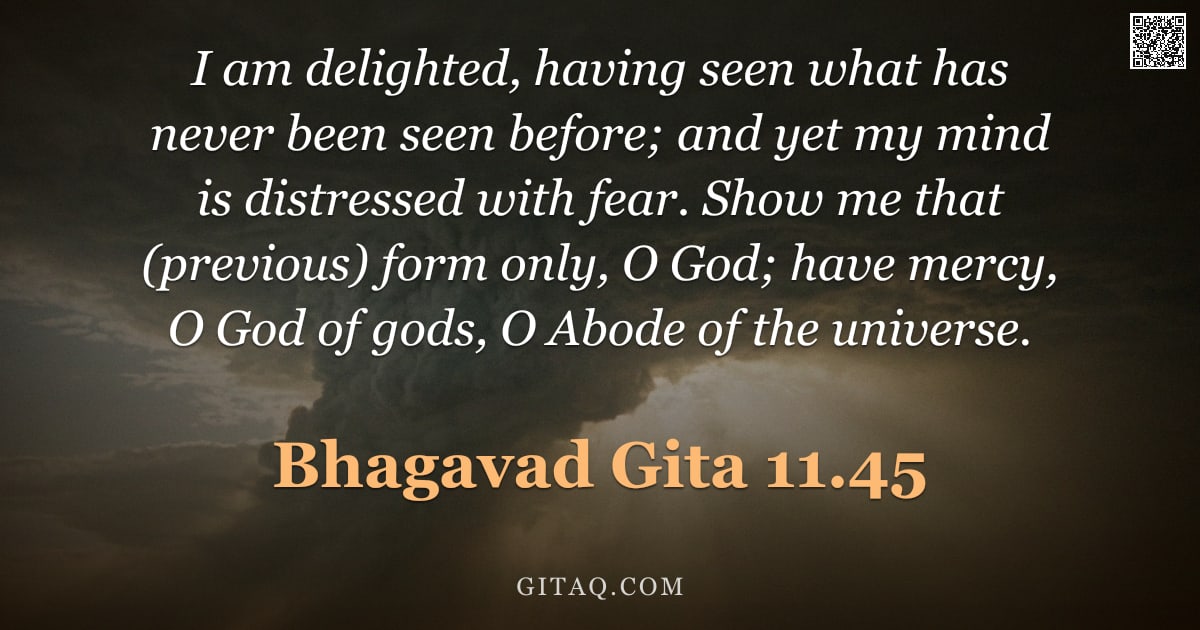
Bhagavad Gita 11.45
Vishvarupa Darshana Yoga · English Translation
अदृष्टपूर्वं हृषितोऽस्मि दृष्ट्वा भयेन च प्रव्यथितं मनो मे | तदेव मे दर्शय देव रूपं प्रसीद देवेश जगन्निवास ||११-४५||
adṛṣṭapūrvaṃ hṛṣito.asmi dṛṣṭvā bhayena ca pravyathitaṃ mano me . tadeva me darśaya deva rūpaṃ prasīda deveśa jagannivāsa ||11-45||
What Does This Verse Mean?
In this verse, Arjuna expresses a profound mix of emotions after witnessing Krishna's terrifying cosmic form: immense delight at seeing something never seen before, coupled with deep fear that leaves his mind trembling. He immediately asks the Divine to return to his familiar, gentle human form because he cannot bear the overwhelming vision in its full intensity. The core teaching is that while divine revelation can bring joy, it also requires a state of grace and mercy for the seeker's limited mind to endure; thus, Arjuna seeks Krishna's compassion (prasīda) as the ultimate refuge.
The Teaching Behind It
This verse is a cornerstone of Bhakti Yoga, illustrating that pure devotion involves surrendering the ego's limitations in exchange for divine grace. It develops the concept that while Jnana (knowledge) reveals the terrifying absolute power of Brahman, it requires Bhakti (love and surrender) to make that realization accessible and bearable for the human soul.
Word by Word
Classical Commentary
Where This Happens
This verse occurs in Chapter 11 of the Bhagavad Gita on the battlefield of Kurukshetra, during a moment where Arjuna has been granted divine sight by Krishna. Just prior to this, Krishna revealed his Vishvarupa (Cosmic Form), an infinite manifestation containing all gods, time, and destruction, which filled the sky with terrifying radiance. Overwhelmed by both awe at seeing the Creator of the universe and terror from witnessing the power that destroys worlds, Arjuna's mind becomes agitated. He realizes he is not prepared to witness this ultimate reality without divine grace and urgently pleads for Krishna to revert to his benevolent human form.
Living It Out Today
When a person faces an overwhelming breakthrough moment—such as being promoted to a leadership role or receiving unexpected news of success—they often feel excited yet paralyzed by the sudden responsibility. Just like Arjuna, they may realize that while the achievement is wonderful ('delighted'), their current capacity to handle it feels insufficient ('distressed with fear'). The solution lies in seeking guidance and support from mentors or faith communities (the 'divine mercy') rather than trying to force through alone until one's mind steadies enough to integrate the new reality.
Explained for Children
Imagine you are looking at your favorite parent, but suddenly they turn into a giant star full of fire and lights that is so bright it scares you. You feel happy because seeing them like this is amazing, but you also want to run away because it's too big for you to handle. Arjuna felt the same way: he was amazed by God's huge form but got scared, so he asked his friend Krishna to turn back into just 'Krishna' again and be nice to him.
Daily Reflection
You often find yourself oscillating between moments of deep inspiration and sudden anxiety when faced with life's vastness; this verse validates that holy confusion as a natural part of spiritual growth. When you feel overwhelmed by the sheer scale of existence, remember that it is safe to ask for clarity and mercy rather than trying to grasp everything at once. The path forward begins not with conquering fear, but with surrendering your mind back to the source who holds both creation and destruction.
A Practice for Today
Close your eyes and acknowledge that you have witnessed something profound today, allowing yourself to feel a sense of awe rather than just ordinary joy. Then, gently release the tension by visualizing the Divine's previous gentle form, inviting peace into any fear or overwhelm arising within your mind.
Key Teachings
- The Paradox of Awe
True spiritual awakening often brings a mixture of supreme delight ('hṛṣita') alongside trembling fear ('bhaya'), as the human mind struggles to contain infinite reality. This verse teaches us that such conflicting emotions are not signs of failure, but evidence of encountering something beyond ordinary perception. - The Call for Mercy
Even after witnessing cosmic grandeur, Arjuna requests the return to a familiar, gentle form ('prasīda'), acknowledging that human beings need divine compassion to endure such visions. The seeker's ultimate refuge is not just in seeing power, but in experiencing the deity as 'Prasīda' (gracious) and accessible. - The Abode of All
Addressing Krishna as 'Jagannivāsa' reminds us that God is not only the majestic creator but also the very ground of existence where all beings find rest. This title shifts our focus from fear of destruction to trust in the divine presence that sustains and houses the entire universe.
Themes
Related Verses
Read This Next
- 2.47 — Read this next to understand how Arjuna's earlier fear was rooted in attachment, contrasting with his current vision of the universal.
- 3.30 — This verse follows well as it teaches dedicating all actions and their fruits to God, which is a practical way to live after seeing the Cosmic Form.
- 12.15 — Reading this concludes the theme of devotion by highlighting how Krishna loves those who are free from fear and hatred toward all beings.
Recommended Reading
GitaQ earns from qualifying purchases as an Amazon Associate.