Bhagavad Gita 11.46
Vishvarupa Darshana Yoga · English Translation
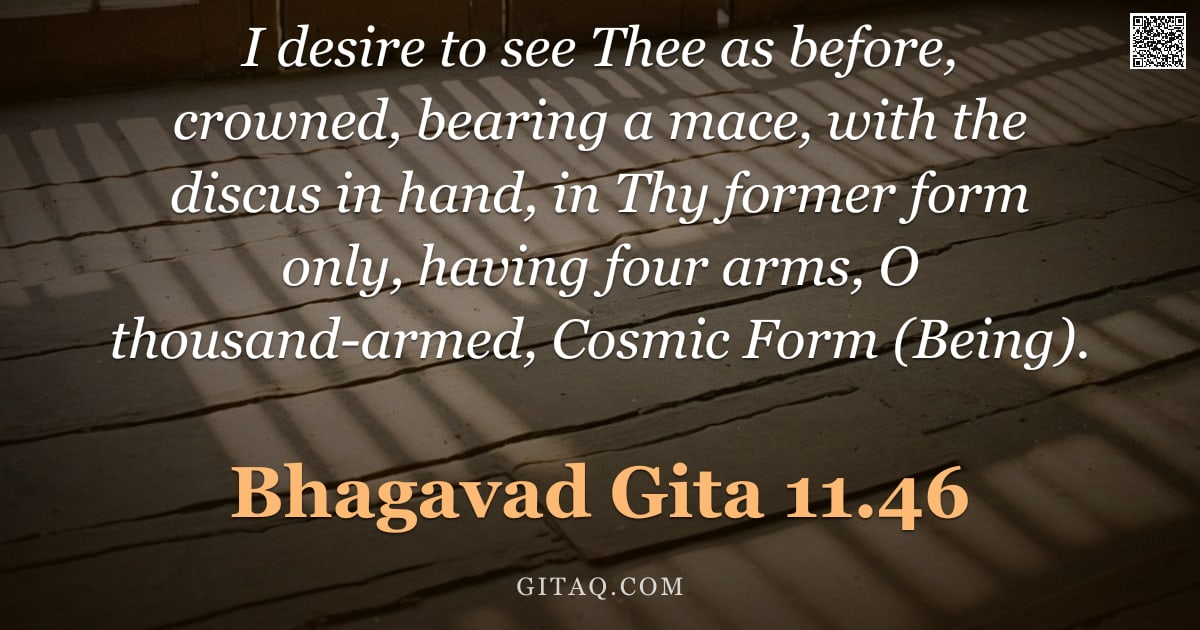
किरीटिनं गदिनं चक्रहस्तं इच्छामि त्वां द्रष्टुमहं तथैव | तेनैव रूपेण चतुर्भुजेन सहस्रबाहो भव विश्वमूर्ते ||११-४६||
kirīṭinaṃ gadinaṃ cakrahastaṃ icchāmi tvāṃ draṣṭumahaṃ tathaiva . tenaiva rūpeṇa caturbhujena sahasrabāho bhava viśvamūrte ||11-46||
What Does This Verse Mean?
In this verse, Arjuna is speaking to Lord Krishna and expresses a specific desire after witnessing the terrifying universal cosmic form (Vishvarupa). Although he has just seen God in His infinite, thousand-armed manifestation that fills the universe, Arjuna asks Krishna to return to his familiar human-like four-armed form. He specifically requests the image of Krishna wearing a crown, holding a mace and discus, as this form represents divine protection and order without overwhelming fear.
The Teaching Behind It
This verse sits firmly within Bhakti Yoga (the path of devotion), illustrating that while ultimate knowledge of God's infinite nature is essential for liberation (Jnana), the devotee often requires a personal, manageable form (Saguna Brahman) to sustain love and connection. It develops the concept of Ishvara Arpana Buddhi, where the infinite reality becomes accessible through specific attributes like beauty, power, and grace that inspire surrender rather than fear.
Word by Word
Classical Commentary
Where This Happens
This verse occurs at the climax of Chapter 11 on the battlefield of Kurukshetra, immediately after Lord Krishna reveals his terrifying Vishvarupa (Universal Form) to Arjuna. Having just witnessed the divine vision where time devours worlds and countless warriors are seen entering Krishna's mouths in fear, Arjuna is overwhelmed by a mixture of awe and terror. He trembles and bows down, asking for the return of Krishna's four-armed form as he had known him before—crowned with his royal insignia (Kirita), holding weapons like the mace (Gada) and discus (Chakra)—which signifies a manageable aspect of divinity that encourages devotion rather than paralyzing fear.
Living It Out Today
Consider a moment when you receive a massive, complex task at work or face a sudden family crisis that feels too big to handle; the sheer scale might cause you to freeze in anxiety. This verse teaches us to ask for clarity and grounding: just as Arjuna asked for the familiar form, we should seek out our core values, trusted mentors, or simplified steps when overwhelmed by chaos. Instead of staring at the terrifying magnitude of a problem, focus on your specific role (the 'four-armed' duty) with confidence in divine support to move forward effectively.
Explained for Children
Imagine you are looking at a giant firework that is so bright and loud it makes you want to hide your eyes under your blanket. Even though the light is amazing, you miss seeing just one friendly person holding out their hand. Arjuna feels this way; he saw God as an enormous, glowing star with thousands of arms, which was too scary for him. So, he asks Krishna to show his special four-armed form again—like a superhero in armor but calm and kind—so Arjuna can feel safe and happy seeing the Divine.
Daily Reflection
You often find yourself overwhelmed when faced with forces larger than you can comprehend, much like Arjuna was before the vision of the universe. Yet today, remember that even in moments where life feels vast and mysterious, there is a divine intimacy waiting for you—a form that knows your name and holds safety in its hands. Just as Krishna restored his four-armed form to soothe his friend's heart, He invites you back into His familiar grace whenever fear takes hold.
A Practice for Today
Close your eyes and gently visualize Arjuna's request to see the Lord not as a terrifying cosmic giant, but returning to his familiar, beloved four-armed form holding the discus and mace. In this moment of safety and love, offer up your own fears about the unknown by surrendering them into that comforting presence.
Key Teachings
- The Need for Divine Intimacy
Even when witnessing the most awe-inspiring cosmic power, the human soul craves a personal connection with the Divine. Arjuna's request reveals that true devotion seeks not just to witness glory, but to be held in a relationship of love and familiarity. - The Symbolism of Form
Specific attributes like the crown, mace, and discus represent ordered power, protection, and spiritual knowledge. These symbols transform abstract cosmic energy into tangible tools that reassure the devotee of God's protective nature. - The Balance of Power and Grace
The verse bridges the gap between the terrifying universal form and the gentle personal deity, showing they are one. It teaches us to embrace divine majesty without losing sight of the compassionate heart that underlies it.
Themes
Related Verses
Read This Next
- 2.47 — Read this verse next to recall Arjuna's initial resolve to focus on duty rather than the fruits of action, grounding his desire for vision in practical devotion.
- 3.30 — This verse offers a direct instruction from Krishna to surrender all actions and thoughts to Him, reinforcing the theme of total reliance found in Arjuna's plea.
- 12.15 — Reading this later helps understand how one who is dear to God becomes a beacon of devotion, completing the journey from fear to intimate love with the Divine.
Recommended Reading
GitaQ earns from qualifying purchases as an Amazon Associate.