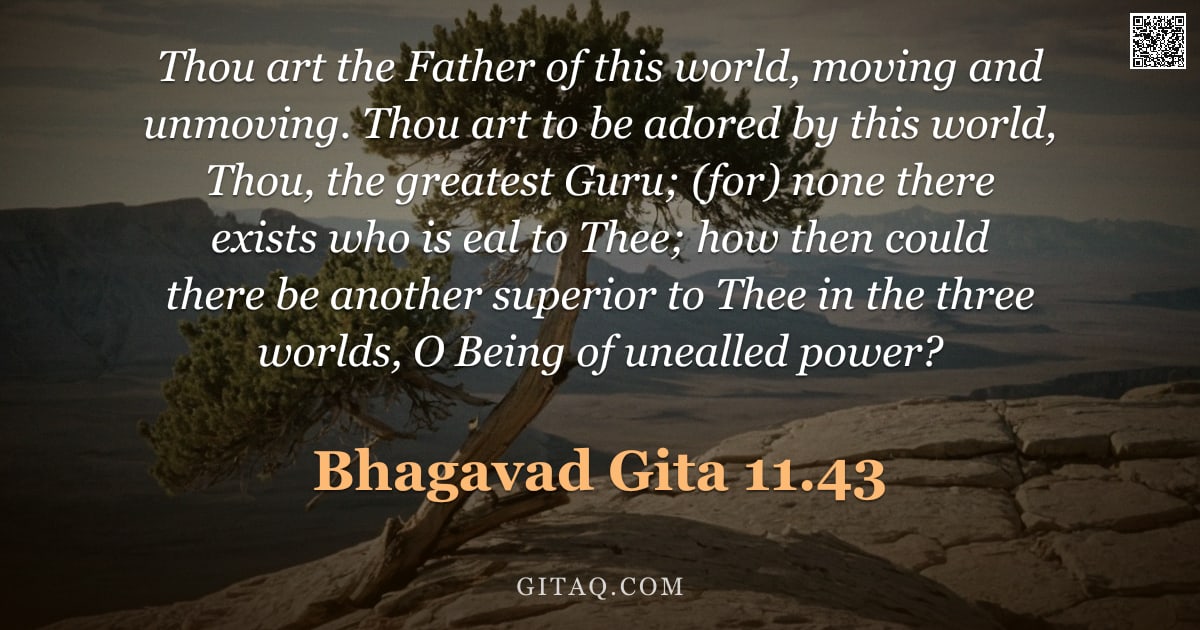
Bhagavad Gita 11.43
Vishvarupa Darshana Yoga · English Translation
पितासि लोकस्य चराचरस्य त्वमस्य पूज्यश्च गुरुर्गरीयान् | न त्वत्समोऽस्त्यभ्यधिकः कुतोऽन्यो लोकत्रयेऽप्यप्रतिमप्रभाव ||११-४३||
pitāsi lokasya carācarasya tvamasya pūjyaśca gururgarīyān . na tvatsamo.astyabhyadhikaḥ kuto.anyo lokatraye.apyapratimaprabhāva ||11-43||
What Does This Verse Mean?
In this verse, Arjuna addresses Lord Krishna as the supreme Father of all moving and unmoving beings in the universe. He declares that no one is equal to or greater than God, establishing His unique status as the ultimate teacher (Guru) worthy of worship by everyone. This moment captures Arjuna's realization that after witnessing the Cosmic Form, he understands his own insignificance compared to this divine power.
The Teaching Behind It
This verse belongs primarily to Bhakti Yoga, as it emphasizes devotion, reverence, and the personal relationship between the devotee and the Divine as Father and Guru. It also integrates Jnana Yoga by establishing the metaphysical truth of God's supremacy (Svarupa) over all creation, affirming that nothing exists independently of this ultimate reality.
Word by Word
Classical Commentary
Where This Happens
This verse occurs during Chapter 11 of the Bhagavad Gita, immediately after Arjuna has witnessed Krishna's terrifying yet magnificent Universal Form (Vishvarupa) containing all universes. The setting is still the battlefield of Kurukshetra, but the atmosphere shifts from fear to awe as Arjuna trembles and falls prostrate in surrender. Speaking directly to Krishna, a shaken but enlightened warrior acknowledges that he now fully understands the divine source behind his friend's guidance.
Living It Out Today
When facing an overwhelming career crisis or a family decision where no solution seems clear, you can apply this verse by shifting your perspective from 'I must solve everything alone' to trusting in a higher wisdom. Instead of letting anxiety consume you about the future, acknowledge that there is a greater intelligence (or universal order) guiding events beyond your immediate control. This mindset reduces ego-driven stress and allows you to act with clarity while surrendering the outcome.
Explained for Children
Imagine you meet a giant superhero who is not just strong but also created everything in the world—every star, every tree, and even yourself! That person is like God. Arjuna was so amazed by seeing Lord Krishna as this amazing being that he said, 'You are the best Father and Teacher anyone could ever have.' He realized that no one else on Earth or anywhere else can compare to such a powerful and loving friend.
Daily Reflection
In moments when you feel small against the vast currents of life, remember that the very world moving around you finds its origin and purpose in a Father who knows every atom. You do not need to search for a guru or guide beyond this One, because He is both the ultimate teacher and the most worthy object of your devotion. Let this truth dissolve any fear you hold about standing alone, knowing instead that you are held by a power without equal.
A Practice for Today
Sit quietly and visualize the universe not as something separate from you, but as a living child of this Divine Presence that holds all motion and stillness within it. Rest your mind in the realization that since no being is equal to or greater than this Source in any realm, you are safe returning to its embrace.
Key Teachings
- The Divine as Cosmic Parent
Krishna reveals Himself not just as a warrior or friend, but as the source of all existence for both moving and unmoving entities. This shifts our relationship from one of distant reverence to intimate familial trust in the Creator. - The Supreme Guru
By declaring Himself 'Gururgarīyān', Krishna establishes that no other teacher can surpass His wisdom or authority. He is the ultimate guide whose direction leads directly to liberation and truth. - Absolute Uniqueness
The verse asserts that there is nothing equal or superior in the three worlds, establishing a non-dual hierarchy where God alone stands supreme. This realization removes all competition from our spiritual life, allowing us to focus entirely on surrender. - Unequalled Power
The description of Krishna as having 'apratima-prabhāva' (unevalued power) confirms that His influence transcends all limitations of time and space. It invites the devotee to find absolute security in a strength that cannot be challenged.
Themes
Related Verses
Read This Next
- 2.47 — After acknowledging Krishna's supreme status in Chapter 11, this verse reminds us to focus on our duty without attachment to results.
- 3.30 — This verse offers the practical method of surrendering all actions and their fruits to God after seeing His cosmic form.
- 12.15 — Following the vision, this teaching describes the qualities of a devotee who is dear to Krishna, grounding our devotion in character.
Recommended Reading
GitaQ earns from qualifying purchases as an Amazon Associate.