Bhagavad Gita 11.29
Vishvarupa Darshana Yoga · English Translation
यथा प्रदीप्तं ज्वलनं पतङ्गा विशन्ति नाशाय समृद्धवेगाः | तथैव नाशाय विशन्ति लोकास्- तवापि वक्त्राणि समृद्धवेगाः ||११-२९||
yathā pradīptaṃ jvalanaṃ pataṅgā viśanti nāśāya samṛddhavegāḥ . tathaiva nāśāya viśanti lokāsa- tavāpi vaktrāṇi samṛddhavegāḥ ||11-29||
What Does This Verse Mean?
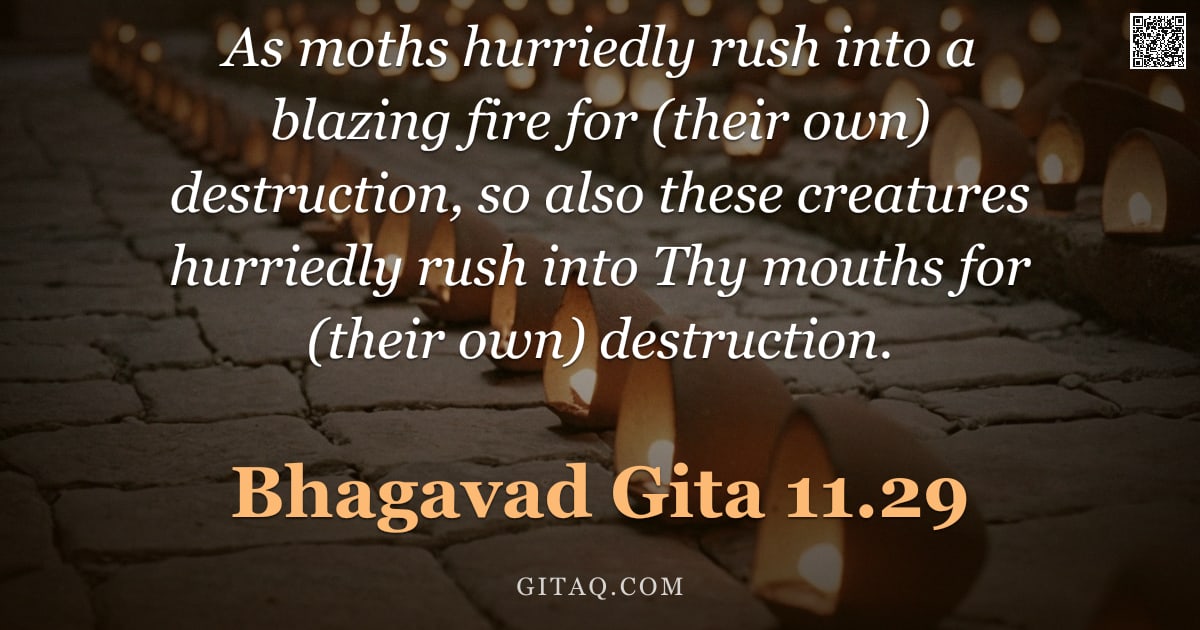
In this verse, the terrified warrior Arjuna speaks to Lord Krishna after witnessing his terrifying Cosmic Form (Vishvarupa). He compares people rushing into battle and dying to moths flying blindly into a blazing fire for their own destruction. The key teaching is that just as insects cannot escape the natural force of fire due to their instinctive nature, all beings are drawn inevitably toward their destined end by Krishna's divine will.
The Teaching Behind It
This teaching belongs primarily to the strand of Jnana Yoga (the path of knowledge) and Bhakti Yoga (devotion), illustrating the concept of Ishvara's supreme control over creation. It develops the understanding that individual agency is limited when pitted against divine will, emphasizing that all beings are instruments in the cosmic play.
Word by Word
Where This Happens
This verse occurs in Chapter 11 during the 'Vishvarupa Darshana Yoga,' immediately after Arjuna has witnessed the terrifying Universal Form of Krishna containing all worlds and destroying armies. On the battlefield of Kurukshetra, Arjuna is overwhelmed with fear as he sees that his own relatives are being consumed by this divine fire before his eyes. He speaks these words to express his awe and terror at seeing how inescapable destiny and God's power are for every living creature.
Living It Out Today
Consider a modern scenario where an employee, driven by greed or addiction (like the moths), continues to make risky financial decisions despite knowing the consequences of losing their job. Just as the moth is drawn to the flame against its better judgment due to instinctual impulse, we often rush toward self-destruction in our habits until reality forces a stop. This verse reminds us that without aligning with higher wisdom or divine will, our frantic efforts may lead only to ruin rather than success.
Explained for Children
Imagine you see a really bright campfire and some little bugs fly right into it without thinking because they think it looks warm or shiny. They can't stop themselves from going in close to the flames! Arjuna is saying that all people are like those tiny bugs, rushing toward their time of death with great speed. Lord Krishna's power is so big that everyone moves exactly where He wants them to go, just like moths moving into a fire.
Daily Reflection
You may find yourself running into situations or habits that you know will eventually harm your peace, yet the pull is irresistible just as a moth cannot resist the light. This verse invites you to pause and ask where in your life you are rushing toward destruction under the guise of necessity. When you slow down from these hurried impulses, you create space for true safety within the Divine rather than seeking it in fleeting distractions.
A Practice for Today
Visualize your own attachments as moths drawn to the flame of desire, rushing toward a destruction that feels like fulfillment. Sit with this image not to fear the fire, but to recognize how easily we mistake burning for warmth when our minds are driven by urgency.
Key Teachings
- The Illusion of Urgency
Just as moths mistake a fire's heat for life-giving energy, our minds often confuse destructive desires with urgent needs. This verse teaches that the 'samṛddhavegāḥ' or intense speed of action is frequently driven by ignorance rather than wisdom. - The Nature of Divine Justice
Krishna's cosmic mouths do not actively hunt for destruction; they simply allow the law of karma to unfold naturally. The fire does not chase the moth, but the moth rushes in because it cannot perceive its own peril. - Destruction as Liberation
In the context of Vishvarupa, destruction is often a necessary clearing away of ego and false identification. What appears as terrifying dissolution to the limited self is actually the process by which the soul returns to its true source.
Themes
Related Verses
Read This Next
- 2.47 — To understand how acting without attachment prevents us from being like moths driven by desire.
- 3.30 — To learn the practice of surrendering all actions to Krishna, removing the need for self-driven destruction.
- 12.15 — To discover how becoming pleasing to others and free from desire leads to a safe path distinct from this verse's warning.
Recommended Reading
GitaQ earns from qualifying purchases as an Amazon Associate.