Bhagavad Gita 11.24
Vishvarupa Darshana Yoga · English Translation
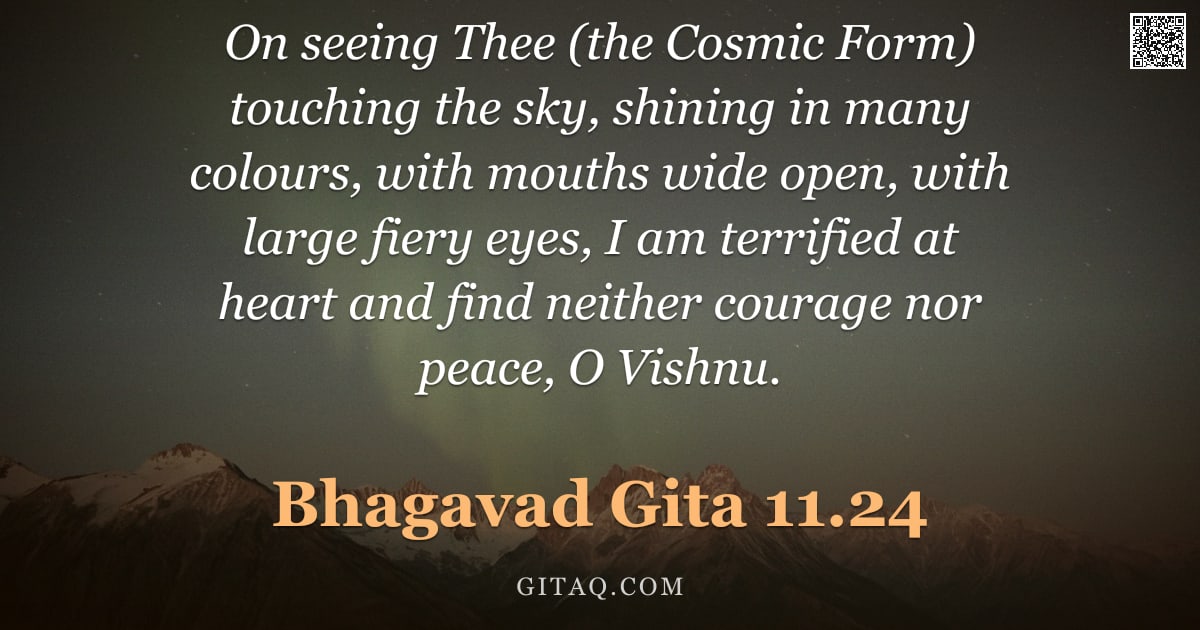
नभःस्पृशं दीप्तमनेकवर्णं व्यात्ताननं दीप्तविशालनेत्रम् | दृष्ट्वा हि त्वां प्रव्यथितान्तरात्मा धृतिं न विन्दामि शमं च विष्णो ||११-२४||
nabhaḥspṛśaṃ dīptamanekavarṇaṃ vyāttānanaṃ dīptaviśālanetram . dṛṣṭvā hi tvāṃ pravyathitāntarātmā dhṛtiṃ na vindāmi śamaṃ ca viṣṇo ||11-24||
What Does This Verse Mean?
In this verse, the warrior Arjuna speaks to Lord Krishna after witnessing His terrifying Cosmic Form (Vishvarupa). He describes seeing a dazzling being that touches the sky with glowing eyes and open mouths, which fills him with such awe that he loses all courage and inner peace. The key teaching is that realizing God's infinite power can overwhelm human fearlessness, yet this surrender of ego is necessary for true devotion.
The Teaching Behind It
This verse belongs primarily to Bhakti Yoga (the path of devotion) and Jnana Yoga (the path of knowledge), illustrating the initial stage of 'Atmavairagya'—dispassion born from realizing God's majesty. It develops the concept that true realization of the Divine requires the ego to shatter, as human courage is insufficient before the infinite power of Ishvara.
Word by Word
Classical Commentary
Where This Happens
This verse occurs immediately after Arjuna witnesses the Vishvarupa Darshana (Vision of the Universal Form) in Chapter 11, a moment where Krishna reveals his infinite nature to dispel Arjuna's doubts about fighting. On the battlefield of Kurukshetra, just moments prior, the sky darkened and strange omens appeared as the divine form displayed its terrifying aspect with countless mouths and flaming eyes. Overwhelmed by this direct glimpse of the Absolute, Arjuna is physically trembling and mentally shattered, losing his composure before he can even ask for a return to peace.
Living It Out Today
Consider a moment when you are making an incredibly difficult life decision, such as ending a long-term relationship or confronting a powerful authority figure at work. In that state of high stakes, your mind may race with anxiety and fear, causing you to feel paralyzed just like Arjuna did before the Cosmic Form. The lesson here is not to force yourself to be brave immediately, but to acknowledge the magnitude of the situation; by surrendering that specific panic in prayer or deep breaths, you create the mental space needed to find clarity.
Explained for Children
Imagine you are looking at a giant, friendly dragon in a storybook, but suddenly the book comes to life with bright lights everywhere and the dragon speaks with many voices. That is how Arjuna felt when he saw Krishna's huge cosmic body; it was so big and bright that his heart started shaking like leaves in a storm. He told Krishna, 'I am too scared to stay still or find my bravery right now.' It teaches us that sometimes seeing something truly amazing can make our hearts beat fast until we feel safe again.
Daily Reflection
It is perfectly human to feel shaken when faced with something larger than our daily routines or expectations; even the noblest among us like Arjuna trembled before the cosmic reality. You do not need to force yourself into immediate courage or false peace, for your honest recognition of fear is actually a form of surrender that opens the door to grace. When you stop resisting this trembling and simply rest in it with faith, the very source of your awe becomes your sanctuary.
A Practice for Today
Close your eyes and acknowledge where you feel most overwhelmed, imagining that fear as a small flame held within the vastness of your own spirit. Breathe deeply into that space of uncertainty, trusting that just as Arjuna's terror was met with divine presence, so too is your inner turmoil seen by the same infinite consciousness.
Key Teachings
- The Paradox of Awe
True encounters with the divine often begin not with comfort, but with a terrifying realization of our own smallness against infinite majesty. This initial shock is necessary to shatter our limited ego and prepare us for a higher state of consciousness. - The Necessity of Surrender
When human strength fails, as seen when Arjuna loses his 'dhriti' (steadiness), it is the moment to surrender control completely. The loss of personal courage marks the beginning of receiving divine support and peace that cannot be manufactured by willpower. - The Reality Beyond Appearance
Our ordinary perception sees only a limited form, but spiritual vision reveals a universe pulsating with infinite energy, color, and life. Recognizing this cosmic reality helps us understand that our temporary fears are insignificant within the scope of eternal truth.
Themes
Related Verses
Read This Next
- 2.47 — To understand how Arjuna learns to act without attachment after his initial confusion and fear.
- 3.30 — For the instruction on offering all actions to God, which is a practical response to feeling overwhelmed by life's magnitude.
- 12.15 — This verse completes the journey of Arjuna, showing him what a steady heart looks like after witnessing the cosmic form.
Recommended Reading
GitaQ earns from qualifying purchases as an Amazon Associate.