Bhagavad Gita 10.39
Vibhuti Yoga · English Translation
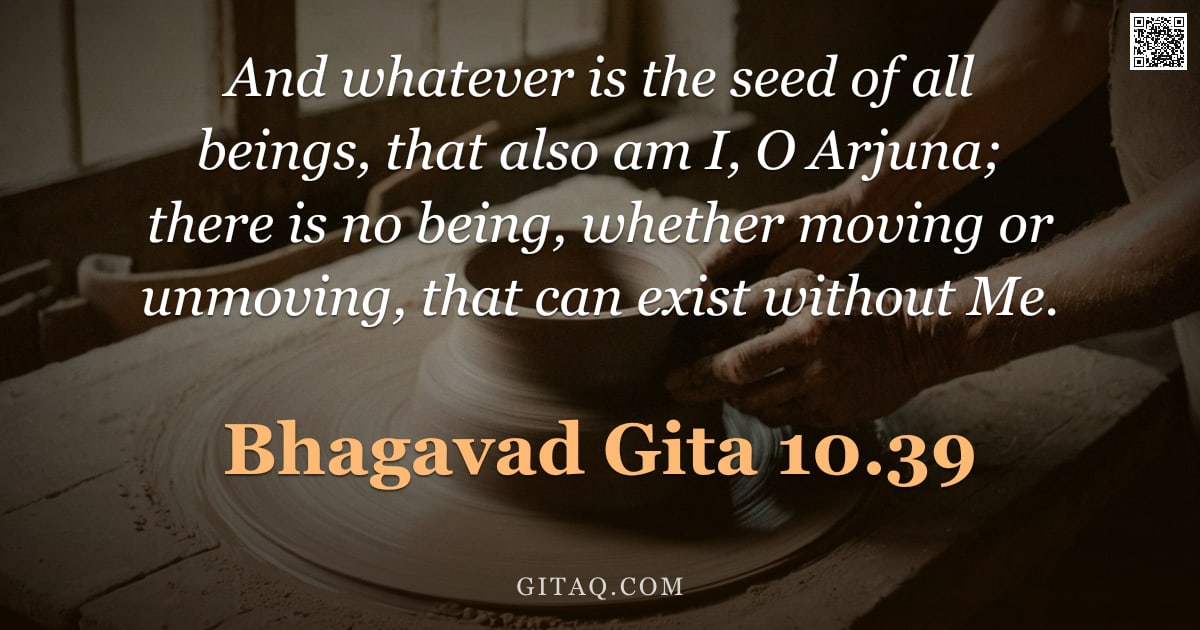
यच्चापि सर्वभूतानां बीजं तदहमर्जुन | न तदस्ति विना यत्स्यान्मया भूतं चराचरम् ||१०-३९||
yaccāpi sarvabhūtānāṃ bījaṃ tadahamarjuna . na tadasti vinā yatsyānmayā bhūtaṃ carācaram ||10-39||
What Does This Verse Mean?
In this verse, Lord Krishna speaks to Arjuna to reveal that He is the essential source or 'seed' from which all living beings originate. Whether a being moves like an animal or remains still like a tree, nothing in existence can survive without His underlying energy and presence. The core teaching here is that God is not just a distant ruler but the very foundation of reality itself.
The Teaching Behind It
This verse is central to Jnana Yoga (the path of knowledge) and Vedanta philosophy, specifically illustrating the concept of Brahman as the underlying substrate of all existence. It establishes non-dualism by asserting that no separate entity exists independently from the Divine source.
Word by Word
Classical Commentary
Where This Happens
This verse occurs during Chapter 10 of the Bhagavad Gita on the battlefield of Kurukshetra, where Krishna is describing his divine manifestations (Vibhuti) to Arjuna. After revealing that he is the smell in the earth and the light in fire, Krishna moves from listing specific examples to stating a universal truth about existence itself. Arjuna has just begun to understand Krishna's infinite nature, shifting from seeing him merely as a friend or charioteer to recognizing him as the Supreme Being.
Living It Out Today
When you face an overwhelming project at work that feels too big to handle alone, remember this verse: your ability to solve problems comes from the same creative intelligence that powers all life. Instead of feeling isolated by anxiety, view every challenge as a chance to tap into that universal 'seed' of potential within yourself and others. This perspective shifts you from fear of failure to confidence in being supported by the very fabric of reality.
Explained for Children
Imagine the sun shining on the Earth; every flower grows because it gets sunlight's energy to start its life. Lord Krishna tells Arjuna that He is like that Sun for everyone and everything in the world. Just as no plant can live without the sun, nothing exists—whether a running dog or a sleeping stone—if God isn't holding them together inside.
Daily Reflection
When you feel isolated or overwhelmed by your own smallness today, remember that even your breath and thoughts arise within the infinite consciousness of God. There is no part of your life where His presence has withdrawn; whether in motion like a rushing river or still as a mountain, everything sustains itself through Him alone. Allow this truth to dissolve any fear of abandonment you might carry.
A Practice for Today
Close your eyes and visualize every living creature, from the smallest insect to the vastest star, as a single drop of water returning to the ocean that is Krishna's presence. Rest in the quiet certainty that you are not separate from this divine source; you exist because He holds you.
Key Teachings
- The Universal Seed
Just as a tiny seed contains the potential for an entire tree, Krishna is the essential cause from which all beings emerge. Recognizing Him as the primal source transforms how we view every living form around us. - Omnipresent Immanence
The Lord permeates both moving and unmoving entities, meaning nothing exists in isolation from the Divine. This teaching shatters the illusion of a separate self by revealing our constant dependence on His energy. - Unity in Diversity
While forms vary infinitely across the spectrum of life, their underlying essence remains one and identical to Krishna. Seeing this unity allows us to honor the sacred spark present in every creature without distinction.
Themes
Related Verses
Read This Next
- 7.19 — Read this to see the culmination of devotion where one realizes Krishna as everything after many lifetimes.
- 8.4 — This verse defines what Krishna is and how He exists within every living entity, complementing the seed metaphor.
- 13.27 — It expands on seeing the Supreme Lord equally present in all beings as the witness of nature's activities.
Recommended Reading
GitaQ earns from qualifying purchases as an Amazon Associate.