Bhagavad Gita 10.38
Vibhuti Yoga · English Translation
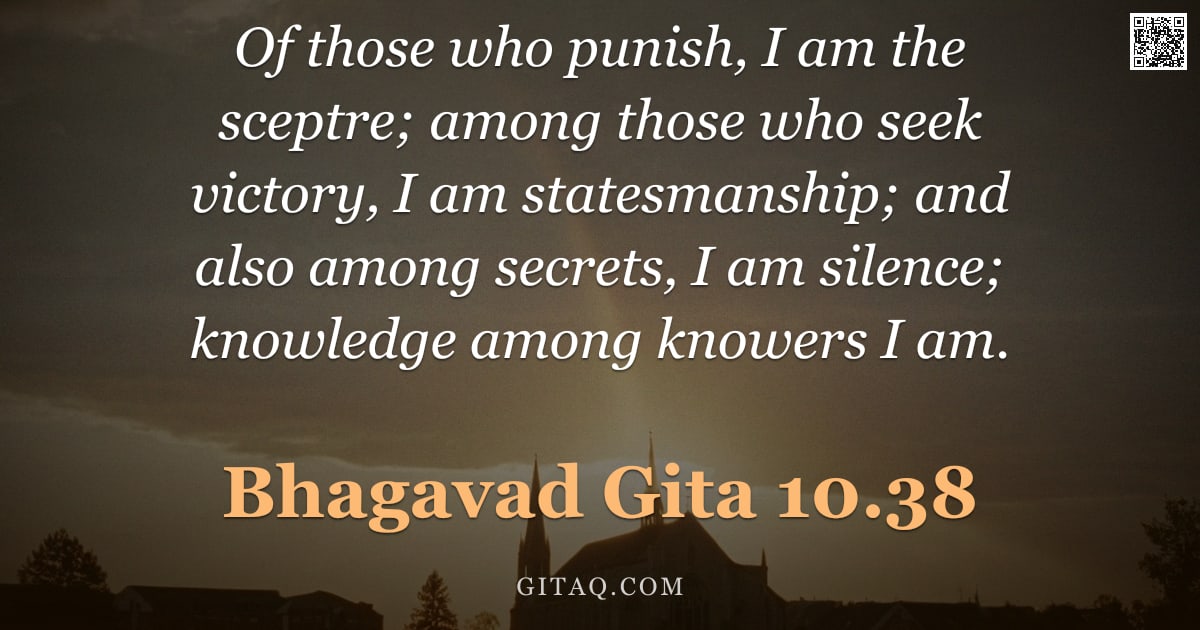
दण्डो दमयतामस्मि नीतिरस्मि जिगीषताम् | मौनं चैवास्मि गुह्यानां ज्ञानं ज्ञानवतामहम् ||१०-३८||
daṇḍo damayatāmasmi nītirasmi jigīṣatām . maunaṃ caivāsmi guhyānāṃ jñānaṃ jñānavatāmaham ||10-38||
What Does This Verse Mean?
In this verse, Lord Krishna explains that He is the essential power behind all forms of authority and success. When a just ruler punishes to maintain order, it is His energy driving that action; when someone seeks victory through strategy, Krishna is that wisdom. Furthermore, for those guarding secrets or seeking deep knowledge, silence and understanding are manifestations of His presence, showing that every virtue stems from the Divine.
The Teaching Behind It
This verse is central to the concept of 'Vibhuti' or Divine Manifestation within Bhakti Yoga, illustrating that God permeates all aspects of reality. It teaches that no virtue—whether it be justice (danda), strategy (niti), wisdom (jnana), or restraint (mauna)—exists independently but is a reflection of the Supreme Consciousness.
Word by Word
Classical Commentary
Where This Happens
This verse occurs during the Bhagavad Gita's 'Vibhuti Yoga,' where Krishna is revealing His infinite divine glories to Arjuna on the battlefield of Kurukshetra. Just before this, Arjuna was overwhelmed by grief and confusion about fighting his own kin; Krishna has been shifting Arjuna's perspective from seeing Him as a friend to recognizing Him as the Supreme Being behind all existence. In this specific moment, Krishna assures the despondent prince that even forces of justice, strategy, and silence are not separate from God but are His very essence.
Living It Out Today
Consider a manager facing a difficult decision to let an underperforming employee go for the good of the team; instead of acting out of anger or personal bias, they can realize this 'sceptre' is their duty. Or think of a negotiator in a high-stakes meeting where speaking less (silence) and listening deeply leads to better outcomes than aggressive talking. By viewing these actions as divine expressions rather than just political moves, the individual acts with greater clarity, detachment from ego, and confidence.
Explained for Children
Imagine a superhero who isn't just one person but lives inside all good things you see. When a teacher stops bad behavior to keep everyone safe, it's like having 'super-safety' working through them. If an athlete wins because they have great strategy or if someone knows the answer by being quiet and listening carefully, that winning spirit and smart thinking are actually the superhero helping out inside of us.
Daily Reflection
Today, notice how your own inner strength manifests as discipline when you feel chaotic; remember that even your ability to impose order comes from the same source as the cosmos. When you face challenges seeking victory, trust that strategic wisdom flows through you rather than relying solely on your ego's limited plans. Even in silence or confidentiality, know that you are embodying a profound divine mystery that transcends ordinary speech.
A Practice for Today
Close your eyes and acknowledge that every action you take to correct or guide others is an expression of the Divine Sceptre, wielded not for power but for balance. In moments where silence speaks louder than words, rest in the understanding that this quietude itself is a form of supreme knowledge and divine presence.
Key Teachings
- The Divine as Rightful Authority
Krishna reveals Himself not just as the creator of power but as the very essence of legitimate authority used to restore dharma. The sceptre is only effective when held by one who acts with self-restraint and for the welfare of all. - Wisdom Beyond Words
True knowledge often resides in silence, where the deepest secrets are guarded not by secrecy itself but by a profound inner stillness. This teaches us that the most powerful communication is sometimes the absence of noise and the presence of understanding. - Divine Strategy for Victory
Victory in life's struggles belongs to those who align their actions with divine will rather than mere ambition. Krishna identifies as the very intelligence that guides the righteous toward success through proper conduct and timing.
Themes
Related Verses
Read This Next
- 2.47 — This verse establishes the foundation of acting without attachment to results, which is essential before wielding the 'sceptre' or seeking victory discussed in Chapter 10.
- 3.30 — It reinforces the concept of surrendering all actions and their fruits to Krishna, deepening the understanding of how divine authority functions through human agents.
- 12.15 — This verse highlights the qualities of a devotee who is dear to God, including being silent and self-controlled, directly connecting back to Krishna's identification with silence and wisdom in Chapter 10.
Recommended Reading
GitaQ earns from qualifying purchases as an Amazon Associate.