Bhagavad Gita 10.15
Vibhuti Yoga · English Translation
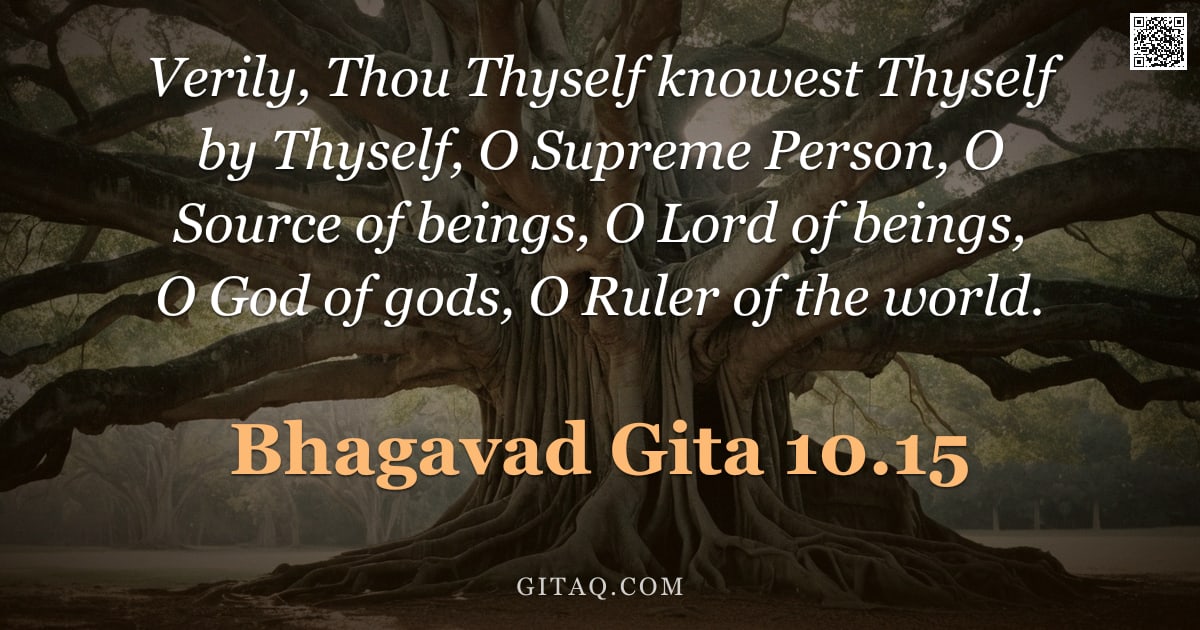
स्वयमेवात्मनात्मानं वेत्थ त्वं पुरुषोत्तम | भूतभावन भूतेश देवदेव जगत्पते ||१०-१५||
svayamevātmanātmānaṃ vettha tvaṃ puruṣottama . bhūtabhāvana bhūteśa devadeva jagatpate ||10-15||
What Does This Verse Mean?
In this verse, Arjuna speaks directly to Lord Krishna after listening to the divine glories (Vibhuti) that Krishna has revealed about himself. Acknowledging Krishna's supreme status as the 'Purushottama' and ruler of all worlds, Arjuna admits his own limitation: only the Supreme Self can truly know Himself in His entirety. The key teaching is a profound act of surrender where the devotee recognizes that while they may understand fragments of the Divine through scripture or teachers, complete self-realization belongs solely to God.
The Teaching Behind It
This verse is a cornerstone of Bhakti Yoga (the path of devotion) intertwined with Jnana Yoga (the path of knowledge), emphasizing that ultimate self-knowledge belongs exclusively to the Divine. It develops the concept of 'Ahamkara' or ego dissolution, where the seeker realizes their finite nature compared to the infinite Self (Atman/Brahman). The teaching asserts that while human effort can lead one close to God, true realization requires divine grace and humility.
Word by Word
Classical Commentary
Where This Happens
This verse occurs in the midst of Chapter 10 on the battlefield of Kurukshetra, following Krishna's extensive description of His divine manifestations throughout creation. Arjuna, who had just been overwhelmed by the magnitude of Krishna's glory (Vibhuti), shifts from asking questions to offering a declaration of faith and surrender. He speaks as the humble devotee rather than the warrior prince he was moments ago, acknowledging that while others may know Him through tradition or scripture, only God knows His own true nature fully.
Living It Out Today
When you face a complex decision at work where no amount of research seems to provide a clear answer, remember Arjuna's humility in admitting what is beyond his control. Instead of forcing yourself to find the 'perfect' solution through your limited perspective alone, pause and surrender that specific part of the outcome to a higher wisdom or principle you trust. This allows you to act with clarity on what you can do while releasing the anxiety of needing total certainty about everything.
Explained for Children
Imagine you have a super-smart friend who knows everything about how the whole universe works, from the tiniest ant to the biggest star. Arjuna is telling Krishna that while he loves and respects him as his teacher and leader, only Krishna himself truly understands all of his own amazing powers. It's like asking why someone can know themselves perfectly better than anyone else could; it takes a special kind of wisdom that only God has.
Daily Reflection
You often seek validation from others to understand who you truly are, yet Krishna reminds us that the ultimate reality needs no outside proof because it exists by its own light. In your daily life, try to rest in the confidence of knowing yourself as a fragment of this self-sufficient Divinity, rather than looking for approval from the world.
A Practice for Today
Sit quietly and acknowledge that just as you are aware of your own self, the Supreme Lord is fully aware of His true nature through Himself alone. Rest in this realization that the Divine Source knows itself perfectly without needing any external witness.
Key Teachings
- Self-Existence (Svayam)
The Supreme Person is not dependent on any other cause or witness to know His own nature; He knows Himself through His own infinite consciousness. - Divine Mastery
As the Creator, Sustainer, and Ruler of all beings, Krishna possesses a total sovereignty that transcends the limitations of creation and time. - The Ultimate Identity
By recognizing Arjuna's own inner self as identical with this Supreme Lord, one realizes that the seeker and the sought are ultimately non-different in essence.
Themes
Related Verses
Read This Next
- 2.47 — Follows the recognition of divine glory by shifting focus to one's own duty without attachment to results.
- 3.30 — Continues the theme of surrender and offering actions, deepening the understanding of relating to the Divine after realizing His supremacy.
- 12.15 — Concludes with the qualities of a devotee who has fully internalized this knowledge by being free from selfish desires and agitation.
Recommended Reading
GitaQ earns from qualifying purchases as an Amazon Associate.