Bhagavad Gita 1.7
Arjuna Vishada Yoga · English Translation
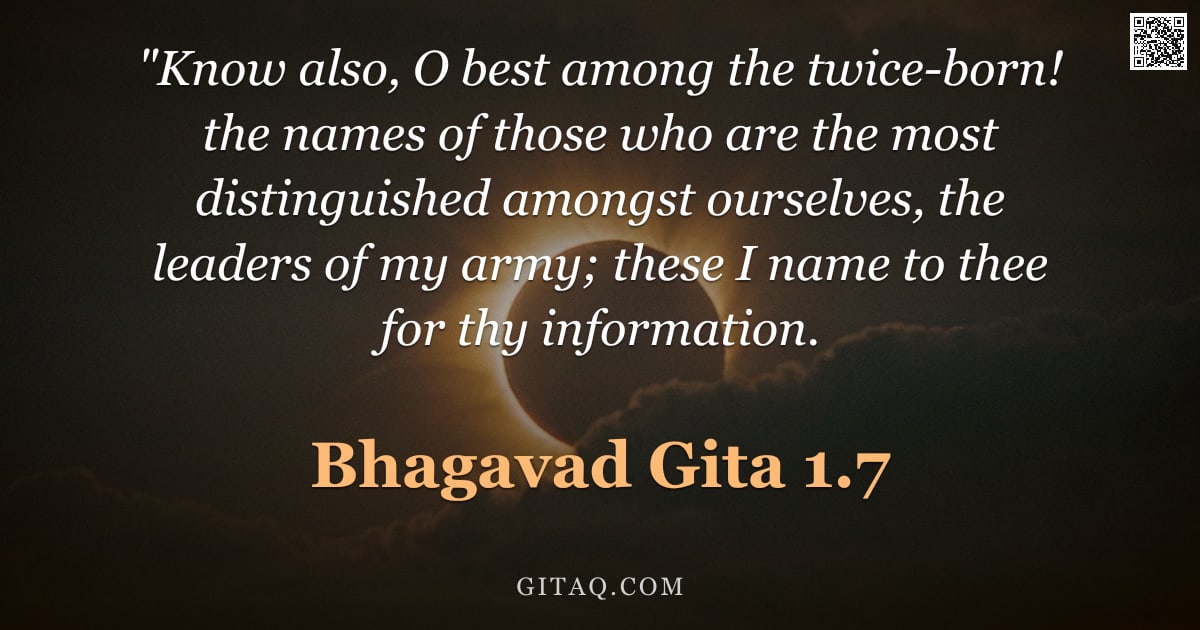
अस्माकं तु विशिष्टा ये तान्निबोध द्विजोत्तम | नायका मम सैन्यस्य संज्ञार्थं तान्ब्रवीमि ते ||१-७||
asmākaṃ tu viśiṣṭā ye tānnibodha dvijottama . nāyakā mama sainyasya saṃjñārthaṃ tānbravīmi te ||1-7||
What Does This Verse Mean?
In this verse, Karna addresses Duryodhana, who is referred to as the 'best among the twice-born' (a term of respect for a king and scholar). Karna lists that he will now name the distinguished leaders of their army so that Duryodhana can recognize them. The key teaching here is about situational awareness; before engaging in any major endeavor, one must first clearly identify the resources, allies, and strengths available to ensure readiness and strategic planning.
The Teaching Behind It
This verse is foundational for Karma Yoga, which emphasizes performing one's duty with full awareness and clarity before action begins. It develops the concept that effective action requires a clear understanding of one's own capacities (svabhava) and the composition of one's forces, ensuring that duty is performed intelligently rather than impulsively.
Word by Word
Where This Happens
This verse occurs on the battlefield of Kurukshetra during the first chapter, 'Arjuna Vishada Yoga,' immediately after Arjuna has refused to fight and laid down his bow. Duryodhana is addressing Karna as he surveys the vast Pandava army with growing anxiety about their superior numbers. In a moment where fear might overwhelm him, Duryodhana asks Karna to identify the formidable warriors on the opposing side so that they can prepare mentally for the imminent conflict.
Living It Out Today
When facing a high-stakes project at work or preparing for a difficult family negotiation, it is crucial to first take inventory of your team's specific skills and strengths rather than focusing solely on the threat. Just as Karna lists leaders to build confidence, you should identify who in your circle has the expertise needed to handle different aspects of the challenge. This preparation transforms anxiety into actionable strategy by grounding you in the reality of available resources.
Explained for Children
Imagine you are playing a big team game with your friends, but you need to know exactly who on your side has the strongest skills so everyone knows their job. Karna is like that friend telling Duryodhana: 'Don't worry about where we stand; let me tell you which of our players are the best leaders and what they can do.' This helps us feel brave because when we know our team's strengths, we aren't afraid to face a challenge.
Daily Reflection
Just as Bhishma takes pride in listing his warriors' names, you are invited to recognize and honor your own inner resources without hesitation. When we acknowledge our unique gifts with humility rather than arrogance, they transform from mere assets into instruments of divine service. This simple act of recognition grounds us, reminding us that every strength has a place where it can shine for the greater good.
A Practice for Today
Sit quietly and visualize your own 'army' of responsibilities, relationships, and talents that stand ready to serve a higher purpose today. Acknowledge each unique strength not as a source of ego, but as a distinct offering from the Divine meant for a specific role in life's grand design.
Key Teachings
- The Dignity of Distinction
Arjuna does not boast about his army's power but respectfully identifies those who are 'viśiṣṭā' (distinguished) to honor their specific contributions. This teaches us that recognizing excellence in others and acknowledging our own specialized roles is an act of spiritual respect. - Clarity Through Naming
By naming the leaders, Arjuna creates a map for understanding who holds responsibility within his unit during this critical moment. In life, clarity comes from identifying our specific duties and the people we rely on to fulfill complementary roles. - Service Over Ego
Even while listing names of war leaders, Arjuna addresses Krishna as 'dvijottama' (best among twice-born), showing his focus remains on duty and knowledge rather than personal pride. True leadership involves knowing your team's strengths not to elevate the self, but to effectively serve a higher cause.
Themes
Related Verses
Read This Next
- 2.47 — After identifying the roles and strengths, this verse provides the essential instruction on how to act without attachment to the results.
- 3.30 — This follows naturally as it expands the theme of offering one's specific actions (including those listed in 1.7) entirely to the Divine.
- 12.15 — Reading this later reveals Krishna's definition of a true devotee who, like Arjuna identifying his army, is dear to all beings through selflessness and equanimity.
Recommended Reading
GitaQ earns from qualifying purchases as an Amazon Associate.