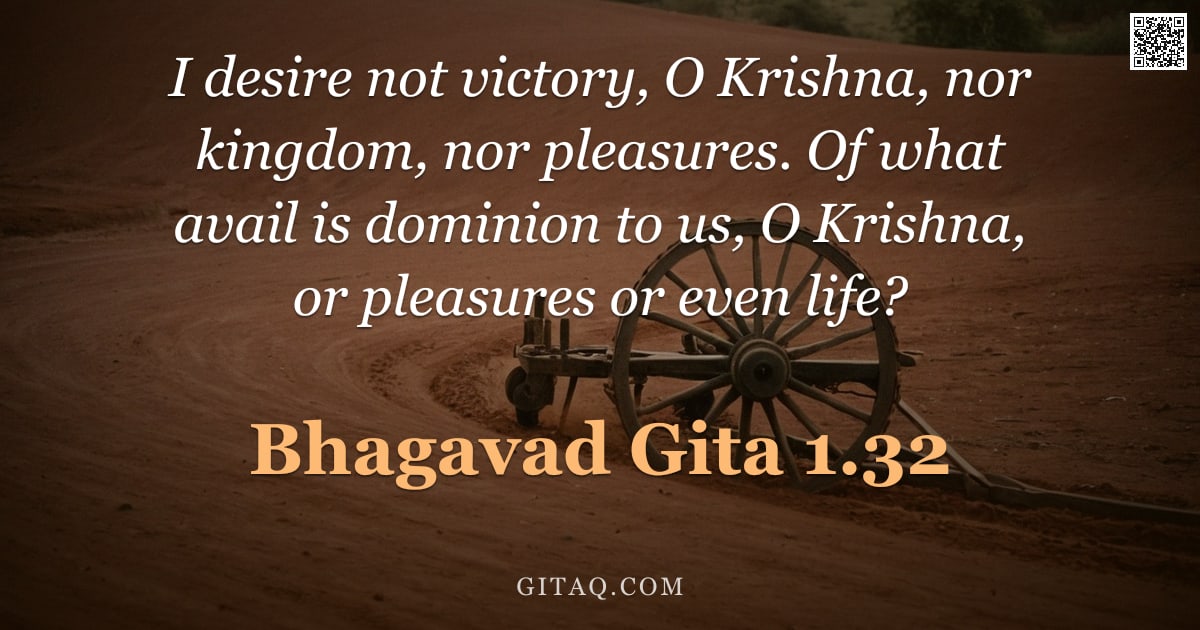
Bhagavad Gita 1.32
Arjuna Vishada Yoga · English Translation
न काङ्क्षे विजयं कृष्ण न च राज्यं सुखानि च | किं नो राज्येन गोविन्द किं भोगैर्जीवितेन वा ||१-३२||
na kāṅkṣe vijayaṃ kṛṣṇa na ca rājyaṃ sukhāni ca . kiṃ no rājyena govinda kiṃ bhogairjīvitena vā ||1-32||
What Does This Verse Mean?
In this verse, Arjuna speaks to Lord Krishna and declares that he no longer desires victory, kingdom, or material pleasures if they come at the cost of killing his own kin. He questions the very value of ruling a kingdom when life itself is lost through such an act. The key teaching here is the realization that external success like power and wealth loses all meaning if it requires sacrificing one's relationships, morality, and inner peace.
The Teaching Behind It
This verse marks the beginning of the transition from attachment-based action to Karma Yoga and Jnana Yoga (the path of knowledge). It develops the concept that true wisdom involves seeing beyond the fleeting nature of material results like victory or wealth, recognizing them as secondary to spiritual duty and inner purity.
Word by Word
Where This Happens
This verse occurs in Chapter 1 during 'Arjuna Vishada Yoga,' situated on the battlefield of Kurukshetra just before the great war begins. Arjuna, seeing his teachers and relatives arrayed against him as enemies, has dropped his bow and is overcome with intense grief and moral confusion after witnessing the devastation a civil war would cause. He turns to Krishna, his charioteer and divine friend, rejecting the traditional Kshatriya goal of victory because he realizes that winning this battle means destroying his own family.
Living It Out Today
Consider a professional facing a promotion that requires them to cut corners or exploit colleagues; they might realize that achieving 'success' through unethical behavior will destroy their self-respect and peace of mind. In this moment, the person must prioritize integrity over career advancement, understanding that material gain is hollow if it compromises one's core values. Just as Arjuna questioned the value of a kingdom without life or love, we too should evaluate whether our ambitions align with who we truly want to be.
Explained for Children
Imagine you have to choose between winning a huge trophy or playing with your best friends; Arjuna feels he cannot win the 'trophy' of ruling his country if he has to hurt the people he loves most. He tells Krishna that having a big house, lots of toys, or being the boss doesn't feel good at all when it makes you sad and lonely inside. It's like realizing that some things are more important than winning any game.
Daily Reflection
You often feel pressured to earn your worth through achievements or possessions, believing that success is required for happiness. Yet this verse reminds you that true peace comes not from acquiring kingdoms or pleasures, but from realizing they are temporary and insufficient on their own. When you release the grip on needing a specific result, you discover a freedom that no victory can grant.
A Practice for Today
Sit quietly and ask yourself what you are currently chasing that feels like 'victory' or 'security.' Visualize setting down the heavy weight of needing a specific outcome, allowing your spirit to rest in the present moment without demanding a reward.
Key Teachings
- The Illusion of Victory
Arjuna recognizes that winning a war against one's own kin is a hollow triumph if it costs the soul its connection to dharma. True victory is internal, not defined by external conquest or material gain. - The Futility of Worldly Dominion
Kingdoms and pleasures are transient gifts that cannot satisfy the eternal longing of the spirit for meaning. Possessing a kingdom does not guarantee inner peace, as life itself is fleeting without spiritual purpose. - Detachment from Outcomes
The verse teaches us to value our relationship with the Divine over any worldly reward or even survival in this temporary body. By surrendering attachment to results, we align ourselves with a higher will that transcends fear and desire.
Themes
Related Verses
Read This Next
- 2.47 — Arjuna's despair deepens into the need for this verse to understand performing duty without attachment to results.
- 3.30 — This verse provides Krishna's direct instruction on how to dedicate all actions and their fruits to Him as a solution to Arjuna's confusion.
- 12.15 — Read this next to see the qualities of one who is free from such desires, having transcended both pleasure and pain through devotion.
Recommended Reading
GitaQ earns from qualifying purchases as an Amazon Associate.