Bhagavad Gita 1.21
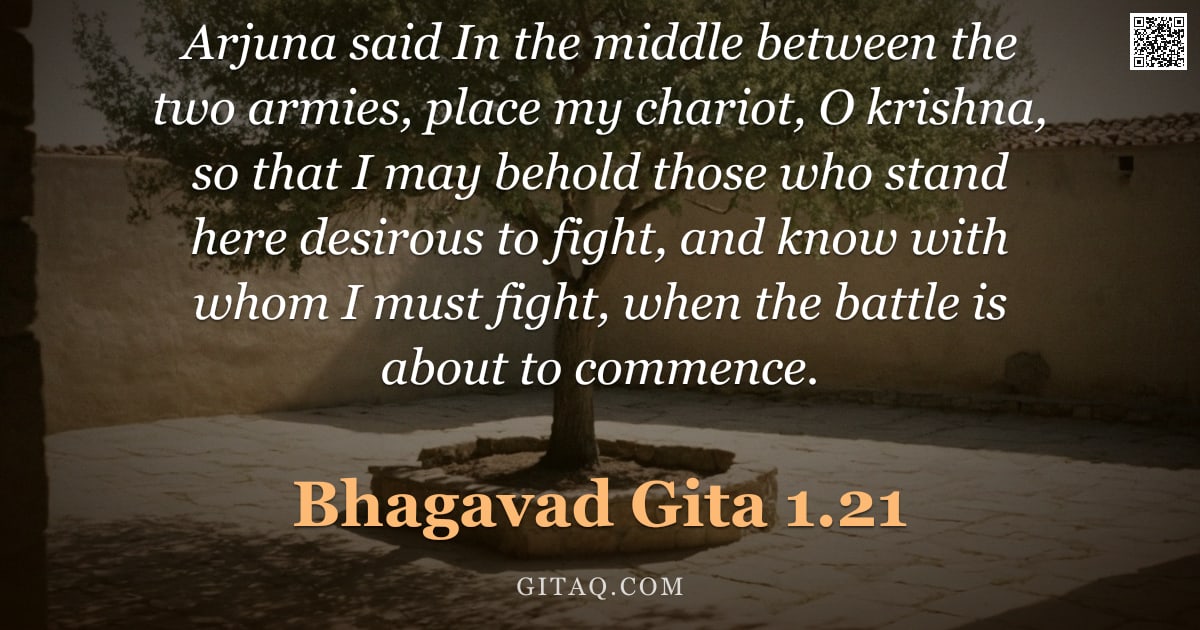
Arjuna Vishada Yoga · English Translation
अर्जुन उवाच | सेनयोरुभयोर्मध्ये रथं स्थापय मेऽच्युत ||१-२१||
hṛṣīkeśaṃ tadā vākyamidamāha mahīpate . arjuna uvāca . senayorubhayormadhye rathaṃ sthāpaya me.acyuta ||1-21||
What Does This Verse Mean?
In this verse, Arjuna asks Krishna to place his chariot between the two opposing armies just before the battle begins. He expresses a desire to see and identify everyone he is about to fight against. This moment marks the shift from preparation for war to the immediate confrontation with moral conflict as he recognizes his own teachers and family on the other side.
The Teaching Behind It
This verse belongs to the transition from ignorance (Avidya) to knowledge (Jnana), initiating the path of Karma Yoga where one must act with full awareness rather than blind impulse. It develops the concept that right action requires clear vision and understanding of reality, setting the stage for Krishna's teachings on duty performed without attachment.
Word by Word
Where This Happens
This verse occurs in Chapter 1, known as 'Arjuna Vishada Yoga,' immediately after Arjuna sees the vast armies of the Kauravas gathering for war at Kurukshetra. As the commander-in-chief of the Pandava forces, Arjuna has just heard Krishna's name and is now requesting a strategic pause to survey his enemies. The listener, Bhishma (the eldest warrior), feels the tension as this request halts the momentum of battle before it even starts.
Living It Out Today
Before accepting that high-pressure job offer you've been dreading or deciding on a difficult family intervention, take time to 'place your chariot' in the middle. Instead of rushing into action based on fear or impulse, pause to clearly see all parties involved and understand exactly what is at stake. This moment of clarity prevents regret later by ensuring you know who will be affected by your decision before you commit.
Explained for Children
Imagine you are getting ready for a big game, but instead of just running in, you want to stop right in the middle so you can look at your opponents. That is what Arjuna asks Krishna to do: drive the chariot between the two teams so he can see exactly who his friends and family are on the other side. It's like wanting a closer look before making a big decision.
Daily Reflection
You often find yourself rushing into conflict or debate without truly seeing who stands across from you today. Like Arjuna asking Krishna to place his chariot in the center, take a moment right now to step back and observe your situation with fresh eyes rather than immediate reaction. This pause allows you to recognize that behind every adversary lies another soul deserving of respect, transforming anger into understanding before you speak or act.
A Practice for Today
Pause to imagine standing at a crossroads where two powerful forces demand your allegiance, yet you choose the center as your ground of stillness. Close your eyes and visualize placing yourself in that precise middle space between opposing armies, not to fight, but to see clearly with compassion before any action is taken.
Key Teachings
- The Power of the Pause
Before engaging in conflict, one must create a sacred space for clarity and observation rather than reacting from impulse. This verse teaches that true wisdom arises when we step back to see the whole picture before committing our energy. - Seeing Beyond Enmity
Arjuna requests this position not to strategize an attack, but to behold his opponents as human beings with whom he shares a bond. The practice of seeing clearly dissolves the illusion that others are merely obstacles rather than fellow souls in need. - The Chariot as Inner Stability
In this context, the chariot represents the disciplined mind anchored by divine guidance (Krishna) amidst external chaos. We must learn to center our consciousness so that even when surrounded by turmoil, we remain steady and perceptive.
Themes
Related Verses
Read This Next
- 2.47 — This verse directly answers Arjuna's hesitation by teaching the duty of action without attachment to results.
- 3.30 — It expands on surrendering all actions and their fruits to God, which is necessary for fighting with a clear heart.
- 12.15 — This verse describes the qualities of one who does not disturb others and is loved by them, contrasting Arjuna's initial fear.
Recommended Reading
GitaQ earns from qualifying purchases as an Amazon Associate.