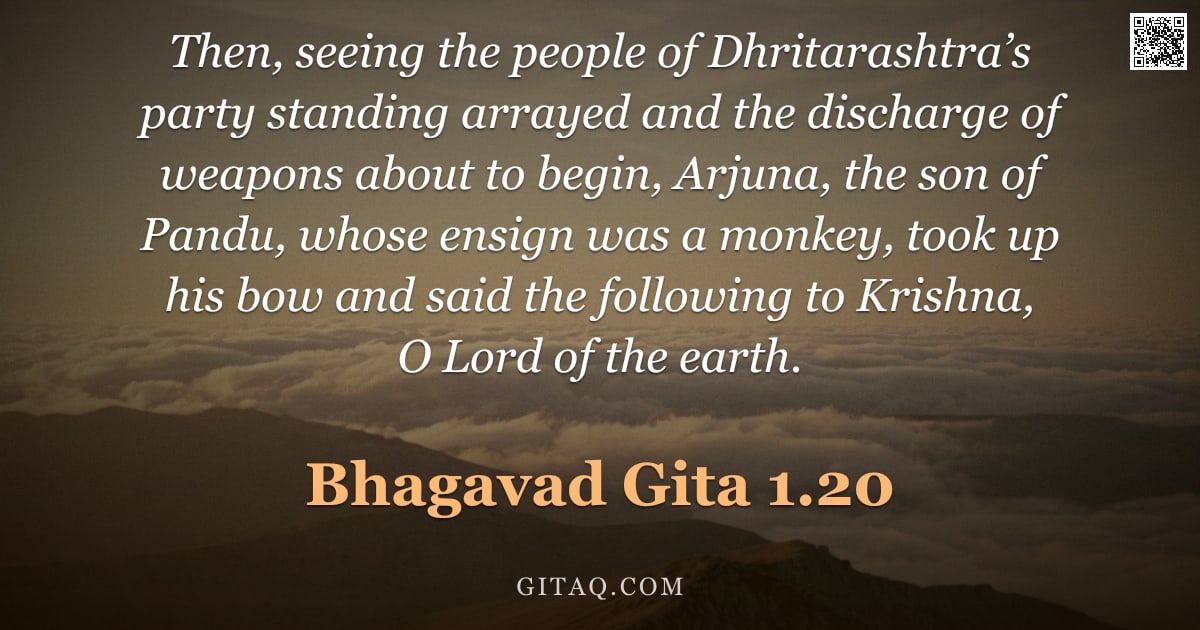
Bhagavad Gita 1.20
Arjuna Vishada Yoga · English Translation
अथ व्यवस्थितान्दृष्ट्वा धार्तराष्ट्रान् कपिध्वजः | प्रवृत्ते शस्त्रसम्पाते धनुरुद्यम्य पाण्डवः | हृषीकेशं तदा वाक्यमिदमाह महीपते ||१-२०||
atha vyavasthitāndṛṣṭvā dhārtarāṣṭrān kapidhvajaḥ . pravṛtte śastrasampāte dhanurudyamya pāṇḍavaḥ ||1-20||
What Does This Verse Mean?
In this verse, Arjuna observes the enemy army fully assembled and ready to fight as weapons are about to clash. Seeing the imminent danger, he picks up his divine bow named Gandiva, signaling his readiness for battle. He then turns to Lord Krishna, who is seated beside him in the chariot, preparing to speak with deep emotion before the war begins. The key teaching here highlights the critical moment of transition from hesitation to action and the necessity of seeking guidance when facing a great crisis.
The Teaching Behind It
This verse marks the practical beginning of Karma Yoga in the Gita's narrative arc, transitioning from the state of attachment (Vishada) to the readiness for selfless action. It develops the concept that one must first clearly perceive the reality of a duty before engaging in it with full commitment and surrender. The act of taking up the bow symbolizes 'Sankalpa' or firm resolve, which is essential for any spiritual or worldly endeavor.
Word by Word
Where This Happens
This verse occurs immediately after Arjuna and Krishna have arrived at Kurukshetra and surveyed the opposing armies during Chapter 1. The Kauravas, led by Duryodhana's father Dhritarashtra, are fully arrayed in a battle formation called 'Akshauhini'. As the sound of conch shells blows and weapons readied, Arjuna realizes that war is no longer avoidable; he feels overwhelmed by the prospect of killing his elders. The listener here is Lord Krishna (referred to as Hrishikesha), who serves as both charioteer and spiritual guide.
Living It Out Today
Consider a professional facing a high-stakes board meeting where they must deliver difficult news or make an unpopular but necessary decision that could impact their team's future. The 'arrayed enemy' is the looming pressure of conflict, anxiety, and potential fallout from this hard choice. Just as Arjuna took up his bow before speaking to Krishna, you should pause to prepare your tools (facts, emotional regulation) and then seek counsel or a trusted mentor for clarity. This transforms paralyzing fear into focused action by acknowledging the reality of the situation and asking for wisdom.
Explained for Children
Imagine you are about to play a very big game where everyone is lined up on opposite sides ready to start, just like soldiers waiting for a signal. Arjuna sees all his cousins standing there with their weapons, knowing that things will get loud and scary in seconds. Just like how you might pick up your favorite toy or tool before starting a hard task, he grabs his bow. Then, instead of acting alone, he looks at the wise friend driving the chariot (Krishna) to ask for advice on what to do next.
Daily Reflection
Like Arjuna facing his loved ones on the battlefield, you too may find yourself paralyzed by conflicting loyalties or overwhelming circumstances today. Notice that before any great action can be taken with clarity and strength, there must first be a moment of still recognition where we see the situation exactly as it is. This pause is not hesitation; it is the sacred ground where your true purpose begins to emerge from the fog of confusion.
A Practice for Today
Pause to observe your own internal 'army' of thoughts and anxieties standing ready for battle against your peace. Before raising the bow of action, take a moment to witness who you are beneath the noise—the silent observer behind every impulse.
Key Teachings
- The Power of Witnessing
Before acting, one must first see the reality clearly without immediate judgment or reaction. This act of 'seeing' creates a necessary gap between stimulus and response where wisdom can arise. - Readiness in Stillness
True readiness is not frantic movement but a poised state of awareness, symbolized by Arjuna raising his bow before speaking. It teaches us that the most powerful actions stem from a calm and focused mind. - Identity Beyond Roles
Arjuna is identified not just as a warrior but by his banner, reminding him of his divine nature amidst the chaos of duty. We must remember our higher self even when surrounded by the pressures of immediate worldly conflicts.
Themes
Related Verses
Read This Next
- 2.47 — This verse follows immediately as Krishna explains how Arjuna should act without attachment, resolving the despair shown in Chapter 1.
- 3.30 — It expands on the theme of surrendering actions to the Divine, offering a practical method for maintaining equanimity when facing difficult duties.
- 12.15 — This verse describes the qualities of one who is dear to Krishna, providing an aspirational vision of the calm and compassionate state Arjuna must cultivate.
Recommended Reading
GitaQ earns from qualifying purchases as an Amazon Associate.