Bhagavad Gita 1.2
Arjuna Vishada Yoga · English Translation
सञ्जय उवाच | दृष्ट्वा तु पाण्डवानीकं व्यूढं दुर्योधनस्तदा | आचार्यमुपसंगम्य राजा वचनमब्रवीत् ||१-२||
sañjaya uvāca . dṛṣṭvā tu pāṇḍavānīkaṃ vyūḍhaṃ duryodhanastadā . ācāryamupasaṃgamya rājā vacanamabravīt ||1-2||
What Does This Verse Mean?
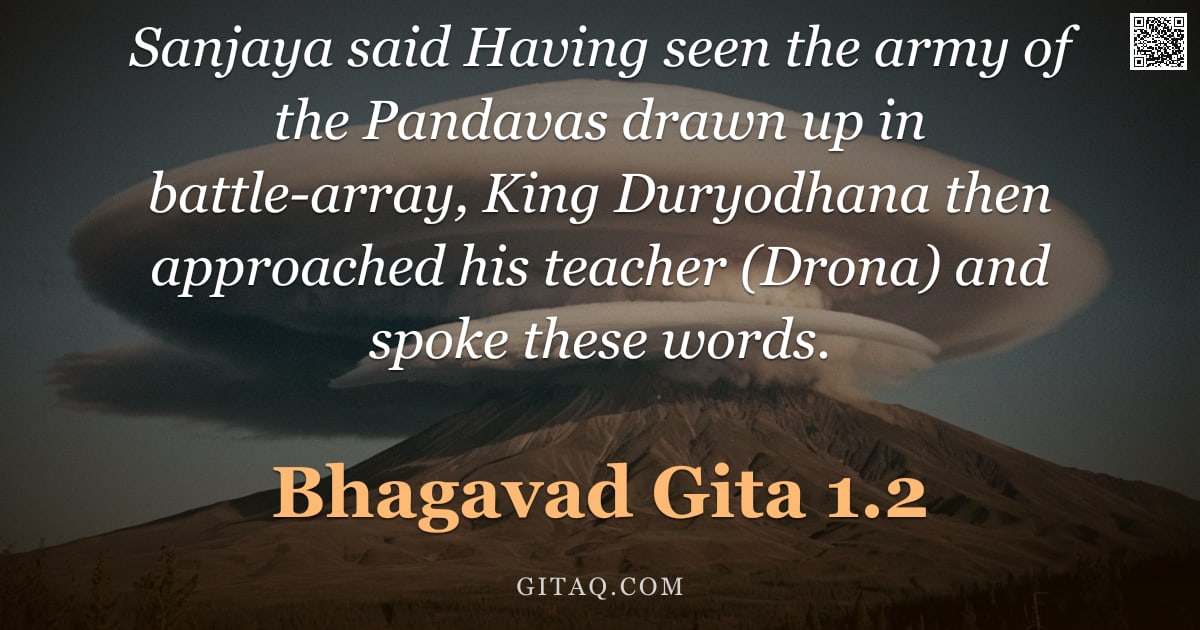
Sanjaya narrates a moment where King Duryodhana, upon seeing the Pandava army perfectly organized for battle, feels a surge of anxiety and envy. He immediately approaches his teacher, Dronacharya, to speak with him about what he has witnessed. This verse sets the stage by contrasting the disciplined strength of one side with the inner turmoil of the other right before the war begins.
The Teaching Behind It
This verse primarily illustrates the concept of 'Viveka' (discrimination) within the Sankhya framework by contrasting external order with internal chaos. It highlights how attachment to outcomes and ego-driven fear can cloud judgment even when one is in a position of power, serving as a precursor to Arjuna's own crisis.
Word by Word
Where This Happens
This verse occurs immediately after the Pandavas have completed their battle formation (Vyuh) on the plains of Kurukshetra. Sanjaya, a narrator with divine sight granted by Vyasa, is describing this scene to King Dhritarashtra in his palace. Duryodhana has just witnessed the formidable army and feels overwhelmed; he approaches Dronacharya not just as a student, but as an anxious king seeking reassurance against a perceived threat.
Living It Out Today
Consider a professional who receives news of a competitor launching a superior product or service right before their own major launch. Instead of panicking or ignoring the reality, they immediately seek counsel from a mentor to strategize a response rather than giving in to fear. This teaches us that seeing others' success can be a trigger for anxiety, but it is also an opportunity to pause, consult wise advisors, and formulate a clear plan.
Explained for Children
Imagine you are at a big school soccer game and your team sees that the other team is lined up perfectly, looking very strong and ready to win. You might feel nervous or worried because they look so prepared! In this story, Duryodhana does exactly what we do when we see our rivals looking super strong—he runs over to ask his coach for help on how to handle it.
Daily Reflection
You often find yourself pausing only after seeing the magnitude of what stands in your way, looking to someone else for permission or strategy instead of trusting your own inner strength. Duryodhana's approach reminds us that true preparation begins not with analyzing the opponent, but with seeking wisdom from a place of humility and guidance before taking action.
A Practice for Today
Sit quietly and observe where you are 'surveying the enemy' or measuring your own limitations against others before a challenge. Notice if your mind is seeking validation from an external authority figure rather than turning inward for clarity.
Key Teachings
- The Power of Perspective
Duryodhana sees only the daunting size of the Pandava army while Sanjaya narrates it objectively. This teaches us that our perception of a challenge is often shaped by fear and comparison rather than objective reality. - The Role of Guidance
Before speaking, Duryodhana approaches his teacher, recognizing the need for wisdom to frame his next move. This highlights that even in moments of aggression or ambition, seeking counsel from a knowledgeable mentor is essential. - The Context of Action
Speech follows observation; Duryodhana does not speak until he has fully surveyed the situation. We learn that effective action and communication must be rooted in clear, deliberate witnessing before any words are uttered.
Themes
Related Verses
Read This Next
- 2.47 — Read this next to understand the antidote to Duryodhana's attachment to results and external validation.
- 3.30 — This verse offers a path of surrender that contrasts with Duryodhana's ego-driven approach to battle strategy.
- 12.15 — Discover how the truly wise person, who is dear to Krishna, behaves in contrast to those driven by envy and comparison.
Recommended Reading
GitaQ earns from qualifying purchases as an Amazon Associate.