Bhagavad Gita 9.28
Raja Vidya Raja Guhya Yoga · English Translation
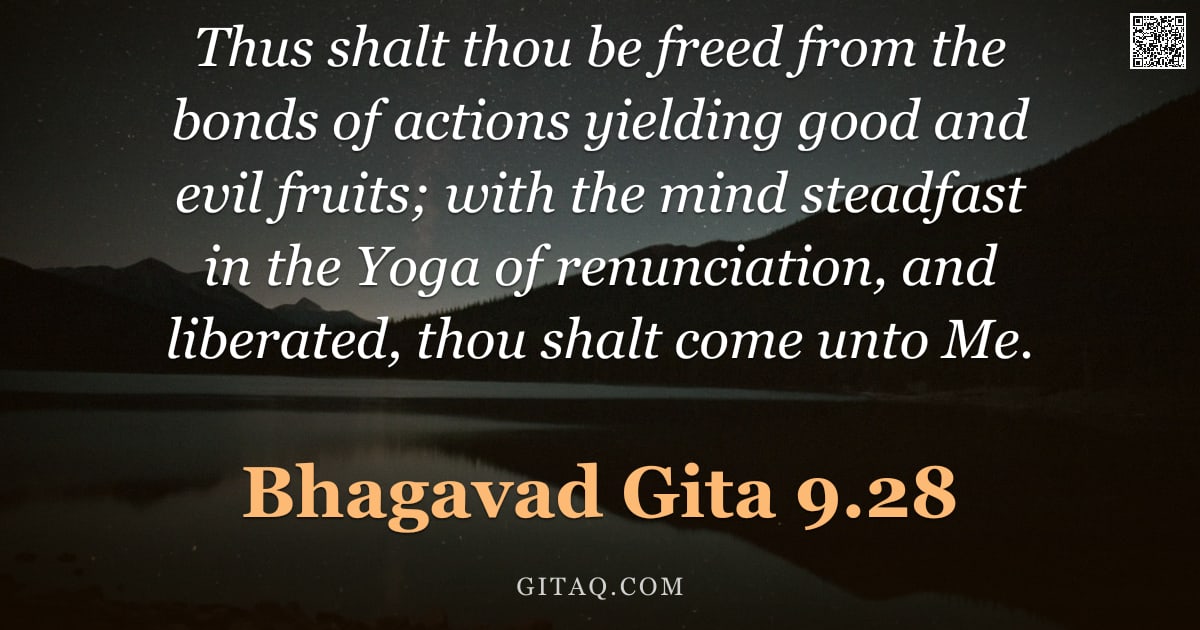
शुभाशुभफलैरेवं मोक्ष्यसे कर्मबन्धनैः | संन्यासयोगयुक्तात्मा विमुक्तो मामुपैष्यसि ||९-२८||
śubhāśubhaphalairevaṃ mokṣyase karmabandhanaiḥ . saṃnyāsayogayuktātmā vimukto māmupaiṣyasi ||9-28||
What Does This Verse Mean?
In this verse, Lord Krishna assures Arjuna that by performing actions without attachment to their results—whether those results are good or bad—one can break free from the cycle of karma. He explains that when a person renounces the desire for personal gain while remaining steady in spiritual practice, they become liberated from material bondage. This liberation leads directly to union with the Divine. The core teaching is that true freedom comes not from stopping action, but from changing one's attitude toward the fruits of those actions.
The Teaching Behind It
This verse synthesizes Karma Yoga (the yoga of action) with Bhakti Yoga (devotion), demonstrating how selfless service leads to liberation. It develops the concept that 'karmabandhanaiḥ' (bonds of actions) are severed only when one performs duties without attachment, transforming work into a spiritual offering rather than a transaction for personal gain.
Word by Word
Classical Commentary
Where This Happens
This verse appears at the climax of Chapter 9, where Krishna reveals his most confidential knowledge as 'Raja Vidya' (Royal Knowledge) to Arjuna on the battlefield of Kurukshetra. Just before this, Krishna has explained how he is present in everything and how simple devotion can lead one back to him. Arjuna, who was previously filled with confusion about fighting his relatives, now hears a promise that even if they perform actions imperfectly or face mixed results, they will still be freed from the heavy chains of past karma. The atmosphere shifts from intense debate to a moment of divine reassurance and spiritual confidence.
Living It Out Today
Consider a manager who has spent years working on a critical project that is about to launch with high stakes for their career bonus or reputation. Instead of being paralyzed by fear of failure or obsessive excitement over success, they focus entirely on executing every task with excellence while mentally detaching from the final outcome. By adopting this 'Yoga of renunciation,' the manager remains calm and makes clearer decisions under pressure. This inner freedom prevents burnout and anxiety, allowing them to perform their best work without being controlled by the stress of the result.
Explained for Children
Imagine you are playing a game where your friends watch how well you play, but they tell you: 'Don't worry about winning or losing; just enjoy playing because it is fun.' If you do this, you stop feeling scared that you might lose. In the same way, Krishna tells us to do our best in life without worrying too much about getting a prize or avoiding trouble. When we play by these rules of kindness and focus, our hearts become free from worry, and we feel close to God.
Daily Reflection
You often feel burdened by the weight of whether your efforts will yield success or failure, yet this verse offers you a profound release from that very anxiety. By shifting your focus from the fruits of action to the act of surrender itself, you find a freedom that no external circumstance can take away. When you perform your duties with a mind steadfast in love for Me, even your most difficult tasks become pathways back home.
A Practice for Today
Sit quietly and visualize the dualities of good and bad results as waves on an ocean, knowing they cannot drown you if your anchor is fixed in devotion to the Divine. Offer every action today not for its outcome but as a sacred exchange with the Beloved, letting go of the need to control the harvest.
Key Teachings
- Freedom from Dualistic Fruits
The verse teaches that liberation comes not by avoiding good or bad actions, but by transcending the attachment to their specific results. When one stops craving favorable outcomes and fears unfavorable ones, the binding chains of karma are automatically severed. - Yoga of Renunciation in Action
True renunciation is not merely abandoning worldly duties but performing them with a mind detached from personal gain. This internal posture allows one to act fully in the world while remaining spiritually unattached and free. - The Promise of Divine Union
Once freed from the cycle of cause and effect, the soul naturally returns to its source through a relationship of love rather than duty alone. The ultimate destination is not an abstract state but a personal communion with the Supreme.
Themes
Related Verses
Read This Next
- 2.47 — This foundational verse defines 'right action' as focusing on duty without attachment to fruit, setting the stage for how one actually practices the renunciation mentioned in Chapter 9.
- 3.30 — Here Krishna explicitly instructs Arjuna to offer all actions to Him, providing the practical method of 'renunciation yoga' required to achieve the freedom described in verse 28.
- 12.15 — To understand what it means to come unto God and attain peace, read this description of Krishna's favorite devotee who is free from envy and established in devotion.
Recommended Reading
GitaQ earns from qualifying purchases as an Amazon Associate.