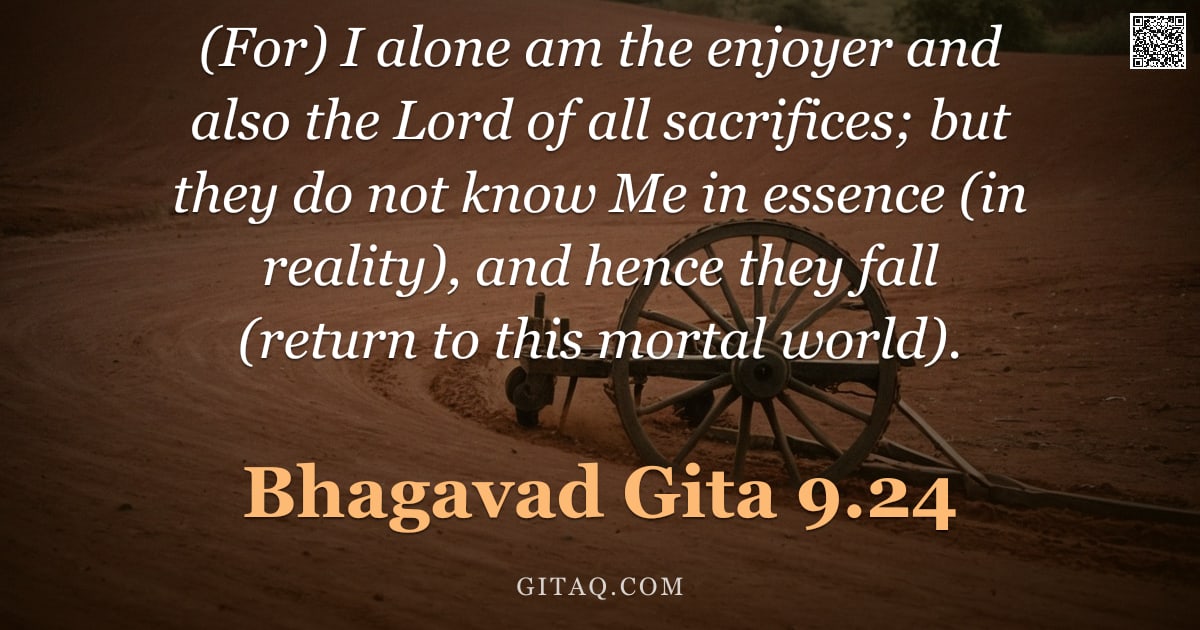
Bhagavad Gita 9.24
Raja Vidya Raja Guhya Yoga · English Translation
अहं हि सर्वयज्ञानां भोक्ता च प्रभुरेव च | न तु मामभिजानन्ति तत्त्वेनातश्च्यवन्ति ते ||९-२४||
ahaṃ hi sarvayajñānāṃ bhoktā ca prabhureva ca . na tu māmabhijānanti tattvenātaścyavanti te ||9-24||
What Does This Verse Mean?
In this verse, Lord Krishna reveals to Arjuna that He is the ultimate recipient and ruler of all religious rituals and offerings made by humanity. Despite people performing sacrifices with devotion or as a duty, they often fail to recognize Him as the supreme source behind these acts. Because their understanding remains superficial rather than seeing His true essence, they remain bound in the cycle of birth and death instead of attaining liberation.
The Teaching Behind It
This verse serves as a foundational teaching for Bhakti Yoga (the path of devotion) by establishing Krishna's status as the sole beneficiary of all actions. It integrates Jnana Yoga (knowledge), emphasizing that true liberation requires not just performing rituals, but possessing 'tattva-jñana'—direct realization of God's essence behind all phenomena.
Word by Word
Classical Commentary
Where This Happens
This verse occurs during the Bhagavad Gita's climax on the battlefield of Kurukshetra, where Krishna is transitioning from teaching Arjuna about duty (karma yoga) to revealing his divine nature. Just before this, Krishna had described His all-pervading glory and how He accepts offerings even with a simple leaf or flower offered in love. Arjuna has just begun to understand the depth of Krishna's divinity but still struggles to fully grasp that every ritual ultimately points back to Him as the supreme goal.
Living It Out Today
Consider a professional who dedicates their hard work and success entirely to God, treating it as an offering rather than personal achievement. While they may perform duties with excellence, if they secretly believe they are doing this for worldly fame or reward without truly surrendering the results to the Divine source of all power, they remain anxious about outcomes. True peace comes when one realizes that every action is a form of worship and trusts completely in the ultimate controller rather than just the fruits of labor.
Explained for Children
Imagine you bake cookies for your family, but when you give them out, everyone thinks it is just a delicious treat without realizing how hard you worked to make them. Krishna says He is like that baker who loves all the food we share in prayers and good deeds because He made everything possible. If people only look at the cookie and forget about the Baker, they don't get to know Him fully; but if they understand His love behind every act of kindness, they can truly connect with Him.
Daily Reflection
Today, consider how often we treat our actions as transactions rather than offerings; perhaps you are seeking recognition from others when the true audience is the Divine presence within. Krishna reveals here that He alone is the ultimate enjoyer of every sacrifice and the supreme Lord over all efforts, yet this truth remains hidden to those who see only the surface of their deeds. When we shift our focus from external validation to internal surrender, we stop 'falling' back into anxiety and begin to rest in the eternal peace that comes from knowing Him as He truly is.
A Practice for Today
Rest your mind in the quiet realization that you are not merely performing rituals, but offering them directly to the Divine who dwells within as both the recipient and the source of all grace. As you breathe, silently acknowledge that every act done with devotion is a return to the One Lord who accepts nothing less than your entire consciousness.
Key Teachings
- The Dual Nature of Divine Acceptance
Krishna establishes Himself simultaneously as the 'Bhokta' (enjoyer) and 'Prabhuh' (Lord), indicating that He is both the one who receives our offerings and the supreme authority governing them. This means no sacrifice exists in a vacuum; every act of devotion finds its true home only within the Divine consciousness. - The Danger of Superficial Knowledge
The verse warns that those who do not know Krishna 'tattvena'—in His essential reality—are destined to cycle through birth and death rather than attaining liberation. It is the lack of deep, experiential knowledge of God's true nature as the sole recipient of all effort that causes spiritual regression. - The Culmination of All Sacrifice
By declaring 'sarvayajñānām' (of all sacrifices), Krishna positions Himself as the ultimate goal and conclusion of every Vedic ritual, karma-yoga action, and spiritual practice. This teaches that diverse paths are not separate from Him but converge within His being when performed with true understanding.
Themes
Related Verses
Read This Next
Recommended Reading
GitaQ earns from qualifying purchases as an Amazon Associate.