Bhagavad Gita 8.24
Akshara Brahma Yoga · English Translation
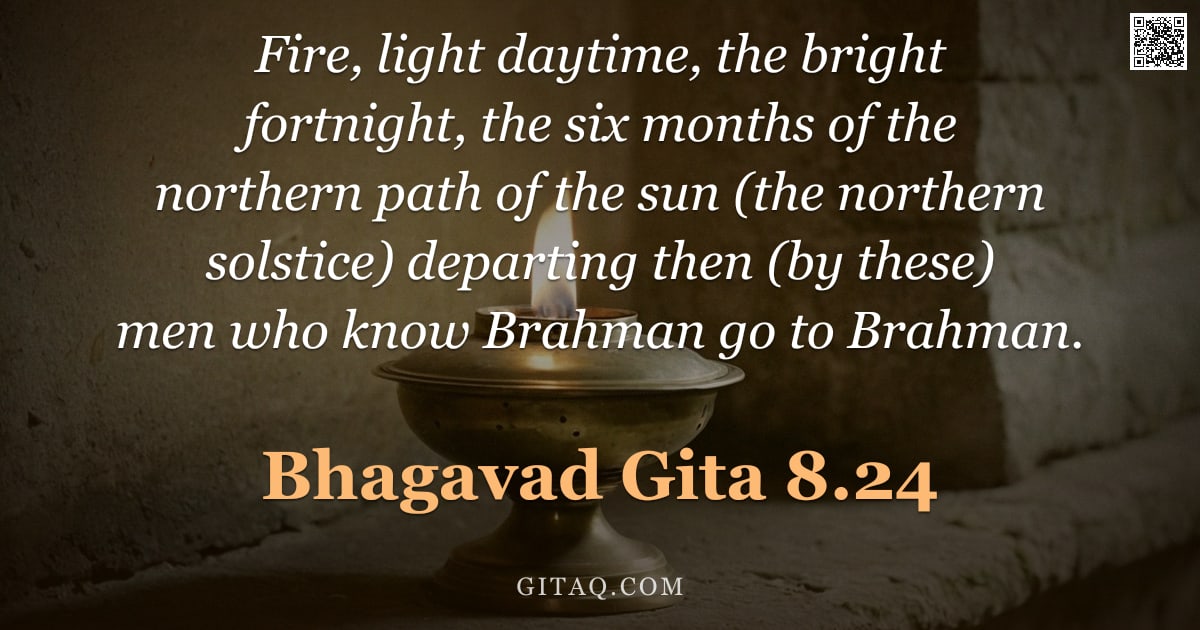
अग्निर्जोतिरहः शुक्लः षण्मासा उत्तरायणम् | तत्र प्रयाता गच्छन्ति ब्रह्म ब्रह्मविदो जनाः ||८-२४||
agnirjotirahaḥ śuklaḥ ṣaṇmāsā uttarāyaṇam . tatra prayātā gacchanti brahma brahmavido janāḥ ||8-24||
What Does This Verse Mean?
In this verse, Lord Krishna describes the path taken by souls who have deeply realized their true nature as Brahman after leaving their bodies during specific auspicious times of day and year. He explains that those who die while in a state of spiritual awareness depart through symbols like fire, light, daytime, and the sun's northern journey to reach the eternal realm of God. The key teaching is that one's consciousness at the moment of death determines the destination of their soul, with clarity leading to liberation rather than rebirth.
The Teaching Behind It
This verse belongs primarily to the Jnana Yoga (path of knowledge) strand of teaching, specifically developing the concept of 'Agni' and celestial symbolism in relation to liberation. It elaborates on the theory that consciousness follows a specific trajectory based on spiritual maturity at death, distinguishing between those who achieve Moksha (liberation) and those subject to reincarnation.
Word by Word
Classical Commentary
Where This Happens
This verse occurs in Chapter 8 on the battlefield of Kurukshetra, spoken by Krishna to Arjuna. Just before this, Krishna has been explaining how remembering God at the moment of death determines one's future journey. Arjuna, overwhelmed with grief and confusion about his duty, is listening intently as Krishna provides a cosmic roadmap for what happens after physical life ends.
Living It Out Today
Consider facing a high-stakes work presentation or a difficult family conversation that requires total mental clarity; this verse teaches us to cultivate such deep focus on our values beforehand so that even in moments of crisis, we remain centered. If you are dealing with anxiety about the future, use this as a reminder that your current habits and state of mind shape how you face life's biggest transitions. By practicing mindfulness daily—focusing on light, truth, or gratitude—you prepare yourself to handle inevitable changes with peace rather than fear.
Explained for Children
Imagine your life is a long day where you are walking from morning until night. If you are doing something wonderful and happy right as the sun rises in winter (when days get longer), it's like taking an elevator up instead of waiting for another bus ride home. This verse says that people who spend their whole lives loving God and knowing they are part of Him, when they leave this world during these special times, don't have to come back; they just go straight to the happy place where everything is light and warm.
Daily Reflection
Today, consider how often you are distracted by the shadows of doubt or the confusion of darkness rather than seeking the light within yourself. Just as the verse describes a specific path for those who know Brahman, remember that every moment offers an opportunity to align with clarity and conscious awareness. When challenges arise, try to see them not as obstacles but as part of the transition toward your true nature.
A Practice for Today
Close your eyes and visualize the path of light, imagining fire dissolving darkness as you breathe in clarity and exhale attachment to fear. Rest your awareness on this inner luminescence that exists beyond the cycles of day and night, knowing it is the true home of your soul.
Key Teachings
- The Path of Light
This verse introduces the Uttarayana path, a symbolic journey through fire and daylight representing spiritual progress. It signifies that those who live with consciousness move from darkness into an eternal state of illumination. - Conscious Departure
The text emphasizes that the destination is not random but follows specific cosmic rhythms accessible only to the self-realized soul. This suggests that how one lives determines exactly where consciousness travels after death. - Union with Brahman
Those who know the Imperishable Brahman do not return to the cycle of rebirth but merge into infinite existence immediately. The journey is completed by transcending time and space through deep knowledge and devotion.
Themes
Related Verses
Read This Next
- 2.47 — To understand how one should act without attachment in order to prepare for this final union.
- 3.30 — To learn the practice of dedicating all actions to God, which purifies the mind for higher realization.
- 12.15 — To discover why a devotee who is free from malice and kind to all beings becomes dear to Krishna.
Recommended Reading
GitaQ earns from qualifying purchases as an Amazon Associate.