Bhagavad Gita 8.6
Akshara Brahma Yoga · English Translation
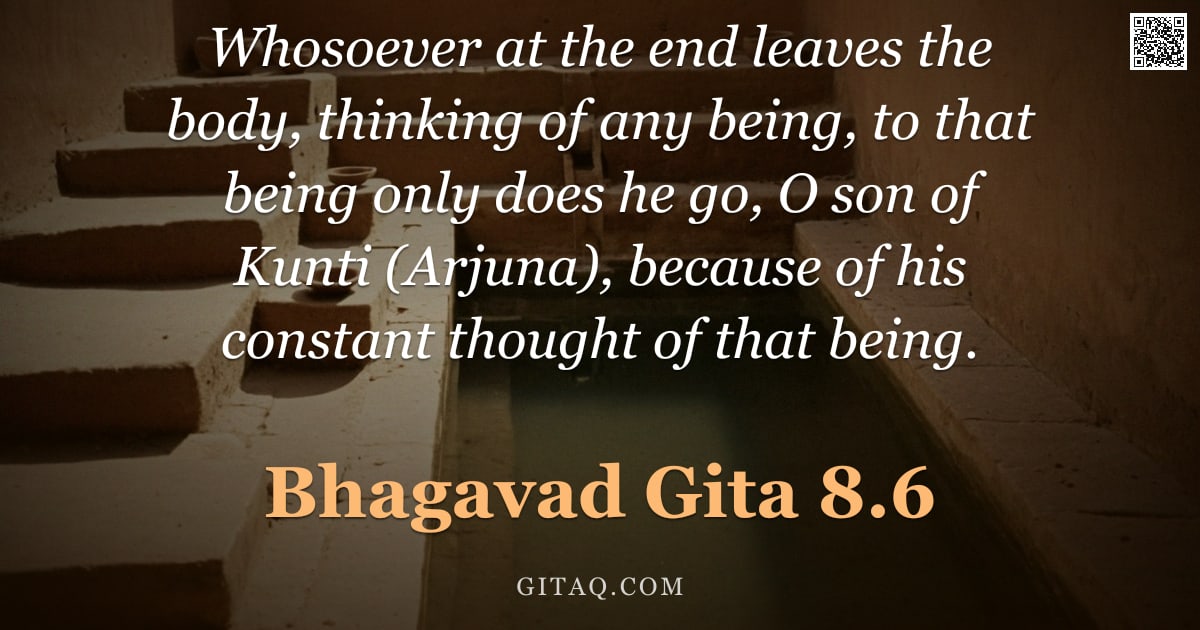
यं यं वापि स्मरन्भावं त्यजत्यन्ते कलेवरम् | तं तमेवैति कौन्तेय सदा तद्भावभावितः ||८-६||
yaṃ yaṃ vāpi smaranbhāvaṃ tyajatyante kalevaram . taṃ tamevaiti kaunteya sadā tadbhāvabhāvitaḥ ||8-6||
What Does This Verse Mean?
In this verse, Lord Krishna tells Arjuna that the state of mind one holds at the very moment of death determines their next destination or rebirth. If a person constantly thinks about a specific quality, being, or goal throughout their life, they will naturally be drawn to it when leaving the body. The core teaching is that our final thoughts are not random; they are the culmination of what we have focused on most deeply during our waking hours.
The Teaching Behind It
This verse is foundational to Dhyana Yoga (the yoga of meditation) and connects deeply with Bhakti Yoga by emphasizing that devotion shapes consciousness. It develops the concept of 'Samskaras' (mental impressions), illustrating how our habitual thoughts accumulate to form a trajectory for the soul's journey after physical life.
Word by Word
Classical Commentary
Where This Happens
This verse occurs on the battlefield of Kurukshetra during the Mahabharata war, as Arjuna hesitates to fight his own relatives and kinsmen. Krishna has just finished explaining the nature of the Supreme Absolute Truth (Brahman) in Chapter 8 and is now addressing how one attains that truth or another state after death. He speaks this wisdom to calm Arjuna's confusion about duty versus attachment, offering a practical method for spiritual focus amidst chaos.
Living It Out Today
Consider a professional facing burnout who spends their days obsessing over the fear of failure and criticizing themselves harshly; when they face a major life transition or crisis, that mindset will likely trigger anxiety rather than resilience. Conversely, if someone consistently practices gratitude and focuses on solutions during stressful workdays, their mind at the moment of retirement or a sudden challenge will naturally lean toward peace and constructive action.
Explained for Children
Imagine you play with your favorite toy all day long and think about nothing else before bedtime. When you wake up tomorrow, that toy feels like it's still right there in your mind because you loved playing with it so much. Lord Krishna is saying something similar: if we spend our whole life thinking kindly or practicing good habits, our minds will naturally go to a happy place when the day ends forever.
Daily Reflection
You might wonder why a fleeting moment of thought can shape your entire destiny, yet the Gita reveals that our final state is simply the culmination of everything we have cherished and practiced. As you move through this day, notice what captures your heart's attention most deeply; those are the seeds being sown for your future journey. By consciously choosing to dwell on love, truth, or compassion now, you ensure that when life transitions in its own time, you will naturally flow toward peace.
A Practice for Today
Sit quietly and bring to mind your deepest aspiration or the divine presence you wish to embody today. Hold this single thought with full attention as if it were your only reality, letting all other distractions dissolve into silence.
Key Teachings
- The Law of Final Thought
Your ultimate destination is determined by the state of consciousness at the very moment death occurs. This verse establishes that the end point of life is not random but a direct reflection of our final mental focus. - Samskaras and Habitual Flow
The phrase 'sadā tadbhāvabhāvitaḥ' indicates that this final thought is the result of lifelong habitual meditation. If you constantly cultivate a specific quality or deity, it becomes your natural state when physical consciousness fades. - Active Spiritual Preparation
This teaching transforms death from a frightening unknown into a manageable transition that can be prepared for daily. It invites the seeker to practice constant remembrance so that the final moment is met with clarity and devotion rather than fear.
Themes
Related Verses
Read This Next
- 2.47 — Read to understand how performing duty without attachment creates a stable foundation for that final focused state.
- 3.30 — Explore the practice of dedicating all actions and their fruits to the Divine, which purifies the mind for higher realization.
- 12.15 — Discover how Krishna describes a devotee who is dear to Him because they are free from envy and full of compassion.
Recommended Reading
GitaQ earns from qualifying purchases as an Amazon Associate.