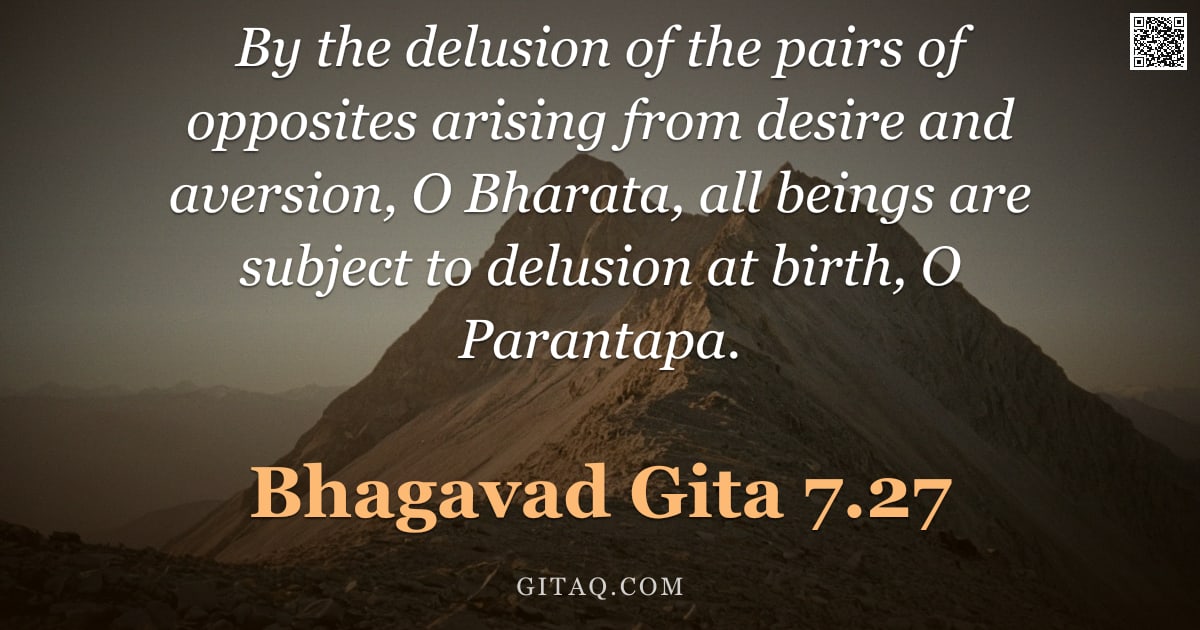
Bhagavad Gita 7.27
Jnana Vijnana Yoga · English Translation
इच्छाद्वेषसमुत्थेन द्वन्द्वमोहेन भारत | सर्वभूतानि सम्मोहं सर्गे यान्ति परन्तप ||७-२७||
icchādveṣasamutthena dvandvamohena bhārata . sarvabhūtāni sammohaṃ sarge yānti parantapa ||7-27||
What Does This Verse Mean?
In this verse, Lord Krishna addresses Arjuna as 'Bharata' and explains that all living beings are born into a state of confusion because their minds are clouded by desire for pleasure and aversion to pain. These opposing forces create an illusion called the 'pairs of opposites,' which makes it impossible for anyone to see reality clearly without spiritual guidance. The key teaching is that this delusion at birth is universal, affecting every creature regardless of their status or past actions.
The Teaching Behind It
This verse belongs primarily to Jnana Yoga (the path of knowledge) as it identifies ignorance (avidya) caused by attachment as the root cause of suffering. It develops the Sankhya concept that all beings are bound by the dualities of nature (gunas), specifically rajas and tamas, which manifest as desire and aversion to keep the soul entangled in samsara.
Word by Word
Classical Commentary
Where This Happens
This verse occurs on the battlefield of Kurukshetra during the Mahabharata war, where Arjuna has just declared he will not fight due to his emotional confusion. Krishna, acting as both charioteer and divine teacher, begins Chapter 7 by explaining why all beings are trapped in ignorance at birth, setting the stage for revealing how one can transcend this delusion. The listener, Arjuna (addressed here as Bharata), is still struggling with attachment to his relatives and fear of sin, needing a fundamental shift in understanding before he can act.
Living It Out Today
Consider a professional who experiences extreme anxiety when facing a difficult project because they are driven by the desire for praise and the aversion to criticism. This person might freeze or make poor decisions not due to lack of skill, but because their mind is oscillating between these two opposing emotions, creating a mental fog similar to the 'pairs of opposites.' By recognizing that this reaction is a natural human tendency rather than a personal failure, one can step back and observe the situation with clarity instead of reacting impulsively.
Explained for Children
Imagine you are playing a video game where sometimes you want to win the high score (desire) but other times you really hate losing a life (aversion). If your brain gets too busy worrying about winning and losing, you might make silly mistakes in the game. Lord Krishna says that everyone is like this when they are born: their minds get confused because they love some things so much and dislike others just as hard, making it hard to see what is really happening around them.
Daily Reflection
You often find yourself trapped in confusion not because life is complex, but because your mind is reacting to likes and dislikes rather than seeing things as they are. These pairs of opposites—pleasure and pain, gain and loss—are natural, yet clinging to them keeps you in a state of perpetual delusion from the very beginning of your journey. Today, try to step back from these automatic reactions and simply witness how desire clouds your judgment.
A Practice for Today
Sit quietly and observe the sudden surge of desire or aversion that arises when you encounter a pleasant or unpleasant situation today. Notice how this emotional pull creates a mental fog, obscuring your ability to see the reality before you clearly.
Key Teachings
- The Root of Delusion
Krishna identifies 'dvaṇḍvamoha' as the primary obstacle to wisdom, explaining that confusion stems from our attachment to dualities. This delusion is not random but specifically fueled by the twin forces of desire (ichha) and aversion (dvesha). - Universal Nature
The verse emphasizes 'sarvabhūtāni,' indicating that this condition affects all beings at birth, not just a select few. This establishes the need for spiritual practice as a universal remedy rather than an optional luxury. - The Call to Transcendence
By addressing Arjuna as 'Parantapa' (conqueror of enemies), Krishna implies that one can overcome these internal foes. The path forward involves recognizing the source of delusion and transcending the pull of opposites through higher knowledge.
Themes
Related Verses
Read This Next
- 2.47 — To learn how to act without attachment, which is the practical antidote to desire-driven delusion.
- 3.30 — This verse expands on surrendering actions and their fruits, helping one detach from the results that fuel aversion.
- 12.15 — To understand how a devotee who is neither disturbed nor disturbs others naturally transcends these dualities through equanimity.
Recommended Reading
GitaQ earns from qualifying purchases as an Amazon Associate.