Bhagavad Gita 7.18
Jnana Vijnana Yoga · English Translation
उदाराः सर्व एवैते ज्ञानी त्वात्मैव मे मतम् | आस्थितः स हि युक्तात्मा मामेवानुत्तमां गतिम् ||७-१८||
udārāḥ sarva evaite jñānī tvātmaiva me matam . āsthitaḥ sa hi yuktātmā māmevānuttamāṃ gatim ||7-18||
What Does This Verse Mean?
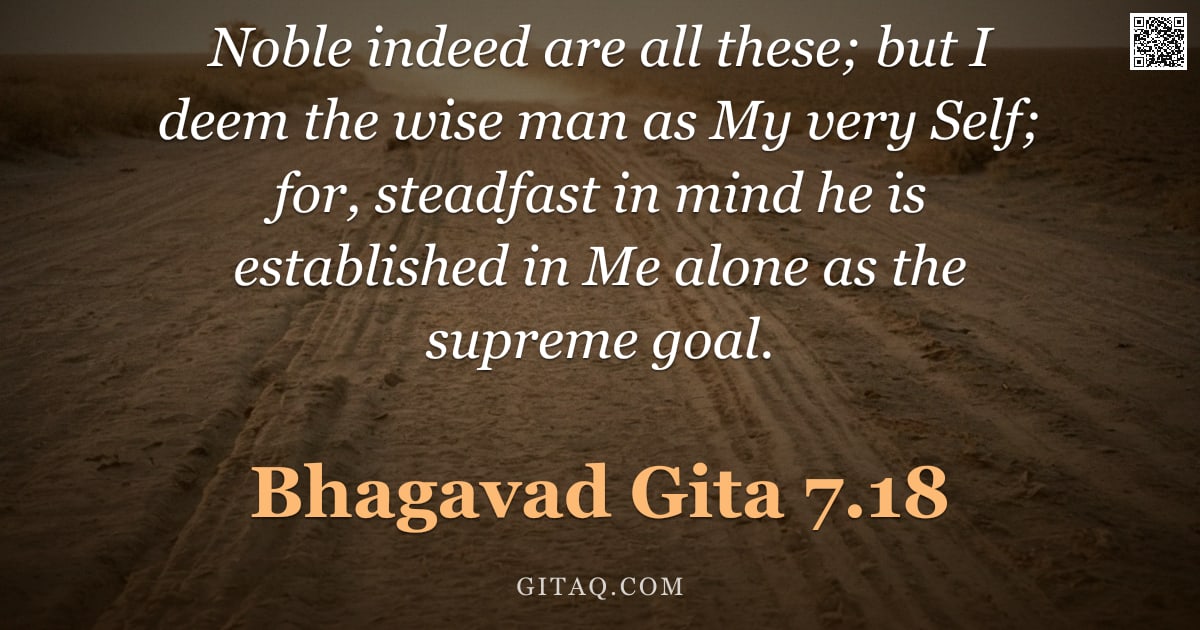
In this verse, Lord Krishna is speaking to Arjuna about the different types of devotees and their spiritual standing. He acknowledges that various paths lead to Him, but he elevates the 'wise man' (jnani) above all others as his very own Self. This wisdom arises because such a person has fixed their mind entirely on Krishna, seeing no goal higher than union with the Divine.
The Teaching Behind It
This verse synthesizes Jnana Yoga (the path of knowledge) and Bhakti Yoga (the path of devotion), showing they converge at the highest level. It teaches that true wisdom (jnani) is not merely intellectual but a state of unwavering love where the individual self realizes its unity with the Supreme, making God their sole goal.
Word by Word
Classical Commentary
Where This Happens
This verse occurs during the dialogue between Prince Arjuna and Lord Krishna on the battlefield of Kurukshetra, where Arjuna is overwhelmed by grief and confusion about fighting his relatives. After explaining that various types of people approach God through different paths in previous verses (7.16), Krishna now reveals which path leads to the highest realization. This moment marks a transition from describing external devotion to highlighting the internal state of total absorption in the Divine.
Living It Out Today
When facing a high-pressure career decision that requires choosing between maximum profit and ethical integrity, apply this verse by first pausing your anxiety about the outcome. Instead of calculating risks based on fear or greed, make the choice as if you were acting directly for God's will, viewing the result with complete detachment. This shifts your focus from the stress of the consequence to the clarity of doing what is right in that very moment.
Explained for Children
Imagine you have many friends who love playing games with you, but one friend is always thinking about how much they want to be your best buddy forever and only plays games together. Lord Krishna says that while all his followers are wonderful, he loves the ones who focus on being close to him above everything else just as a child might rely entirely on their parent for love and safety.
Daily Reflection
You might find today that while you respect others for their different ways of seeking truth, there is a profound peace found in knowing that wisdom itself is nothing other than the Divine. When your mind becomes steady and rooted in this awareness, you realize that your ultimate destination was never distant—it has been within you all along as the Supreme Goal.
A Practice for Today
Begin by gently acknowledging that all spiritual paths are noble, yet the path of wisdom stands as a direct embrace with the Divine. Visualize your own awareness resting not just on God, but recognizing yourself and everything else as inseparable from That very Self.
Key Teachings
- The Nobility of All Paths
Krishna validates every sincere spiritual effort, calling them all 'noble' and worthy of respect. This teaches us to honor diversity in devotion while recognizing that wisdom stands apart as the most direct approach. - The Identity of the Wise
The verse reveals a unique status where the knower is regarded not just as dear, but as the Divine's own Self. This signifies a state where the separation between the devotee and the Beloved dissolves completely. - Steadfastness in Supreme Goal
The defining characteristic of this wise soul is being 'steadfast' (sthita-prajña) with an integrated mind. Such a person has no other goal than the Divine, making them established firmly in union.
Themes
Related Verses
Read This Next
- 2.47 — This verse establishes the foundation of duty without attachment, which is essential before one can become a 'steady' knower.
- 3.30 — Read this to understand how offering all actions to God leads to the purification required for true wisdom and unity with the Divine.
- 12.15 — It expands on the nature of those who have established themselves in Me alone.
Recommended Reading
GitaQ earns from qualifying purchases as an Amazon Associate.