Bhagavad Gita 6.36
Dhyana Yoga · English Translation
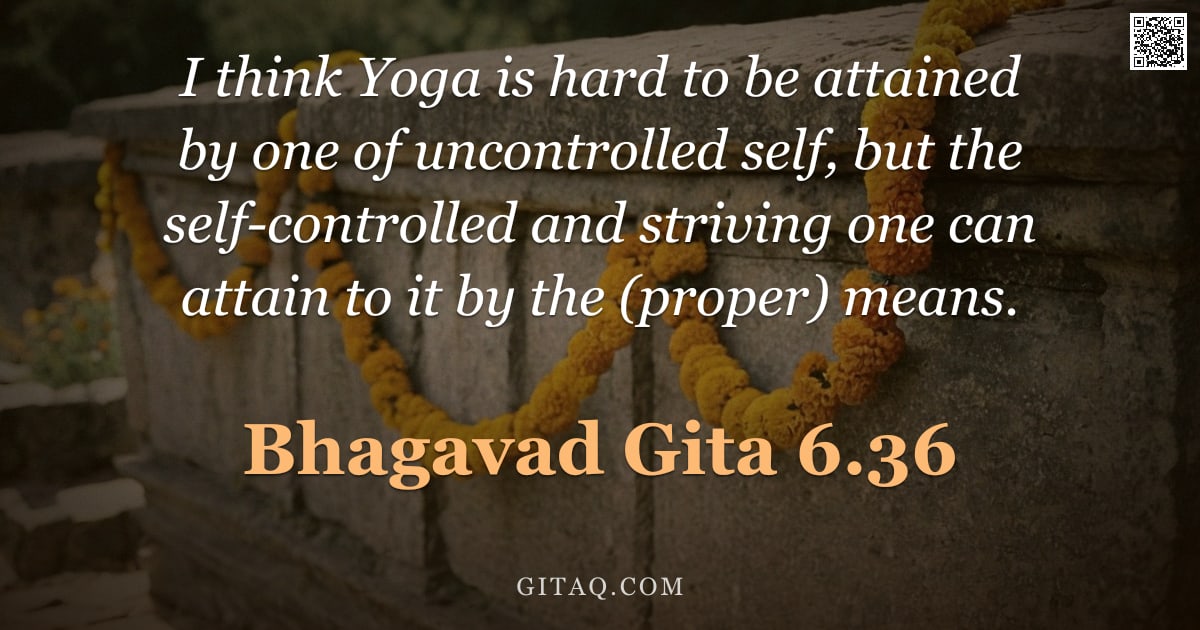
असंयतात्मना योगो दुष्प्राप इति मे मतिः | वश्यात्मना तु यतता शक्योऽवाप्तुमुपायतः ||६-३६||
asaṃyatātmanā yogo duṣprāpa iti me matiḥ . vaśyātmanā tu yatatā śakyo.avāptumupāyataḥ ||6-36||
What Does This Verse Mean?
In this verse, Lord Krishna is speaking to Arjuna about the difficulty of mastering meditation and spiritual discipline (Yoga). He states that for a person who has not learned to control their mind and senses, achieving Yoga feels nearly impossible. However, he offers hope by clarifying that anyone who strives diligently while maintaining self-control can indeed attain this state through the right methods.
The Teaching Behind It
This verse is foundational to Dhyana Yoga, specifically detailing the necessary prerequisites for successful meditation within the Sankhya philosophy of self-control. It develops the concept that spiritual attainment (Yoga) requires an active partnership between human effort (yatatah) and internal discipline (vashya-atma), rejecting fatalism.
Word by Word
Classical Commentary
Where This Happens
This verse appears in the sixth chapter of the Bhagavad Gita during the intense conversation on the battlefield of Kurukshetra between Lord Krishna and Prince Arjuna. Just prior to this exchange, Arjuna has expressed deep concern that a mind too restless for meditation might lead him astray from spiritual progress. He is seeking reassurance about whether it is even possible for ordinary humans with turbulent minds to succeed in the path of self-realization.
Living It Out Today
Consider a professional trying to implement mindfulness techniques while managing high-stress deadlines and constant digital notifications; attempting this without first establishing basic boundaries feels overwhelming, much like uncontrolled Yoga. By setting specific 'no-phone' times at home or using structured breathing exercises before meetings (the proper means), they make the practice achievable despite their busy life. This shift from an all-or-nothing mindset to a disciplined approach turns mental chaos into focused clarity.
Explained for Children
Imagine trying to ride a bicycle without holding onto the handlebars; it would be very wobbly and hard to balance, just like meditation for someone whose mind is all over the place. But if you hold on tight and keep your focus steady while practicing every day, riding smoothly becomes possible! Lord Krishna tells us that controlling our thoughts is like learning to ride a bike: difficult at first without discipline, but completely achievable with patience and practice.
Daily Reflection
You might have felt discouraged today thinking yoga or inner peace was too difficult because your mind kept racing. Krishna reminds us that this struggle isn't a failure but simply part of the process; it is only when we stop and try again with self-control that progress begins to happen. Today, celebrate just one small moment where you caught yourself drifting and chose to return.
A Practice for Today
Close your eyes and take three deep breaths, noticing the moment you feel a thought pulling you away from stillness. Silently acknowledge that this wandering is natural for an untrained mind, then gently guide your attention back to the rhythm of your breathing without judgment.
Key Teachings
- The Obstacle of Unrest
A mind lacking discipline finds the path of yoga as difficult as climbing a steep cliff. This verse acknowledges that without initial self-regulation, spiritual practice feels insurmountable. - The Power of Effortful Control
Attainment becomes possible only when one actively controls the senses and strives with determination. The barrier is not external but lies in our own unmastered nature, which must be tamed through practice. - The Availability of Methods
For those who are self-disciplined and diligent, Krishna promises there are proper means to achieve this state. The path is accessible not by magic, but through the application of specific spiritual techniques aligned with a controlled mind.
Themes
Related Verses
Read This Next
- 2.47 — This verse establishes the foundational principle of performing action without attachment to results, which is essential before attempting deep control.
- 3.30 — Here Krishna instructs Arjuna on how to surrender all actions and senses to Him, offering a practical method for the self-control mentioned in 6.36.
- 12.15 — This verse describes the qualities of one who has successfully mastered the mind through devotion, serving as an inspiring example of the goal you are striving toward.
Recommended Reading
GitaQ earns from qualifying purchases as an Amazon Associate.