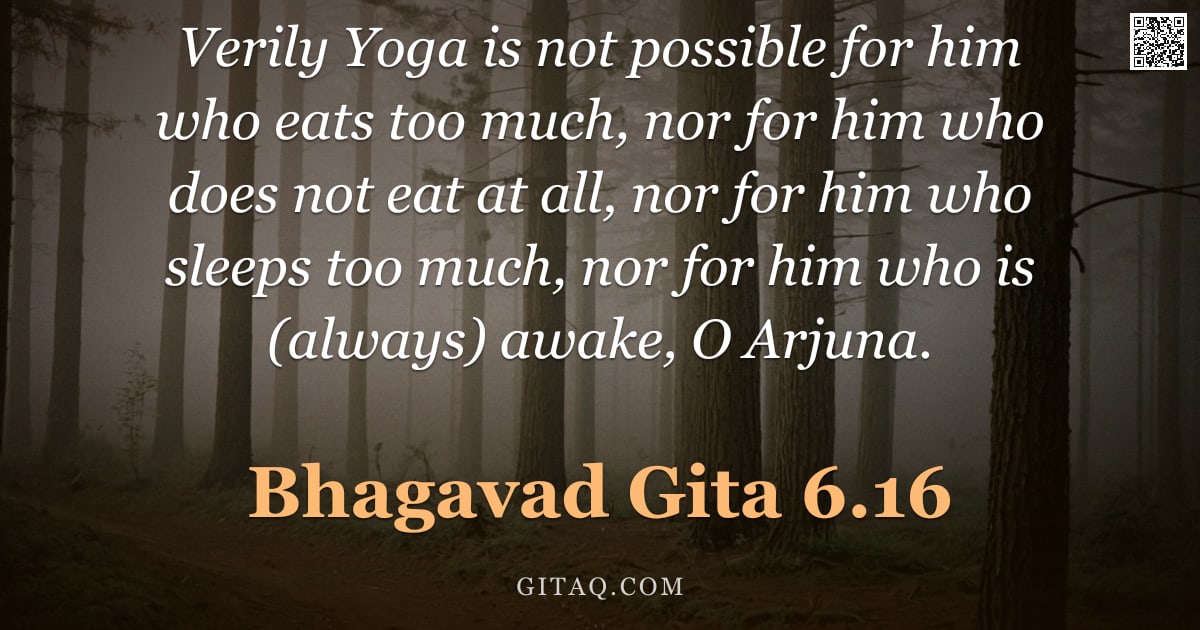
Bhagavad Gita 6.16
Dhyana Yoga · English Translation
नात्यश्नतस्तु योगोऽस्ति न चैकान्तमनश्नतः | न चातिस्वप्नशीलस्य जाग्रतो नैव चार्जुन ||६-१६||
nātyaśnatastu yogo.asti na caikāntamanaśnataḥ . na cātisvapnaśīlasya jāgrato naiva cārjuna ||6-16||
What Does This Verse Mean?
In this verse, Lord Krishna advises Arjuna that the path of Yoga requires a balanced lifestyle rather than extreme discipline. He explains that one cannot practice meditation effectively if they overeat or starve themselves, just as sleep and wakefulness must be regulated in moderation. The key teaching is that physical extremes hinder spiritual progress, while a middle way creates the stability needed for inner peace.
The Teaching Behind It
This verse belongs specifically to Dhyana Yoga (the yoga of meditation) within the broader framework of Sankhya philosophy which distinguishes between the body-mind complex and the eternal Self. It develops the concept of 'Yukta-Ahara-Vihara' or regulated conduct, establishing that physical discipline is a prerequisite for mental mastery in the pursuit of self-realization.
Word by Word
Classical Commentary
Where This Happens
This verse appears in Chapter 6 of the Bhagavad Gita, set on the battlefield of Kurukshetra where Prince Arjuna is paralyzed by doubt and emotional turmoil before war. Krishna has just completed a detailed discourse on Karma Yoga and Sankhya philosophy, transitioning now to instructing Arjuna specifically on Dhyana Yoga or meditation techniques. The listener, Arjuna, is exhausted from his mental conflict and needs practical guidance on how to prepare the body for the intense focus required to calm his mind.
Living It Out Today
Consider a professional facing burnout who tries to compensate by pulling all-nighters (excessive wakefulness) or skipping meals entirely; this often leads to poor decision-making and anxiety rather than productivity. Krishna's teaching suggests that establishing a consistent routine of moderate work, balanced nutrition, and adequate rest is the most effective strategy for maintaining mental clarity during high-pressure projects. By avoiding these extremes, you build the endurance needed to handle difficult decisions with a calm and focused mind.
Explained for Children
Imagine your body is like a battery-powered toy car; if you put too much food or water in it, it gets heavy and won't move well, but if you give it nothing at all, it stops working. Krishna tells Arjuna that to play the best game of meditation, we need to find the happy middle spot—eating just enough so our tummies are comfortable and sleeping when tired so our minds feel fresh. This helps us have a clear head for thinking big thoughts without feeling too sleepy or too hungry.
Daily Reflection
Today, take a moment to check in with how you treat your own vessel; often we swing between overindulgence and harsh denial, forgetting that true peace lives in balance. Krishna invites Arjuna to understand that yoga flourishes only when the body is neither weighed down by excess nor exhausted by deprivation. When you find this equilibrium today, you create a calm inner space where the mind can finally settle into its natural state.
A Practice for Today
Sit quietly and bring your awareness to your current relationship with food, sleep, and wakefulness. Notice if you are seeking comfort through excess or denying yourself out of fear, and gently invite a middle path where the body is cared for just enough to sustain stillness.
Key Teachings
- The Golden Mean of Discipline
True spiritual progress requires moderating physical habits rather than indulging in or suppressing them completely. This balance creates a stable foundation where the mind is neither lethargic nor agitated, allowing for deep concentration. - Regulating Sleep and Wakefulness
Extremes of sleepiness (tamas) and insomnia (rajas) are obstacles to meditation because they cloud or disrupt the mind's clarity. One must cultivate a rhythm where rest is sufficient for renewal but not so much that it leads to delusion. - Yoga as Sustainable Practice
The verse emphasizes that yoga is an enduring path, not a momentary feat achievable only through extreme asceticism. It teaches that the body must be maintained with care so that it becomes a fit instrument for higher consciousness rather than a hindrance.
Themes
Related Verses
Read This Next
- 2.47 — To understand how this physical discipline supports the larger principle of performing duty without attachment to results.
- 3.30 — To see how surrendering all actions and maintaining balance in daily life is a prerequisite for true yoga practice.
- 12.15 — To learn the qualities of one who has achieved this inner stability, becoming dear to Krishna by being balanced and free from agitation.
Recommended Reading
GitaQ earns from qualifying purchases as an Amazon Associate.