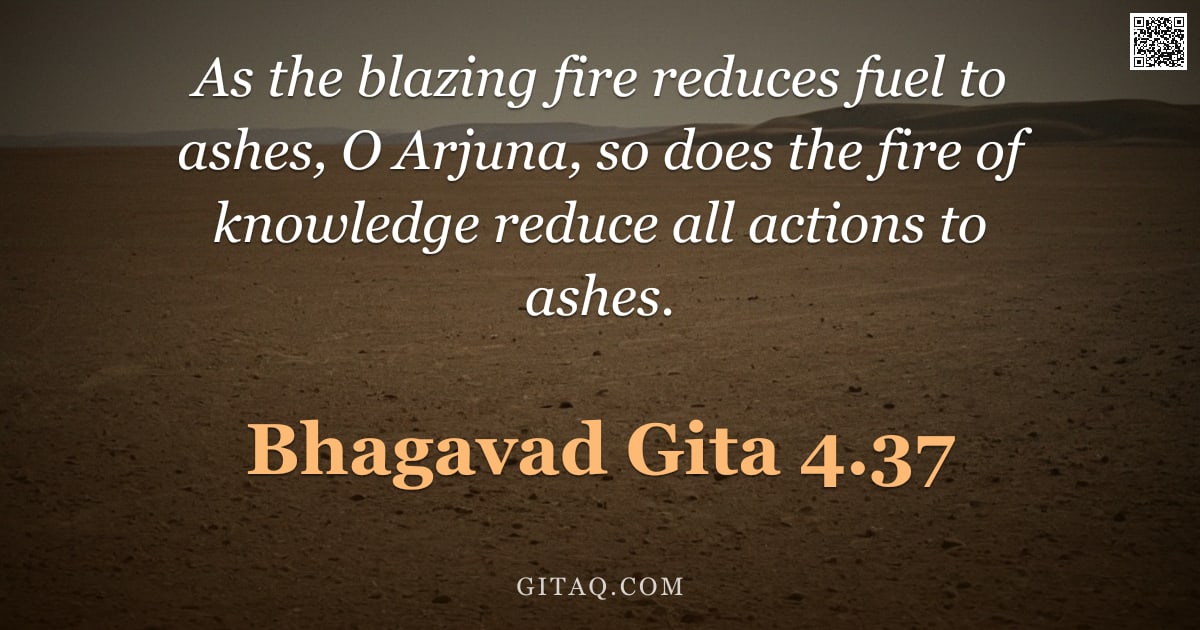
Bhagavad Gita 4.37
Jnana Karma Sanyasa Yoga · English Translation
यथैधांसि समिद्धोऽग्निर्भस्मसात्कुरुतेऽर्जुन | ज्ञानाग्निः सर्वकर्माणि भस्मसात्कुरुते तथा ||४-३७||
yathaidhāṃsi samiddho.agnirbhasmasātkurute.arjuna . jñānāgniḥ sarvakarmāṇi bhasmasātkurute tathā ||4-37||
What Does This Verse Mean?
In this verse, Lord Krishna speaks to Arjuna about the transformative power of spiritual wisdom. He explains that just as a blazing fire turns fuel into harmless ash, the 'fire of knowledge' burns away all past and future karmic reactions attached to our actions. The key teaching is that true understanding of one's divine nature liberates us from the burden of guilt or fear regarding what we have done or might do.
The Teaching Behind It
This verse is central to Jnana Yoga (the path of knowledge) within the Vedanta tradition. It develops the concept that self-realization acts as a destructive force against 'samsara' and karmic accumulation, asserting that wisdom does not just cover sins but annihilates their potential for future suffering.
Word by Word
Classical Commentary
Where This Happens
This verse occurs in Chapter 4 during the intense dialogue on the battlefield of Kurukshetra, where Prince Arjuna is paralyzed by moral confusion before his relatives attack him. Krishna has just concluded His teaching on 'Jnana Karma Sanyasa Yoga' (the renunciation of action through knowledge) and needs to reassure a hesitant disciple. After explaining that wisdom destroys karma, Krishna uses this fiery analogy immediately after describing the nature of the enlightened one who sees inaction within action.
Living It Out Today
Consider someone stuck on an old mistake at work that they feel will ruin their career reputation forever; no matter how much they apologize or overwork to fix it, the anxiety persists. By applying this verse's teaching, they shift focus from obsessing over the past error (the fuel) to understanding their core competence and value as a professional (the fire of knowledge). This perspective burnaways the paralyzing guilt, allowing them to learn from the incident without carrying its emotional weight into future projects.
Explained for Children
Imagine holding a piece of paper over a campfire; as soon as it touches the flames, it turns into tiny bits of ash and disappears. Krishna tells Arjuna that when you really understand who you are deep inside, your mind gets like that hot fire. Any bad feelings or worries about past mistakes melt away completely, leaving you feeling light and free to start fresh.
Daily Reflection
Today, I invite you to release the heavy burden of your past actions by trusting in the transformative power of wisdom rather than effort alone. Just as a blazing fire turns wood into harmless ash, true knowledge dissolves the karmic consequences that bind us to anxiety and regret. When you realize that consciousness itself is beyond action, you find freedom from the need to constantly fix or justify what has already been done.
A Practice for Today
Close your eyes and visualize the fire of knowledge burning within you, transforming every past action into ash without leaving a trace of guilt or regret. Breathe deeply as this inner flame consumes the weight of deeds done in ignorance, replacing them with the lightness of pure awareness.
Key Teachings
- The Alchemy of Wisdom
Knowledge acts not merely as information but as an active fire that incinerates the karmic seeds of past actions. This transformation changes the nature of karma from a binding chain into ash, leaving no residue for future suffering. - Total Purification
The verse emphasizes 'sarvakarmani,' indicating that this cleansing is comprehensive and applies to all types of actions. No deed remains untouched by the fire of Jnana; even complex or seemingly insignificant acts are purified when viewed through the lens of truth. - Arjuna's Assurance
Krishna addresses Arjuna directly to offer a specific promise that this spiritual realization is accessible and effective. This personal address underscores that the fire of knowledge is not an abstract concept but a practical remedy for the warrior in everyone.
Themes
Related Verses
Read This Next
- 2.47 — Reads directly after establishing the power of knowledge, reminding us to focus on duty without attachment to results.
- 3.30 — Complements this verse by explaining how one should mentally dedicate all actions to Krishna as a form of renunciation.
- 12.15 — Follows the theme of purification, describing the qualities of someone who has been refined and freed from anger and fear.
Recommended Reading
GitaQ earns from qualifying purchases as an Amazon Associate.