Bhagavad Gita 4.35
Jnana Karma Sanyasa Yoga · English Translation
यज्ज्ञात्वा न पुनर्मोहमेवं यास्यसि पाण्डव | येन भूतान्यशेषेण द्रक्ष्यस्यात्मन्यथो मयि (var अशेषाणि) ||४-३५||
yajjñātvā na punarmohamevaṃ yāsyasi pāṇḍava . yena bhūtānyaśeṣāṇi drakṣyasyātmanyatho mayi ||4-35||
What Does This Verse Mean?
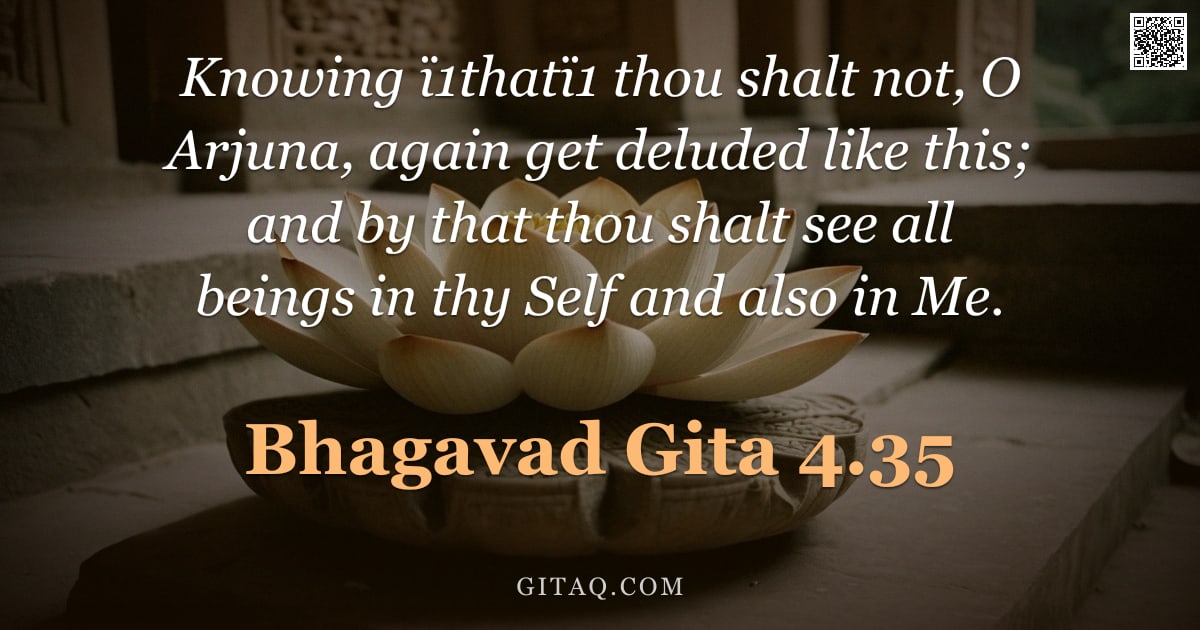
In this verse, Lord Krishna concludes a profound teaching to Arjuna by promising that true knowledge of the Self eliminates all future confusion and doubt. He explains that once you realize your essential oneness with everything in existence and understand their unity within him, no further delusion will remain. This insight transforms how one sees oneself and others, replacing separation with a vision of universal connection.
The Teaching Behind It
This verse is the culmination of Jnana Yoga (the path of knowledge) integrated into Karma Yoga (action), bridging Vedantic non-dualism with practical devotion. It develops the concept that true wisdom (jnana) is not merely intellectual but a transformative realization of 'Advaita'—that the individual self, all beings, and the Supreme are fundamentally one.
Word by Word
Classical Commentary
Where This Happens
This verse appears at the climax of Chapter 4 on the battlefield of Kurukshetra, where Prince Arjuna has just heard Krishna explain the eternal nature of the soul and the path of knowledge. After listening to complex teachings about performing duty without attachment and understanding the cycle of birth and death, Arjuna was still wrestling with a deep sense of confusion regarding his duty as a warrior. Krishna speaks this verse now to provide the final assurance that mastering these truths will instantly dissolve all his doubts.
Living It Out Today
Consider a manager facing a high-stakes decision between cutting costs by laying off loyal staff or protecting them at the risk of company failure; traditional thinking creates intense anxiety and fear of making the wrong choice. However, applying this verse's wisdom means realizing that both the employees' well-being and the company's survival are part of a larger interconnected whole rather than opposing forces. By seeing the situation with clarity and unity in mind—acting for the greater good without being paralyzed by ego-driven fear—the manager can make a decisive, compassionate choice free from regret.
Explained for Children
Imagine looking at different toys—a red car, a blue ball, and a wooden doll—and suddenly realizing they are all made from the exact same kind of clay. That is what Krishna tells Arjuna: when you truly understand that everyone and everything around us comes from the same source (the Divine), you stop feeling confused or afraid. Once you see this deep connection in your heart, every person becomes like a friend to be loved rather than an enemy.
Daily Reflection
When we truly know that the Divine resides in all beings, our fear and judgment naturally dissolve into compassion. You are invited today to look at someone difficult or different from you and realize they share the same essential Self as yourself. This shift in vision transforms ordinary interactions into sacred moments of recognition.
A Practice for Today
Close your eyes and breathe deeply, visualizing the unity that dissolves all boundaries between you and the divine presence within every being. Silently repeat the sentiment: 'I see no separation; I perceive the same Light in others as I do in my own heart.' Rest in this awareness of non-dual connection for a few moments before returning to your day.
Key Teachings
- The Destruction of Delusion
True knowledge is not merely intellectual but a transformative realization that permanently removes the fog of spiritual ignorance. Once this wisdom takes root, the mind ceases to be deceived by superficial differences or dualistic perceptions. - Seeing All in the Self
The wise perceive the universal Atman within every living creature, recognizing a shared essence rather than isolated existence. This vision of unity replaces ego-centric isolation with an all-encompassing sense of belonging to one life. - Beholding the Lord in All
The ultimate realization is seeing Krishna as the indwelling witness and source within every being, making the entire universe a manifestation of the Divine. This perspective turns the act of 'seeing' into an act of worship and profound reverence.
Themes
Related Verses
Read This Next
- 2.47 — Read this next to understand how acting without attachment creates the mental clarity necessary for such deep realization.
- 3.30 — This verse complements 4:35 by showing how dedicating all actions to God is a practical method of living in that unity.
- 12.15 — Read this to see the qualities of one who has achieved the vision described, as they delight equally in all beings and are dear to Krishna.
Recommended Reading
GitaQ earns from qualifying purchases as an Amazon Associate.