Bhagavad Gita 3.31
Karma Yoga · English Translation
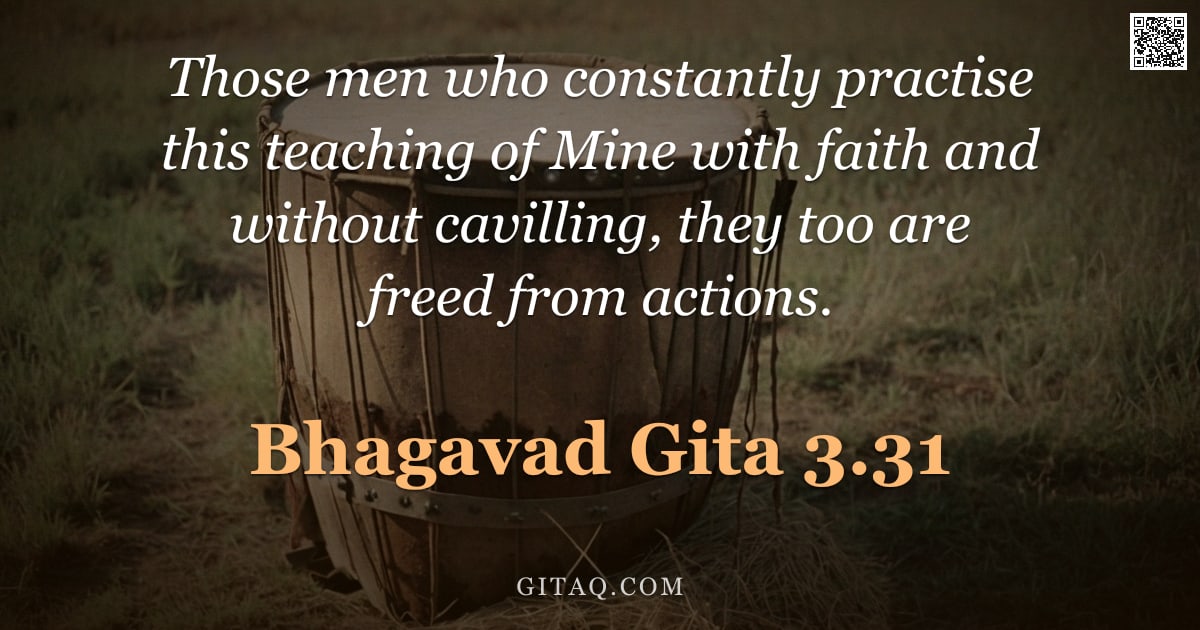
ये मे मतमिदं नित्यमनुतिष्ठन्ति मानवाः | श्रद्धावन्तोऽनसूयन्तो मुच्यन्ते तेऽपि कर्मभिः ||३-३१||
ye me matamidaṃ nityamanutiṣṭhanti mānavāḥ . śraddhāvanto.anasūyanto mucyante te.api karmabhiḥ ||3-31||
What Does This Verse Mean?
In this verse, Lord Krishna speaks to Arjuna about the path of spiritual liberation through action. He explains that anyone who consistently follows His teachings with unwavering faith and without resentment or doubt will be freed from the binding effects of their actions. The key condition is maintaining a positive attitude (without cavilling) while practicing these principles daily.
The Teaching Behind It
This verse is central to Karma Yoga, which teaches that action itself does not bind the soul; rather, it is attachment and ego in action that create bondage. It integrates Bhakti (devotion/faith) as a necessary catalyst for Jnana (knowledge), showing that faith transforms ordinary duty into a means of liberation.
Word by Word
Classical Commentary
Where This Happens
This verse appears in Chapter 3 during the intense dialogue between Lord Krishna and Prince Arjuna on the battlefield of Kurukshetra. Having just explained the philosophy of Karma Yoga (action without attachment), Krishna is now reassuring a confused Arjuna that this path leads to liberation if followed correctly. At this moment, Arjuna has surrendered his doubts but remains unsure about how ordinary people can achieve such spiritual freedom while living in society.
Living It Out Today
Consider a team leader facing a difficult project deadline where the team is exhausted and frustrated. Instead of complaining or blaming others (cavilling), they consistently apply a strategy of doing their best work with full trust that the outcome will be handled by higher forces, focusing only on their duty. By maintaining this faith and positive attitude through the stress, they perform effectively without feeling weighed down by anxiety or fear of failure.
Explained for Children
Imagine you are learning to ride a bike, but instead of just copying someone else's moves perfectly every single time, you truly believe in your teacher and never get annoyed when it takes practice. Krishna says that if we follow his good advice with this kind of happy belief and without complaining or doubting ourselves, our mistakes won't stick to us like mud on shoes—we will feel light and free.
Daily Reflection
Today, notice how often you hesitate before acting because you fear judgment—either from others or within your own mind. When you approach your duties with genuine faith and a heart free from envy or criticism, the heavy weight of karmic binding begins to lift naturally. You are invited to trust that sincere effort, when offered without cavilling, is itself a path to liberation.
A Practice for Today
Sit quietly and recall a moment where you acted with pure faith, free from the need to judge or criticize yourself for imperfections. Visualize your actions as offerings made without attachment to outcomes, allowing that sense of freedom to dissolve any lingering guilt.
Key Teachings
- The Power of Constant Practice
Liberation is not found in occasional spiritual moments but in the daily, consistent adherence to divine wisdom. By making this teaching a permanent habit rather than a temporary experiment, one aligns their entire life with the flow of truth. - Faith as the Anchor
Sincere faith acts as the essential foundation that supports action even when external results are uncertain. Without this deep trust in the wisdom of the teaching, actions remain bound to desire and fear rather than leading to freedom. - Freedom from Cavilling
The mind's tendency to doubt or find fault with spiritual paths creates a subtle barrier to liberation. When one acts without internal criticism or envy of others' practices, the very nature of action transforms into an instrument of release.
Themes
Related Verses
Read This Next
- 2.47 — This verse establishes the foundational principle of acting without attachment to results, which is required for the 'faith' mentioned in 3.31.
- 3.30 — Read this immediately prior contextually, as it explains how one dedicates all actions to Krishna, embodying the practice of 3.31.
- 12.15 — This verse describes the qualities of a devotee who is free from envy and distress, reflecting the 'without cavilling' state essential for liberation.
Recommended Reading
GitaQ earns from qualifying purchases as an Amazon Associate.