Bhagavad Gita 2.60
Sankhya Yoga · English Translation
यततो ह्यपि कौन्तेय पुरुषस्य विपश्चितः | इन्द्रियाणि प्रमाथीनि हरन्ति प्रसभं मनः ||२-६०||
yatato hyapi kaunteya puruṣasya vipaścitaḥ . indriyāṇi pramāthīni haranti prasabhaṃ manaḥ ||2-60||
What Does This Verse Mean?
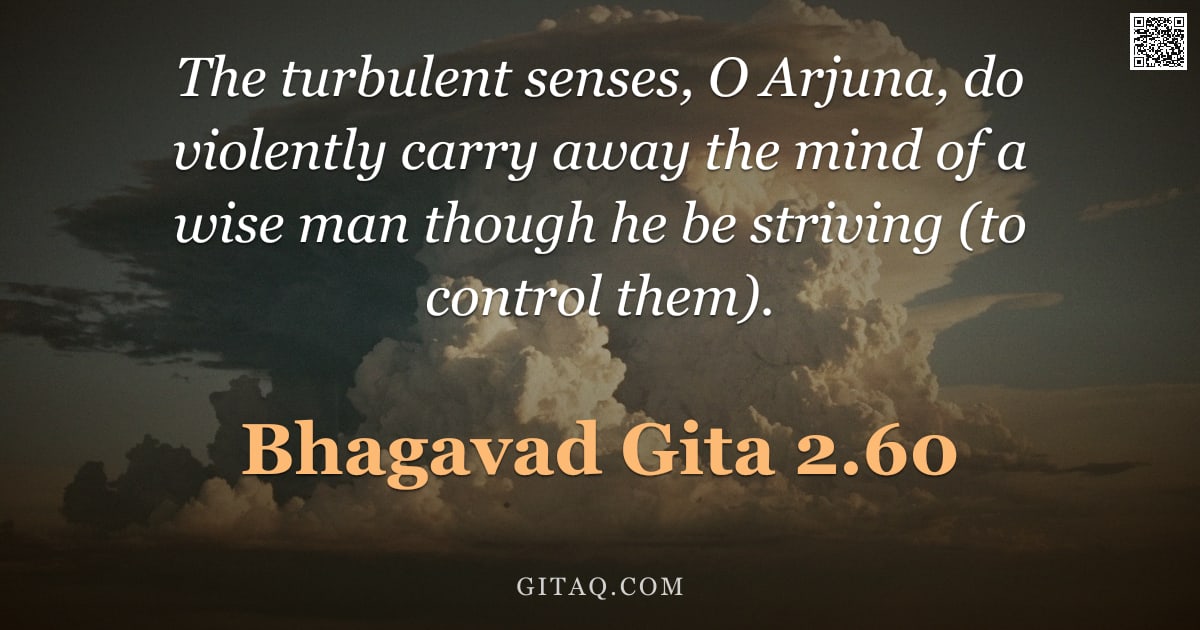
Lord Krishna speaks to Arjuna, a wise warrior who is currently struggling with emotional turmoil on the battlefield of Kurukshetra. He explains that even for an intelligent person striving hard to control their mind and senses, powerful desires can still violently drag the mind away from its focus. The key teaching is that controlling the senses requires constant vigilance because they are naturally turbulent and often overpower our intentions.
The Teaching Behind It
This verse belongs to the framework of Sankhya Yoga (Transcendental Knowledge) which lays the foundation for Karma Yoga. It develops the concept that intellectual knowledge alone is insufficient without mastering the senses, as the sensory organs are inherently restless and must be tamed through disciplined action.
Word by Word
Classical Commentary
Where This Happens
This verse occurs in Chapter 2 of the Bhagavad Gita, set on the battlefield of Kurukshetra during the great Mahabharata war. Krishna is speaking to Arjuna, who has just fallen into a state of deep confusion and grief, refusing to fight his own relatives despite knowing his duty as a warrior. After explaining that the soul is eternal in verses 1-29, Krishna now addresses the practical difficulty Arjuna faces: even with knowledge (jnana), the mind remains easily distracted by sensory impulses.
Living It Out Today
Consider a professional trying to stick to their career goals while facing constant distractions like social media notifications or office gossip. Even though they are knowledgeable and intend to focus, these external 'senses' can violently pull their attention away at critical moments of decision-making. The lesson is not that distraction means failure, but that one must recognize this natural tendency and actively re-anchor the mind through disciplined practice rather than expecting instant perfection.
Explained for Children
Imagine you are trying really hard to finish your homework before watching TV, but a loud toy keeps buzzing nearby. Even though you know you should be studying, the noise pulls your attention away so strongly that you forget what you were doing. Krishna tells Arjuna that sometimes our feelings and senses act like those noisy toys—they can take over even when we are trying to do something good.
Daily Reflection
You might feel discouraged today if your mind wanders despite your best efforts at discipline; please know you are in good company with Arjuna and even the wise. The struggle itself proves your sincerity, for a truly indifferent person would never try to control their senses in the first place. Trust that this friction is not failure but the very fire where your resolve is being forged.
A Practice for Today
Sit with your breath and acknowledge that even when you strive for peace, the senses may still pull your attention outward like a rushing river. Instead of fighting this turbulence harshly, gently return to your intention, recognizing that wisdom is not the absence of disturbance but the steady presence amidst it.
Key Teachings
- The Inevitability of Sensory Turbulence
Even a person of great wisdom and discrimination cannot instantly stop their senses from becoming agitated. The verse teaches that the sheer force (prasabham) of sensory attraction can violently carry away the mind, regardless of one's intellectual understanding. - The Paradox of Effort
Arjuna is told he must strive (yatato), yet even that striving does not guarantee immediate immunity from distraction. This highlights that spiritual maturity involves persistent effort, acknowledging the gap between knowing what to do and fully embodying it. - The Nature of True Wisdom
Wisdom (vipascita) is defined here by one's recognition of this struggle rather than a state of perfect stillness. A wise man does not deny the pull of the senses but engages in the conscious battle to regain control through continued practice.
Themes
Related Verses
Read This Next
- 2.47 — To understand that while you must act and control your senses (as in 2.60), you should not be attached to the results of that effort.
- 3.30 — To learn how offering all actions, including the struggle for self-control, to the Divine transforms personal duty into spiritual practice.
- 12.15 — To see the fruit of mastering these senses in a devotee who is dear to Krishna because they are free from agitation and desire.
Recommended Reading
GitaQ earns from qualifying purchases as an Amazon Associate.