Bhagavad Gita 2.52
Sankhya Yoga · English Translation
यदा ते मोहकलिलं बुद्धिर्व्यतितरिष्यति | तदा गन्तासि निर्वेदं श्रोतव्यस्य श्रुतस्य च ||२-५२||
yadā te mohakalilaṃ buddhirvyatitariṣyati . tadā gantāsi nirvedaṃ śrotavyasya śrutasya ca ||2-52||
What Does This Verse Mean?
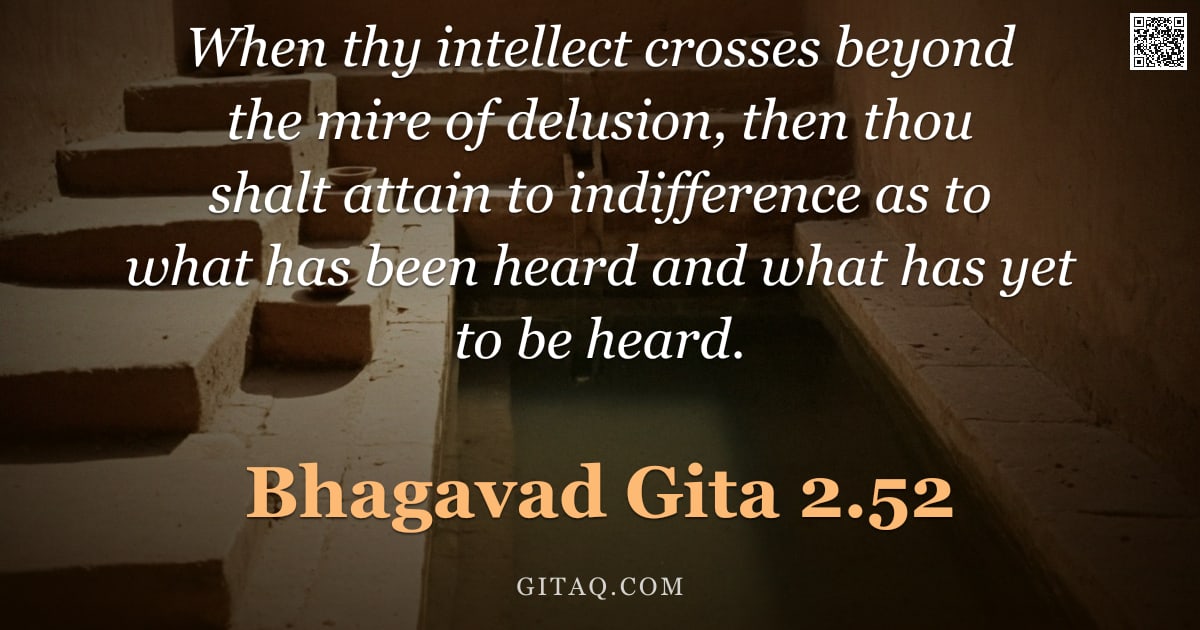
In this verse, Lord Krishna tells Arjuna that once his intellect rises above the confusion and delusion clouding his mind, he will reach a state of complete detachment from all worldly knowledge and experiences. This 'indifference' is not apathy or ignorance, but rather a deep realization that no external information—whether already learned or yet to be discovered—is necessary for true peace. The key teaching is that the ultimate goal is inner clarity achieved through self-realization, which renders the constant seeking of more books or lectures unnecessary.
The Teaching Behind It
This verse is a cornerstone of Jnana Yoga (the path of knowledge) within the broader framework of Sankhya philosophy presented in Chapter 2. It describes the state of 'Nirveda' or dispassion, where the seeker realizes that intellectual accumulation cannot replace direct spiritual realization and self-knowledge.
Word by Word
Classical Commentary
Where This Happens
This verse occurs on the battlefield of Kurukshetra within Chapter 2, known as 'Sankhya Yoga,' where Arjuna has just expressed his despair and refusal to fight due to attachment for his relatives. Lord Krishna is responding directly to Arjuna's confusion, having already explained the nature of the immortal soul (Atman) that cannot be killed. At this specific moment in the dialogue, Arjuna feels overwhelmed by moral conflict and emotional delusion, unable to distinguish between duty and sentiment.
Living It Out Today
Consider a professional who spends months obsessing over every possible news article, market analysis, or 'best practice' guide before making a single strategic decision. Once they develop true clarity of purpose (the crossing beyond the mire), that same person stops feeling anxious about missing out on another report and trusts their judgment to act immediately. They no longer feel compelled to consume more information because they have found an internal certainty that makes external noise irrelevant.
Explained for Children
Imagine you are trying to solve a really hard puzzle, but your brain feels foggy and you keep putting the wrong pieces in place; this is like being lost in 'mire' or mud. Lord Krishna says that once Arjuna's mind clears up and he sees exactly what needs to be done, he will feel calm and won't worry about learning more things from books anymore. It's like when a child finally learns how to ride a bike without training wheels; they don't need someone else to tell them the rules of balancing anymore because they just know it in their heart.
Daily Reflection
Have you ever found yourself exhausted by arguments about what you should know next? Krishna invites you to pause and find peace not in accumulating more knowledge, but in resting within the truth you already hold. When your intellect clears of confusion, even the most thrilling new teachings will lose their power to distract you from your inner stillness.
A Practice for Today
Sit quietly and observe where your mind clings to the need for validation through new information or past debates. Visualize this attachment as a heavy mist of confusion, then gently breathe into that space until clarity reveals what is truly essential.
Key Teachings
- The Mire of Delusion
Mental agitation often stems from a 'knot' of ignorance where we confuse what is temporary with what is eternal. Until this knot loosens, the mind remains trapped in endless cycles of doubt and desire for external validation. - The Crossing of Intellect
True wisdom arises when the intellect transcends mere information to discern the real from the unreal. This transition marks a shift from being driven by confusion to operating with steady, intuitive clarity. - Indifference to Words
Once established in this higher understanding, one becomes free from the compulsion to seek more words or proofs. The seeker no longer needs new doctrines because they have realized the Self is beyond all verbal descriptions.
Themes
Related Verses
Read This Next
- 2.47 — To understand how to act without attachment, which is the practical application of a clear intellect.
- 3.30 — To see how offering all actions to the Divine sustains that state of indifference and detachment in daily life.
- 12.15 — To learn about the qualities of a devotee who has attained such steadiness that they are dear to Krishna.
Recommended Reading
GitaQ earns from qualifying purchases as an Amazon Associate.