Bhagavad Gita 2.32
Sankhya Yoga · English Translation
यदृच्छया चोपपन्नं स्वर्गद्वारमपावृतम् | सुखिनः क्षत्रियाः पार्थ लभन्ते युद्धमीदृशम् ||२-३२||
yadṛcchayā copapannaṃ svargadvāramapāvṛtam . sukhinaḥ kṣatriyāḥ pārtha labhante yuddhamīdṛśam ||2-32||
What Does This Verse Mean?
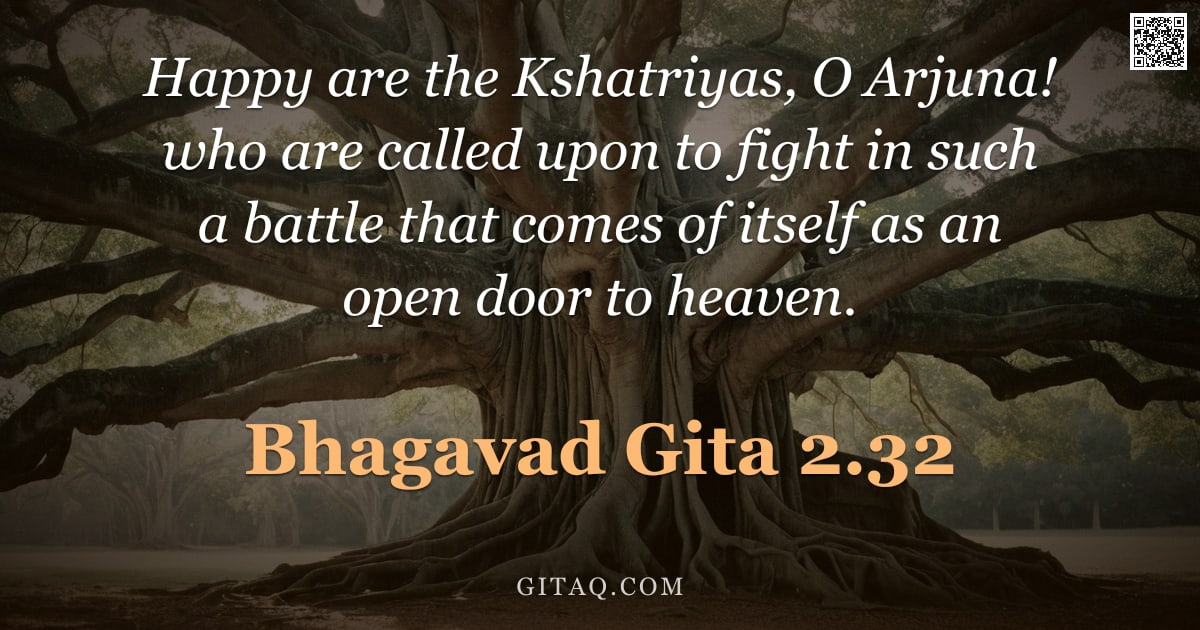
Lord Krishna tells Arjuna that for a warrior like him, this war is a rare opportunity rather than a tragedy because it opens the door to heaven directly. He explains that such battles arrive unexpectedly on their own, and fighting with righteousness in them brings true happiness and spiritual merit. The core teaching is that one should welcome difficult but righteous duties as sacred chances for growth instead of avoiding them out of fear or attachment.
The Teaching Behind It
This verse sits at the heart of Karma Yoga and Sankhya philosophy, emphasizing Nishkama Karma (action without desire for results) and the concept that righteous duty is its own reward. It develops the teaching that when one's specific role in life arises spontaneously ('yadṛcchayā'), performing it with a sense of devotion transforms an ordinary event into a spiritual gateway.
Word by Word
Classical Commentary
Where This Happens
This verse occurs on the battlefield of Kurukshetra during the Mahabharata war, where Lord Krishna has just finished explaining the eternal nature of the soul. He is speaking to Prince Arjuna, who had dropped his bow in despair and refused to fight against his own relatives. Just after Krishna dismantled Arjuna's emotional arguments with logic about death and duty, he uses this specific verse to shift Arjuna's perspective from seeing war as a loss of life to viewing it as a glorious spiritual opportunity.
Living It Out Today
Consider a manager who is terrified to make the difficult decision to lay off underperforming staff members because they fear being hated. Instead of avoiding the issue and letting the team fail, this verse teaches them that making the hard choice for the greater good of the company's survival is their 'dharma' or duty as a leader. By accepting this responsibility without personal attachment to the outcome, they can perform the action with clarity, knowing it opens a path to professional integrity rather than leading to regret.
Explained for Children
Imagine you are playing a very important game where the rules say you must help your team win, even if it's tough to play on a rainy day. If someone tells you that this specific moment is like an open door leading straight to a special prize just for being brave and doing what is right, wouldn't you feel happy instead of scared? Krishna is telling Arjuna the same thing: fighting fairly in a hard battle is not something sad; it's actually a lucky chance to do your best job.
Daily Reflection
You may feel hesitant when life presents difficult challenges, but consider how often these moments are actually gifts disguised as obstacles. Just as Arjuna was offered a rare chance for spiritual elevation through his specific duty, you too have unique responsibilities that, if met with courage, become pathways to your own inner peace and growth.
A Practice for Today
Close your eyes and visualize an opportunity for right action that has arrived unbidden, like a door suddenly opening before you. Instead of hesitating or fearing the consequences, breathe into the stillness that comes from knowing this moment is a sacred invitation to fulfill your duty.
Key Teachings
- The Unbidden Opportunity
Dharma often arrives not when we plan for it, but as an unexpected event 'yadṛcchayā' that tests our readiness. Recognizing these moments requires the clarity to see them not as threats, but as sacred openings. - The Warrior's Happiness
True happiness for a Kshatriya is found in acting according to their nature without attachment to personal gain or fear of loss. This verse redefines success from worldly victory to the spiritual fulfillment of righteous action. - Heaven as an Open Door
The battlefield here symbolizes a direct gateway 'svargadvāram' where one's actions determine their future state. Fighting for truth transforms ordinary conflict into a supreme act of devotion that leads to liberation.
Themes
Related Verses
Read This Next
- 2.47 — Read this next to understand how to act on such opportunities without attachment to the results.
- 3.30 — This verse expands on the practice of dedicating all actions and their fruits to the Divine, deepening your resolve.
- 12.15 — Discover how one who is not disturbed by others' reactions embodies the peace required for such high duty.
Recommended Reading
GitaQ earns from qualifying purchases as an Amazon Associate.