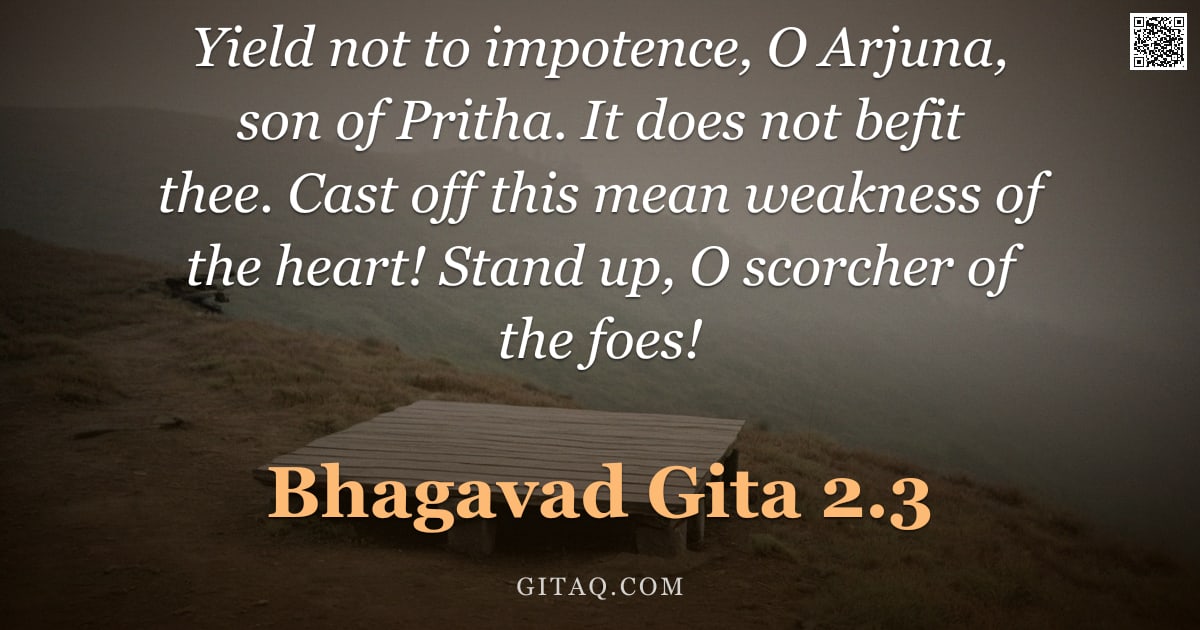
Bhagavad Gita 2.3
Sankhya Yoga · English Translation
क्लैब्यं मा स्म गमः पार्थ नैतत्त्वय्युपपद्यते | क्षुद्रं हृदयदौर्बल्यं त्यक्त्वोत्तिष्ठ परन्तप ||२-३||
klaibyaṃ mā sma gamaḥ pārtha naitattvayyupapadyate . kṣudraṃ hṛdayadaurbalyaṃ tyaktvottiṣṭha parantapa ||2-3||
What Does This Verse Mean?
In this verse, Lord Krishna speaks to Arjuna, who has fallen into a state of despair and is refusing to fight his own relatives. Krishna gently rebukes him for yielding to weakness and cowardice, reminding him that such behavior does not befit a noble warrior or a leader. The core teaching is an urgent call to abandon temporary emotional fragility and stand firm in one's duty with courage.
The Teaching Behind It
This verse belongs primarily to the teachings of Karma Yoga (the yoga of action) while introducing foundational concepts of Sankhya philosophy regarding the true nature of the self. It emphasizes that spiritual progress requires overcoming mental inertia and emotional attachment through right action rather than withdrawal or avoidance, establishing that duty must be performed with a steady mind.
Word by Word
Where This Happens
This verse occurs at the very beginning of Chapter 2 on the battlefield of Kurukshetra, immediately after Arjuna drops his bow in a fit of grief over fighting his cousins. Having just declared he would not fight and sat down to die rather than commit sin, Arjuna is overwhelmed by attachment and moral confusion. Lord Krishna addresses him directly as 'Partha' (son of Pritha) and the fierce warrior who scorches foes ('parantapa'), challenging this sudden collapse in character before offering deeper spiritual wisdom.
Living It Out Today
Consider a professional leader facing a critical, high-stakes decision to restructure their team or cut losses on a failing project. They might hesitate due to fear of conflict, guilt over hurting people's feelings, or anxiety about the unknown outcome. This verse advises them to recognize this hesitation as 'heart-weakness' rather than moral failure and instead summon the courage to make the necessary decision for the greater good, standing firm in their responsibility.
Explained for Children
Imagine you are playing your favorite game and suddenly feel too scared to move because the other team looks strong, so you just want to quit and hide under the table. That moment of wanting to give up is like a heavy blanket that makes it hard for you to play well. Krishna tells Arjuna not to let this fear stop him from being brave; instead, he should take off that 'fear-blanket' and stand tall again because everyone expects great players to keep going even when things get tough.
Daily Reflection
Arjuna's moment of paralysis reminds us that weakness is often just a temporary cloud over our inner strength, not who we truly are. When you feel the urge to retreat from a difficult conversation or task, remember that this 'mean weakness' only exists because it has been invited in by your own hesitation. By casting off that doubt and standing up as an active participant in life's duties, you reclaim the dignity of your true self.
A Practice for Today
Sit with your breath and notice where you are currently yielding to 'impotence' or avoiding a necessary challenge due to fear of failure. Take a moment to silently affirm that this hesitation does not reflect your true nature, then gently resolve to stand up in the face of even one small difficulty today.
Key Teachings
- The Nature of True Strength
Krishna defines strength not by physical power but by the refusal to yield to mental impotence or cowardice. He identifies this yielding as 'unbecoming' for a warrior, suggesting that our inherent nature is always capable of courage. - The Danger of Mean Weakness
What begins as small hesitation can grow into a debilitating state where the heart becomes soft and easily broken. Krishna urges us to recognize this 'mean weakness' immediately so it does not take root in our character. - The Call to Action
Knowledge of duty is incomplete without the resolve to act upon it, which requires rising up despite fear or difficulty. The verse commands us to stand firm as 'scorcher of foes,' symbolizing an active engagement with life's challenges rather than passive avoidance.
Themes
Related Verses
Read This Next
- 2.47 — This verse expands on standing firm by teaching how to act without attachment to results, which cures the fear that causes weakness.
- 3.30 — Following this call to action, Krishna instructs Arjuna to dedicate all actions to Him as a practical method for sustaining courage.
- 12.15 — To understand the character of one who has truly cast off weakness and stands firm in devotion, this verse describes their qualities.
Recommended Reading
GitaQ earns from qualifying purchases as an Amazon Associate.