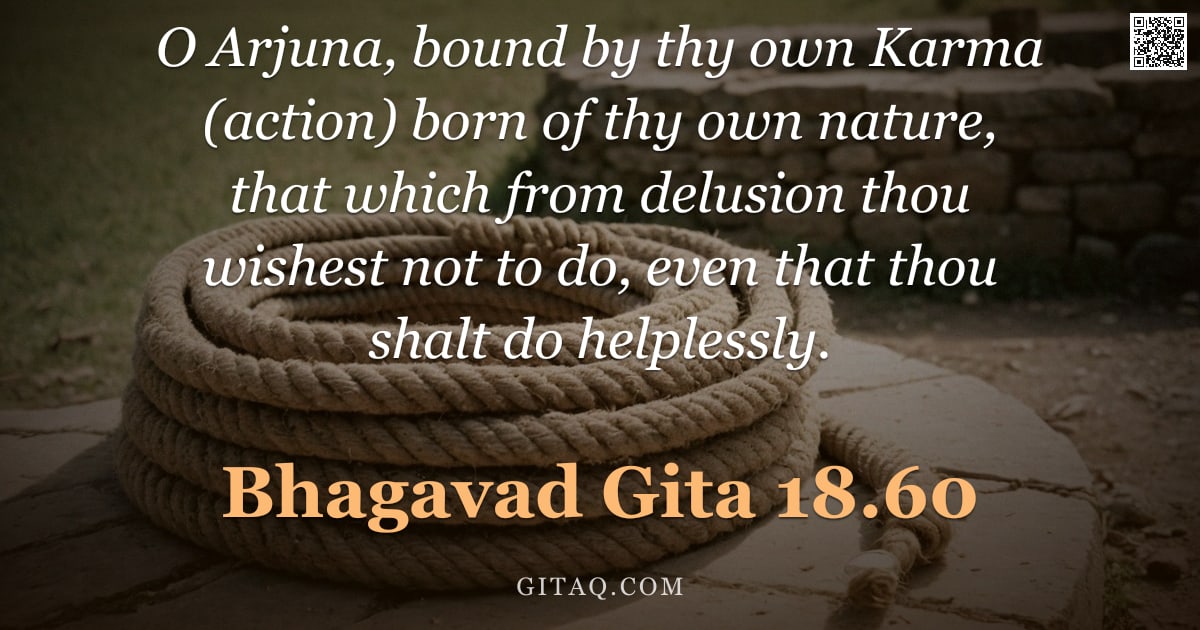
Bhagavad Gita 18.60
Moksha Sanyasa Yoga · English Translation
स्वभावजेन कौन्तेय निबद्धः स्वेन कर्मणा | कर्तुं नेच्छसि यन्मोहात्करिष्यस्यवशोपि तत् ||१८-६०||
svabhāvajena kaunteya nibaddhaḥ svena karmaṇā . kartuṃ necchasi yanmohātkariṣyasyavaśopi tat ||18-60||
What Does This Verse Mean?
In this verse, Lord Krishna tells Arjuna that everyone is bound to act according to their own nature and past actions, even if they do not want to at the moment. It explains that our current behavior is often driven by deep-seated habits and desires created by 'delusion' or ignorance of our true self. The key teaching is that we cannot simply wish away these compulsions; until we understand them, we will act helplessly according to our nature.
The Teaching Behind It
This teaching sits firmly within the framework of Karma Yoga and Sankhya philosophy, focusing on the interplay between Prakriti (nature) and Purusha (the self). It develops the concept that human behavior is driven by the three Gunas (modes of material nature), which bind individuals to action until spiritual knowledge breaks this cycle.
Word by Word
Classical Commentary
Where This Happens
This occurs on the battlefield of Kurukshetra, where Arjuna has just laid down his bow and refused to fight due to overwhelming grief and confusion over killing his relatives. Krishna is gently but firmly challenging this refusal by explaining that it stems from 'moha' (delusion) rather than true wisdom or duty. The speaker is the Supreme Lord guiding a warrior who feels paralyzed, setting the stage for the final instruction on surrender.
Living It Out Today
Consider a professional manager who knows deep down they must fire an underperforming employee to save their team's morale but keeps delaying it out of fear of conflict and personal guilt. Despite repeatedly promising themselves 'I will do this today,' anxiety creates a mental block that makes them avoid the conversation, eventually forcing a crisis situation where they are cornered into acting without preparation. This verse highlights how our natural tendency to avoid pain can force us to act later in ways we least desire.
Explained for Children
Imagine you have a very strong habit of wanting to eat candy before dinner, even though your mom told you not to because she wants you healthy. Even if you say 'No!' in the beginning, that craving is so powerful inside you that you end up eating it anyway without meaning to. This verse teaches us that our bad habits or fears are like a strong magnet pulling us toward actions we don't really want to do until we learn how to change them.
Daily Reflection
You may feel frustrated when you find yourself doing things you know are wrong or avoiding what is right, yet this verse reveals that such actions stem from deep-seated habits of your own nature. This isn't a condemnation but an invitation to see clearly how past actions have shaped your present tendencies. By understanding the mechanics of karma and nature, you can begin to loosen their grip with patience rather than self-judgment.
A Practice for Today
Sit quietly and observe the subtle pull of your own habits that drive you to act against your better judgment, recognizing this not as failure but as the binding force of past impressions. Acknowledge with compassion how nature has set these patterns in motion, creating a space where you can witness the compulsion without immediately identifying with it.
Key Teachings
- The Power of Samskaras
Every action leaves an impression that shapes our future inclinations, creating a cycle where we are compelled by past habits. This verse explains why knowing the right path is often not enough to walk it without conscious effort. - The Illusion of Free Will
We often believe we can simply choose against our nature, yet delusion clouds our will until deeper transformation occurs. True freedom comes only when one transcends the automatic responses dictated by past karma and inherent nature. - The Path to Liberation
Recognizing this involuntary bondage is the first step toward breaking free from it through spiritual discipline. By aligning our actions with divine will rather than selfish desire, we gradually dissolve these binding patterns of action and nature.
Themes
Related Verses
Read This Next
- 2.47 — Read this to understand how to act without attachment, which loosens the grip of binding karma described in verse 60.
- 3.30 — This verse offers the method of surrendering actions to the Divine as a practical countermeasure against being driven by delusion and nature.
- 12.15 — Reflect on this quality of the devotee who is free from agitation, representing the state one moves toward after mastering their own nature.
Recommended Reading
GitaQ earns from qualifying purchases as an Amazon Associate.