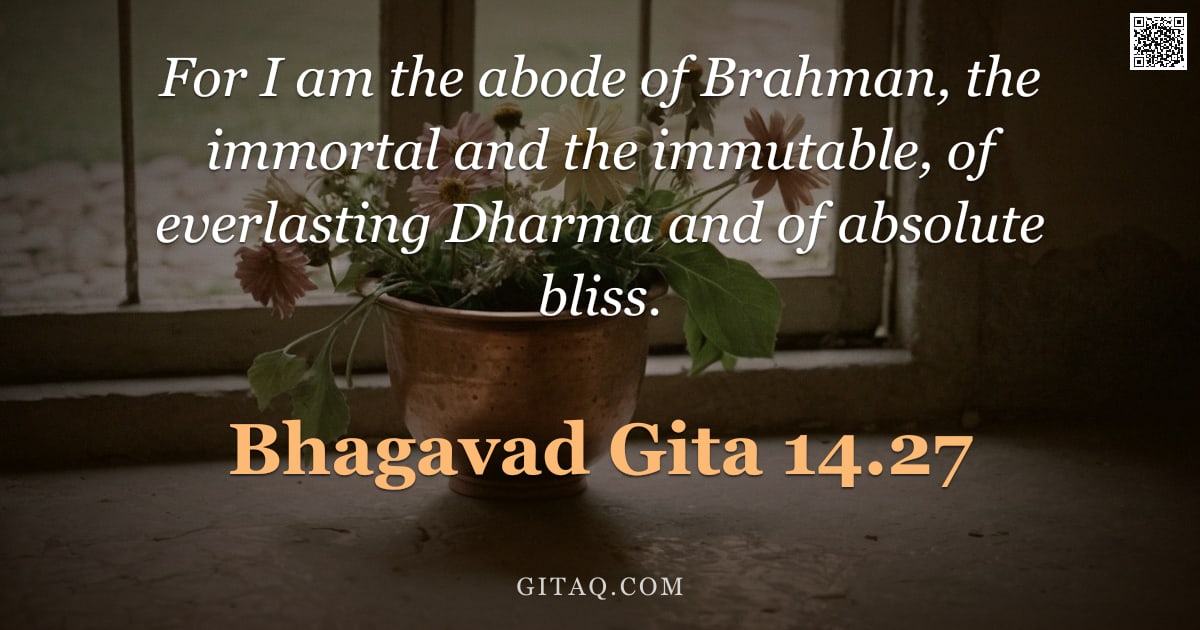
Bhagavad Gita 14.27
Gunatraya Vibhaga Yoga · English Translation
ब्रह्मणो हि प्रतिष्ठाहममृतस्याव्ययस्य च | शाश्वतस्य च धर्मस्य सुखस्यैकान्तिकस्य च ||१४-२७||
brahmaṇo hi pratiṣṭhāhamamṛtasyāvyayasya ca . śāśvatasya ca dharmasya sukhasyaikāntikasya ca ||14-27||
What Does This Verse Mean?
In this verse, Lord Krishna reveals to Arjuna that He is the foundational support for everything eternal and blissful. Just as a mountain stands on solid rock, all existence rests upon Him because He is the source of Brahman (the ultimate reality). This teaching assures us that by connecting with the divine nature within, one accesses immortality, unchanging truth, righteous living, and lasting happiness.
The Teaching Behind It
This verse synthesizes the themes of Bhakti Yoga and Jnana (Knowledge) Yoga by establishing the personal God as the impersonal Absolute. It develops the concept of *Pratishtha* (abode), teaching that while Brahman is formless, it finds its complete manifestation in the Divine Person who sustains all existence.
Word by Word
Classical Commentary
Where This Happens
This declaration comes at the culmination of Chapter 14 on a battlefield where Arjuna has just heard an exhaustive explanation about how to transcend the three modes of nature (goodness, passion, and ignorance). Krishna is speaking as the Supreme Personality of Godhead to his devoted friend and warrior student. At this moment, after resolving Arjuna's confusion about spiritual hierarchy, Krishna shifts from explaining cosmic mechanics to revealing His own divine identity as the ultimate anchor of reality.
Living It Out Today
When facing a career crisis where all your plans seem to be failing due to external market forces or office politics, remember that you are not defined by these temporary fluctuations. Instead of reacting with panic, ground yourself in the understanding that your inner worth and peace (the 'immutable' aspect) come from a source deeper than any job title. By focusing on doing your work with integrity rather than obsessing over outcomes, you access an unshakeable stability that allows you to make clear decisions even during chaos.
Explained for Children
Imagine you are building a tall tower out of blocks. The very bottom block has to be strong and steady so the whole tower doesn't fall. In this verse, Krishna says He is that super-strong bottom block for everything in the universe! Just like the ground supports trees and buildings, Krishna supports all good things forever, making sure they never break or end.
Daily Reflection
Today, you may feel pulled by the shifting moods of joy or sadness, just like leaves on a tree; yet remember that you are not the leaf, but the deep soil from which it grows. The Gita invites you to rest in this certainty: your essence is already whole, immune to decay, and rooted in eternal peace. When anxiety arises, return to this truth—that you are the abode of immortality itself.
A Practice for Today
Sit quietly and visualize yourself not as the changing shadow, but as the unchanging ground upon which all shadows fall. Silently affirm that your true nature is this same immortal foundation of bliss where no sorrow can take root.
Key Teachings
- The Foundation Beyond Form
Krishna reveals that even the formless Absolute (Brahman) rests upon His own divine nature, making Him the ultimate source rather than a distant goal. This teaching shifts our quest from seeking something outside to recognizing the support within. - The Nature of Immortality
By identifying as 'amṛtasya avyayasya', He defines immortality not merely as endless time, but as a quality that cannot be diminished or altered by the modes of nature. True life is defined by this unshakeable stability amidst all change. - Dharma and Bliss are Intrinsic
Eternal Dharma and supreme bliss are not rewards earned through effort, but inherent characteristics of one's true Self once the egoic veil is lifted. To realize this nature is to step into a state where duty becomes effortless joy.
Themes
Related Verses
Read This Next
- 2.47 — This verse introduces the concept of detachment (Karma Yoga) which is necessary before one can realize they are beyond the modes.
- 3.30 — It reinforces surrendering actions to the Divine, a practical step toward stabilizing oneself in that immortal nature described here.
- 12.15 — This verse describes the qualities of one who is established in this same state of being steady and free from distress, serving as the human embodiment of Krishna's description.
Recommended Reading
GitaQ earns from qualifying purchases as an Amazon Associate.