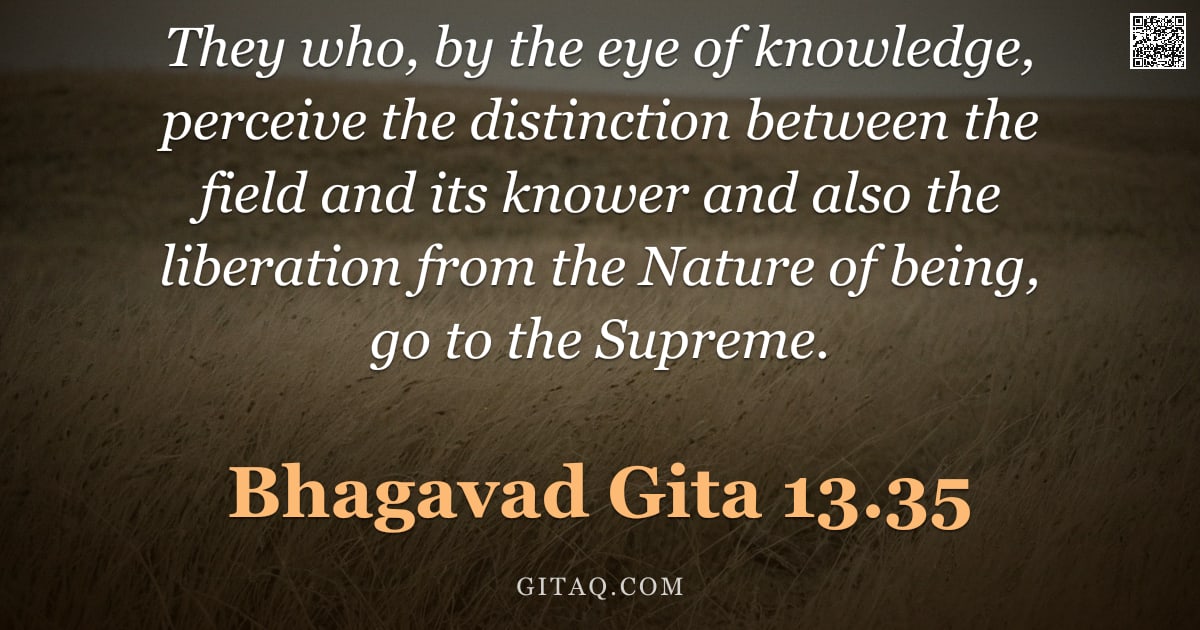
Bhagavad Gita 13.35
Kshetra Kshetrajna Vibhaga Yoga · English Translation
क्षेत्रक्षेत्रज्ञयोरेवमन्तरं ज्ञानचक्षुषा | भूतप्रकृतिमोक्षं च ये विदुर्यान्ति ते परम् ||१३-३५||
kṣetrakṣetrajñayorevamantaraṃ jñānacakṣuṣā . bhūtaprakṛtimokṣaṃ ca ye viduryānti te param ||13-35||
What Does This Verse Mean?
In this verse, Lord Krishna concludes his detailed teaching to Arjuna by summarizing the path to liberation. He explains that true wisdom involves using the 'eye of knowledge' to clearly distinguish between the physical body (the field) and the conscious soul within it (the knower). When one realizes they are not the changing nature but distinct from it, they achieve freedom from material bondage and attain the Supreme reality.
The Teaching Behind It
This verse belongs primarily to Jnana Yoga, the path of knowledge, which relies on discriminative wisdom to separate the seer from the seen. It builds upon Sankhya philosophy's dualistic framework of Purusha (consciousness) and Prakriti (matter), asserting that liberation comes not through action or emotion alone, but through this precise intellectual realization.
Word by Word
Classical Commentary
Where This Happens
This verse appears at the climax of Chapter 13 in the Bhagavad Gita, set on the battlefield of Kurukshetra just before the great war begins. Lord Krishna has been speaking to Arjuna about the subtle distinctions between matter (Prakriti) and spirit (Purusha). Arjuna is listening intently as Krishna wraps up his philosophical discourse with a promise that this specific insight leads directly to spiritual liberation.
Living It Out Today
When you face intense anxiety at work or during a family crisis, pause to ask yourself: 'Is the stress happening to my true self, or am I just identifying too closely with the situation?' By mentally separating your core consciousness from the changing emotions and external circumstances (the field), you stop reacting out of fear. This shift in perspective allows you to make clear decisions rather than being swept away by temporary chaos.
Explained for Children
Imagine you are wearing a special pair of glasses that helps you see exactly what is real inside your body. Krishna teaches us to use these 'glasses' to realize there is a big difference between our clothes (our bodies) and the person watching them from the inside (us). When we understand this, like taking off tight shoes after a long day, we feel free and happy forever.
Daily Reflection
Today, try to notice where your mind gets entangled in roles and reactions as if they were permanent truths. When a challenge arises, pause and ask yourself: 'Is this the field speaking through me, or is my true Self witnessing it?' By shifting from identification with the drama of nature to the stillness of awareness, you begin to taste the freedom that leads straight to the Supreme.
A Practice for Today
Close your eyes and gently distinguish between the changing body you inhabit—the 'field' of sensations—and the silent awareness that witnesses them, the 'knower.' Visualize this inner eye opening to see how liberation arises not from escaping life, but from realizing you are never truly bound by nature's play.
Key Teachings
- The Field and Its Knower
Krishna teaches us to clearly see the difference between the changing body-mind complex (the field) and the eternal consciousness witnessing it (the knower). True wisdom begins when we stop confusing our temporary experiences with who we actually are. - The Eye of Knowledge
This distinction is not grasped by physical sight or intellectual logic, but through a spiritual 'eye' born of direct realization. We must cultivate this inner vision to cut through the veil of illusion that binds us. - Liberation from Nature
The ultimate goal is freedom not just for action, but liberation from the very grip of material nature (Prakriti). Those who realize this truth transcend birth and death to attain the Supreme state.
Themes
Related Verses
Read This Next
- 2.47 — To understand how action without attachment flows naturally from knowing oneself as distinct from the results.
- 3.30 — To see the practical application of offering all actions to the Divine, rooted in this knowledge of the Knower.
- 12.15 — To explore how a person who has realized this distinction becomes dear to Krishna and embodies supreme devotion.
Recommended Reading
GitaQ earns from qualifying purchases as an Amazon Associate.