Bhagavad Gita 13.33
Kshetra Kshetrajna Vibhaga Yoga · English Translation
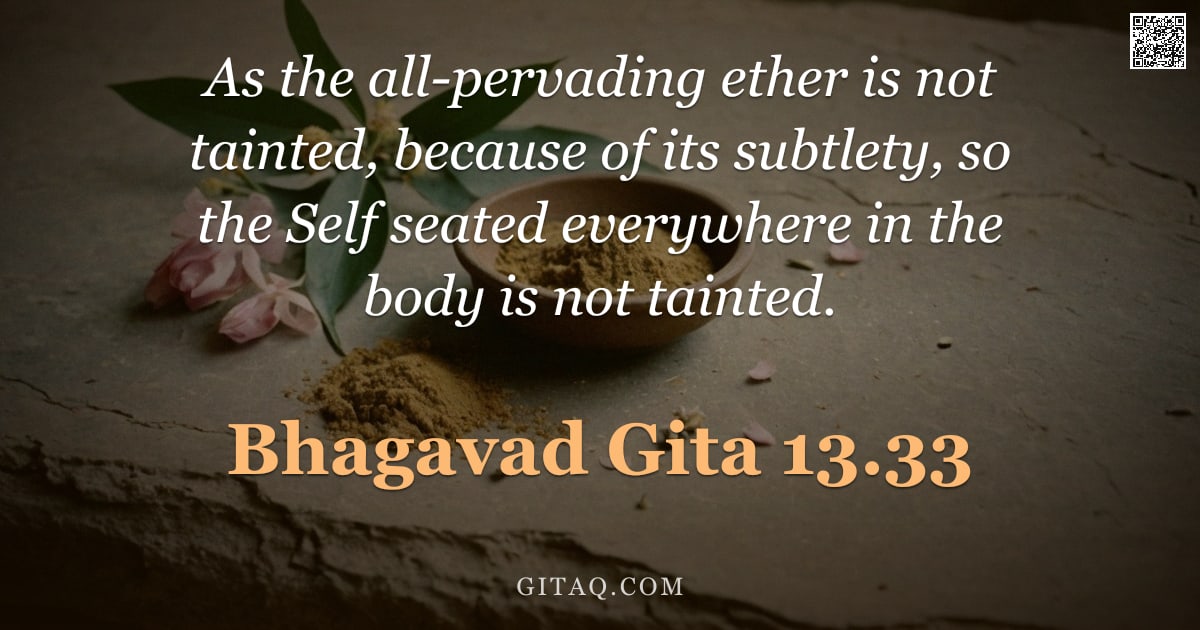
यथा सर्वगतं सौक्ष्म्यादाकाशं नोपलिप्यते | सर्वत्रावस्थितो देहे तथात्मा नोपलिप्यते ||१३-३३||
yathā sarvagataṃ saukṣmyādākāśaṃ nopalipyate . sarvatrāvasthito dehe tathātmā nopalipyate ||13-33||
What Does This Verse Mean?
In this verse, Lord Krishna is explaining to Arjuna how the true Self (Atman) remains untouched by worldly suffering or actions. He uses a powerful analogy: just as space fills every room but never gets stained even when dirt falls on it, the Soul resides in all bodies without absorbing their experiences of good or bad. The key teaching is that your core identity is pure consciousness and exists independently from the temporary physical body or its struggles.
The Teaching Behind It
This verse belongs primarily to Jnana Yoga (the path of knowledge) and the Sankhya philosophical framework, which distinguishes between matter and consciousness. It develops the concept of 'Purusha' (consciousness/Self) as distinct from 'Prakriti' (matter/body), illustrating that pure awareness cannot be altered by material interactions.
Word by Word
Classical Commentary
Where This Happens
This verse appears during the Bhagavad Gita's Chapter 13 on the battlefield of Kurukshetra, where Lord Krishna is instructing Prince Arjuna. At this specific moment in the conversation, they have just finished discussing how the body is merely a field and the soul is its distinct knower; Arjuna has been struggling to understand how he can fight his relatives without creating bad karma if there are two entities involved. The context addresses Arjuna's deep confusion about attachment versus detachment as he prepares for war.
Living It Out Today
When you face a stressful project deadline that feels like it is defining your worth, remember this verse: the pressure and potential failure belong to your body and mind, not your core identity. Just as dust settles on a window but doesn't change what the glass itself is made of, criticism or success are temporary events passing through your life. This perspective allows you to work with full focus and urgency while maintaining an inner calm that remains untouched by external chaos.
Explained for Children
Imagine you are wearing a muddy raincoat while playing outside. Even though mud gets on the coat, your skin underneath stays clean because it's protected by the fabric. This verse says something similar about our true selves: we have a wonderful inner self that lives inside us like space does everywhere in a room. Just as the air doesn't get dirty even if you drop dust into a clear glass of water and stir it up, your real spirit stays pure and happy no matter what happens around you.
Daily Reflection
You carry an inner stillness today just as deep sky carries clouds without becoming cloudy yourself, regardless of the storm outside. It is easy to feel stained by your mistakes or overwhelmed by daily chaos, yet remember that this pure awareness behind your eyes remains untouched and pristine. Allow yourself to rest in that subtle distance where you are not defined by what happens around you.
A Practice for Today
Close your eyes and imagine yourself as space, vast and invisible, filling the room without ever touching its walls or furniture. Visualize any heavy emotion or thought arising within you like a dust mote floating in that clear air; notice how it passes through you without leaving a stain.
Key Teachings
- The Nature of Subtlety
Just as ether pervades all things yet cannot be grasped or soiled due to its infinitesimal nature, the Self exists within every cell without being physically bound by them. This teaches that our true essence operates on a level too subtle for worldly conditions to affect. - The Witness State
You are not the body or the mind experiencing pleasure and pain, but the silent seat of consciousness witnessing these changes from within. Like space that holds everything without changing its own quality, you remain the unchanging observer. - Innocence of the Soul
No action performed in the world can ever truly defile or stain the eternal Self, just as dirt cannot soil the sky. This realization liberates you from guilt and shame by distinguishing your true identity from temporary behaviors.
Themes
Related Verses
Read This Next
- 2.47 — Follows the teaching on non-attachment by reminding you to act without fixation on results.
- 3.30 — Expands on surrendering all actions as an offering, deepening the understanding of a detached doer.
- 12.15 — Describes how such a pure and untroubled self is beloved to Krishna, connecting knowledge to devotion.
Recommended Reading
GitaQ earns from qualifying purchases as an Amazon Associate.