Bhagavad Gita 13.31
Kshetra Kshetrajna Vibhaga Yoga · English Translation
यदा भूतपृथग्भावमेकस्थमनुपश्यति | तत एव च विस्तारं ब्रह्म सम्पद्यते तदा ||१३-३१||
yadā bhūtapṛthagbhāvamekasthamanupaśyati . tata eva ca vistāraṃ brahma sampadyate tadā ||13-31||
What Does This Verse Mean?
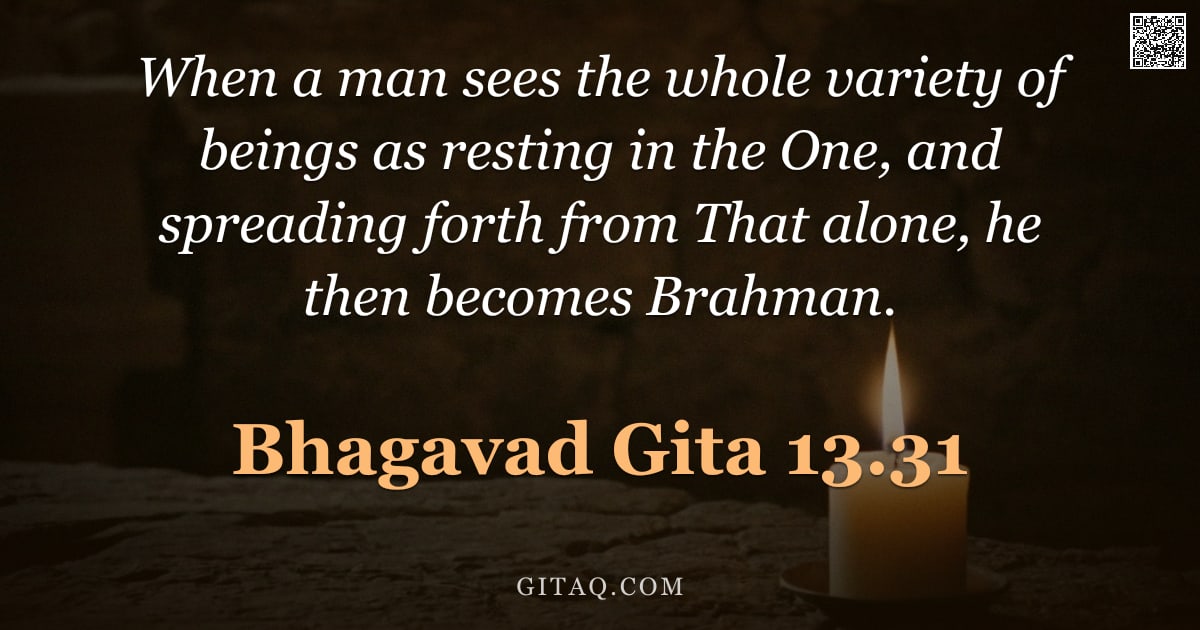
In this verse, Lord Krishna tells Arjuna that true spiritual realization occurs when one perceives all living beings as existing within a single Supreme Reality and recognizes their diversity as an emanation from That source alone. When the mind stops seeing separation and instead sees unity in everything, the individual soul merges with Brahman, or ultimate truth. This teaches that enlightenment is not about escaping the world but understanding its true nature behind the illusion of difference.
The Teaching Behind It
This verse is a cornerstone of Jnana Yoga (the path of knowledge) and Sankhya philosophy within the Gita, focusing on non-dualistic realization. It develops the concept that the perceived multiplicity of the universe is an illusion superimposed upon Brahman, and realizing this unity dissolves the sense of individual separation.
Word by Word
Classical Commentary
Where This Happens
This teaching occurs on the battlefield of Kurukshetra during a critical pause in the Mahabharata war, where Lord Krishna is guiding his friend and devotee Arjuna. Just prior to this verse, Krishna has been explaining the distinction between the physical body (the field) and the conscious soul that knows it (the knower). Arjuna, who was previously overwhelmed by grief and confusion about fighting his relatives, is now being shown how to transcend these emotional attachments through higher knowledge.
Living It Out Today
Imagine you are in a high-stress meeting where a colleague makes a mistake that threatens your project. Instead of reacting with anger or seeing them as an enemy causing the problem (the 'variety' of beings), you pause and realize their anxiety stems from fear, just like yours does, rooted in a shared human desire for success. By shifting your perspective to see this person's struggle within your own experience of pressure, you stop fighting against the situation and start collaborating with compassion. This shift transforms the conflict into an opportunity for joint problem-solving, relieving your personal stress.
Explained for Children
Imagine you are watching a giant movie screen where thousands of different characters appear—some are heroes, some are villains, and they all have different stories. But if you look closely enough, you realize that every single character is actually just made of light from one powerful projector behind the scenes. When you understand that everyone in your school or neighborhood is connected to that same source of love and life, you stop feeling alone or separate. That moment when you see everything as part of one big family is what it means to become truly wise.
Daily Reflection
Today, try to look at someone who feels very different from you and see if you can perceive the same divine light living in their eyes as yours. It is easy to get lost in our separate stories, but remember that every conflict or separation exists only because we have forgotten they are all spreading forth from the One source within us.
A Practice for Today
Close your eyes and gently shift your gaze from the individual forms around you to the singular consciousness that holds them all together. Rest your awareness on the feeling that every being, whether near or far, is simply a unique expression resting within one vast, silent presence.
Key Teachings
- Non-Dual Perception
The verse invites us to move beyond seeing separate entities and instead recognize a single reality underlying all diverse appearances. This shift in vision transforms our perception of difference into an awareness of unity. - Origin and Destination
True wisdom understands that beings are both resting within the One at this moment and emanating from That source alone. It is not just a static existence but a dynamic flow where everything originates in Brahman and returns to it. - Realization as Identity
The ultimate goal described here is not merely intellectual knowledge, but the direct experience of becoming Brahman. When one sees this unity without separation, their individual identity merges with that infinite wholeness.
Themes
Related Verses
Read This Next
- 2.47 — To understand how to act without attachment before seeking union with Brahman.
- 3.30 — To learn the practical method of dedicating all actions as an offering, preparing the mind for higher realization.
- 12.15 — To see how a person who has realized this unity behaves with compassion and equanimity toward others.
Recommended Reading
GitaQ earns from qualifying purchases as an Amazon Associate.