Bhagavad Gita 12.3
Bhakti Yoga · English Translation
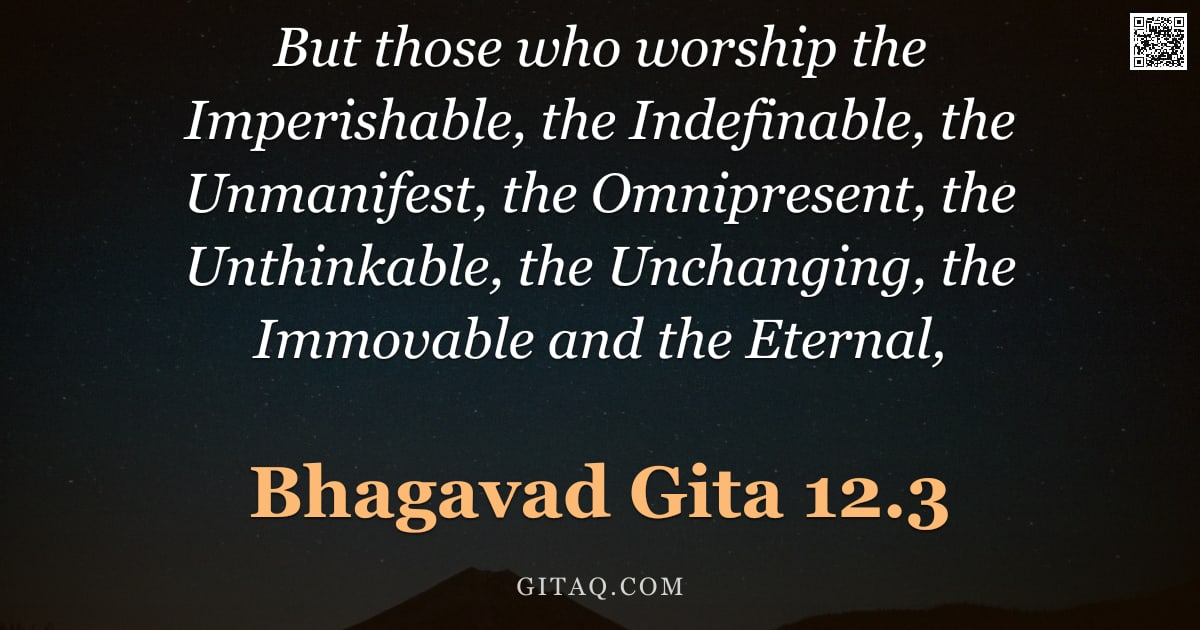
ये त्वक्षरमनिर्देश्यमव्यक्तं पर्युपासते | सर्वत्रगमचिन्त्यञ्च कूटस्थमचलन्ध्रुवम् ||१२-३||
ye tvakṣaramanirdeśyamavyaktaṃ paryupāsate . sarvatragamacintyañca kūṭasthamacalandhruvam ||12-3||
What Does This Verse Mean?
In this verse, Lord Krishna is speaking to Arjuna about the path of worshipping the Formless Divine, known as Brahman. He describes how some devotees choose to meditate on the unmanifested, all-pervading reality that has no beginning and cannot be moved or changed. While acknowledging this as a valid spiritual practice, the verse sets up a comparison with worshiping the Personal God in forms. The key teaching is understanding the distinct nature of the Formless Absolute as infinite consciousness.
The Teaching Behind It
This verse belongs to Bhakti Yoga but specifically addresses the path of 'Nirguna Brahman' (the Formless Absolute) worship within that framework. It develops the Sankhya concept of Purusha as immutable consciousness, contrasting it with Pradhana or material nature which is subject to change and transformation.
Word by Word
Where This Happens
This verse occurs during the Bhagavad Gita on the battlefield of Kurukshetra, where Arjuna has just asked Krishna which path is better: worshipping Him with form or meditating on His formless nature. At this moment in the Mahabharata narrative, Arjuna is seeking clarity after witnessing the terrifying vision of Vishvarupa (the universal form) and wants to know how his own mind should be trained for peace. Krishna has just described the qualities of those who worship Him with a personal image, and now he addresses the more abstract path taken by those whose minds are drawn to the infinite void.
Living It Out Today
Consider a professional facing an unexpected crisis at work where all plans have failed and there is no clear solution or 'face' to blame. Instead of fixating on specific details that cause anxiety, this teaching encourages shifting focus to a broader perspective: recognizing that uncertainty is a natural state of change itself, which remains steady beneath the chaos. By anchoring their mind in the stability of an unshakeable inner core rather than fighting every fluctuating circumstance, one can maintain clarity and calm during high-stress decision-making.
Explained for Children
Imagine you are trying to find your favorite toy. One way is to look for it inside specific boxes or bags; another way is to imagine that the whole room itself has turned into the toy everywhere at once, with no corners and no edges. This verse talks about people who choose to focus on that second idea: seeing God as a big, invisible energy that fills everything in the universe without ever changing its shape. It's like trying to hug the wind—you can feel it all around you, but you can't hold onto just one part of it.
Daily Reflection
Today, let us find peace not by trying to solve every mystery of existence, but by trusting the silent stability beneath all change. You may feel overwhelmed by the need for clarity or control, yet your true self remains untouched like a mountain peak that no storm can shake. Embrace this quiet confidence today; you do not need to see the whole path to know where it leads.
A Practice for Today
Close your eyes and gently release any need to define the infinite or grasp it with your mind, acknowledging that the Absolute is beyond words and forms. Rest your awareness as a still witness in this vast space of silence, knowing you are already anchored in the unchanging consciousness within.
Key Teachings
- The Limitations of Form
This verse introduces the challenging yet profound path of worshipping the formless, unmanifest reality that is beyond all names and descriptions. It suggests that while the divine can be perceived through forms, its ultimate nature as the indescribable 'Akshara' requires a surrender of mental concepts. - The Nature of Stability
Krishna describes this formless reality as immovable and unshakeable (acalandhruvam), standing firm amidst the flux of creation. This teaching invites us to align our inner selves with a consciousness that does not waver, regardless of external circumstances. - The Difficulty of Unmanifest Worship
Arjuna is gently reminded by Krishna in this context that worshiping the unmanifested requires immense discipline because it lacks tangible focal points for the senses. The mind struggles to comprehend what has no shape or location, making this a path reserved for those with unwavering focus. - The Omnipresence of Truth
By describing the Divine as 'sarvatragam' (all-pervading), the verse highlights that the unmanifest reality is present everywhere simultaneously. This teaching dissolves the separation between the seeker and the sought, revealing a unity where consciousness flows through all things without interruption. - The Eternal Witness
The term 'kutastham' refers to that which remains constant at its core while everything else changes around it. This point encourages us to identify with this eternal witness within, rather than the transient thoughts and emotions of the mind.
Themes
Related Verses
Read This Next
- 2.13 — Read this to understand how the 'unchanging' nature of the soul applies even through bodily change and aging.
- 8.4 — This verse explicitly defines Brahman as the unmanifest, providing a deeper scriptural definition for the concept in 12.3.
- 13.17 — Continue exploring the attributes of the Indestructible (Akshara) and its role as the witness within all beings.
Recommended Reading
GitaQ earns from qualifying purchases as an Amazon Associate.