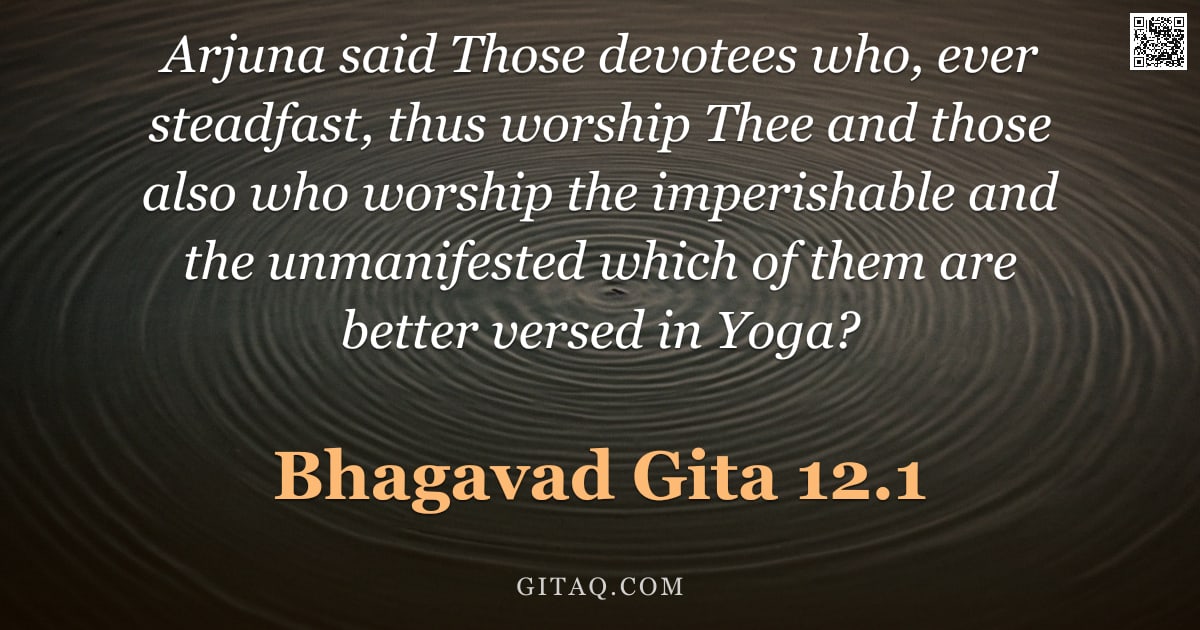
Bhagavad Gita 12.1
Bhakti Yoga · English Translation
अर्जुन उवाच | एवं सततयुक्ता ये भक्तास्त्वां पर्युपासते | ये चाप्यक्षरमव्यक्तं तेषां के योगवित्तमाः ||१२-१||
arjuna uvāca . evaṃ satatayuktā ye bhaktāstvāṃ paryupāsate . ye cāpyakṣaramavyaktaṃ teṣāṃ ke yogavittamāḥ ||12-1||
What Does This Verse Mean?
In this verse, Arjuna asks Lord Krishna a profound question about the best path to spiritual perfection while sitting on the battlefield of Kurukshetra. He contrasts two types of seekers: those who worship God in a personal form with unwavering devotion and those who focus their minds on the infinite, unmanifested absolute reality. By asking 'which of them is better versed in Yoga?', Arjuna seeks to understand if there are different levels of spiritual success or if one path is superior for achieving inner peace.
The Teaching Behind It
This verse sits at the heart of Bhakti Yoga and serves as a pivot point for comparing Devotion with Jnana Yoga. It develops the concept that while both worshipping the personal form of God (Saguna Brahman) and meditating on the impersonal, unmanifested reality (Nirguna Brahman) are valid spiritual disciplines, they represent different stages or approaches to realizing the Divine.
Word by Word
Classical Commentary
Where This Happens
This conversation occurs on the battlefield of Kurukshetra, where Prince Arjuna has just witnessed his relatives and teachers arrayed for war and fallen into despair. Following a long discourse by Krishna explaining the nature of the soul and duty (Chapter 2), Arjuna is now seeking clarity on how to practice Yoga in this difficult situation. Having heard about different spiritual paths, he realizes that while both devotion and meditation are valid, he needs guidance on which approach yields the most immediate stability for a warrior facing such intense emotional turmoil.
Living It Out Today
Consider a professional team leader who is overwhelmed by office politics and considering two coping strategies: constantly praying or meditating with gratitude (Bhakti) versus trying to detach completely from the outcome of their projects (Nirguna focus). This verse helps them realize that choosing the path that aligns best with their current emotional capacity—whether finding solace in a personal connection or trusting an abstract principle—is what truly matters. The key is not debating which method is theoretically superior, but committing wholeheartedly to one's chosen practice of steadiness (satata-yukta) amidst chaos.
Explained for Children
Imagine you have a friend named Krishna who loves talking about how special God is, and he tells two stories. In the first story, people love playing with pictures of their favorite hero every single day without stopping. In the second story, people sit very quietly thinking about something huge that they can't see or touch but know exists forever. Arjuna asks Krishna: Do you think the kids who play with the pictures learn to be good faster than the quiet thinkers? It is like asking if it is better to sing your favorite song all day or just listen carefully to silence.
Daily Reflection
You are standing at a beautiful crossroads where devotion meets deep inquiry, wondering if loving God with a face is better than worshipping an abstract truth without one. The answer lies not in choosing between them, but in realizing that your heart's sincerity transforms any path into the most perfect yoga for you today. Whether you find comfort in a prayer or stillness in silence, know that this steady effort itself is what makes you truly versed in the art of connection.
A Practice for Today
Sit quietly and visualize two paths converging within your heart: the direct love for the Divine presence before you, and the reverence for the unseen truth that holds all existence together. Ask yourself where your attention naturally rests today—does it find more peace in the form of a cherished name or the silence behind the stars?
Key Teachings
- The Equivalence of Forms
Arjuna's question highlights that both personal devotion (Saguna) and impersonal realization (Nirguna) are valid paths, though they appeal to different temperaments. The verse invites the seeker to understand that the intensity of faith matters more than the specific form chosen for worship. - The Primacy of Steadfastness
Krishna's response later in this chapter emphasizes that 'ever steadfast' (satatayuktā) devotees are supreme, suggesting consistency is more vital than the method. Whether one focuses on a deity or the unmanifested void, unwavering dedication is the true mark of spiritual maturity. - Yoga as Mastery through Love
The term 'yogavitamāḥ' implies that mastery in yoga comes from how deeply one surrenders their ego to a chosen ideal. This verse sets the stage for understanding that devotion is not just an emotion, but a disciplined practice of aligning the will with the Divine.
Themes
Related Verses
Read This Next
- 12.5 — To hear Krishna's direct answer comparing which path is easier and more natural for embodied beings to follow.
- 3.30 — To connect this verse with the concept of offering all actions to God, reinforcing the theme of steadfast dedication in daily life.
- 12.15 — To discover the specific character traits that define one as 'dear' in this path of devotion.
Recommended Reading
GitaQ earns from qualifying purchases as an Amazon Associate.