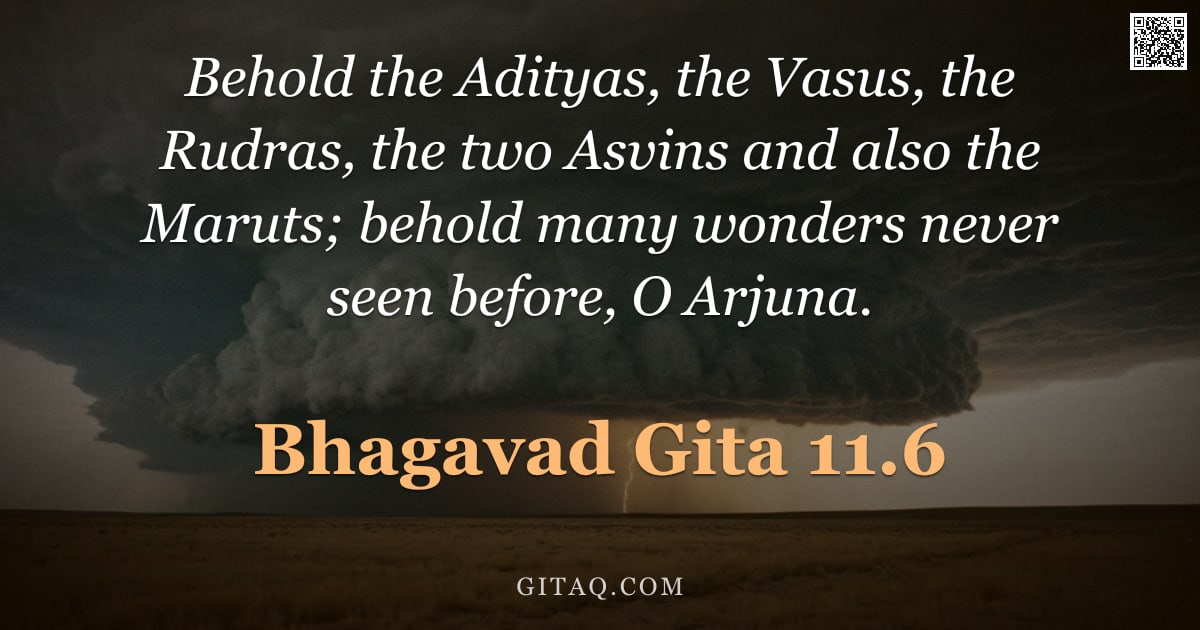
Bhagavad Gita 11.6
Vishvarupa Darshana Yoga · English Translation
पश्यादित्यान्वसून्रुद्रानश्विनौ मरुतस्तथा | बहून्यदृष्टपूर्वाणि पश्याश्चर्याणि भारत ||११-६||
paśyādityānvasūnrudrānaśvinau marutastathā . bahūnyadṛṣṭapūrvāṇi paśyāścaryāṇi bhārata ||11-6||
What Does This Verse Mean?
In this verse, Lord Krishna is inviting Arjuna to witness the incredible diversity of his Cosmic Form (Vishvarupa). He specifically points out various divine groups like the Adityas, Vasus, and Rudras, showing that within him reside all celestial beings. The key teaching is that what appears as separate gods or forces in the world are actually manifestations of one supreme reality. Krishna urges Arjuna to look beyond fear and see these wonders with an open heart.
The Teaching Behind It
This verse is central to the theme of Vishishtadvaita (qualified non-dualism) and Bhakti Yoga, illustrating that the diverse forms of deities are distinct yet inseparable expressions of the one Supreme Being. It develops the concept that the material world's multiplicity is a divine play (Lila), where many names and forms point to a single ultimate truth.
Word by Word
Classical Commentary
Where This Happens
This verse occurs during the climax of the Mahabharata on the battlefield of Kurukshetra, immediately after Krishna reveals his terrifying and magnificent Universal Form to Arjuna. Having just been overwhelmed by this vision containing all time past and future, the warrior prince is in a state of awe and trembling fear. Lord Krishna speaks gently here, shifting focus from the form's intensity to specific divine entities he contains, trying to ground Arjuna as his mind struggles to comprehend what it has seen.
Living It Out Today
When facing an overwhelming work crisis where every department seems separate or in conflict, remember this verse: look for the underlying unity and potential within each team member. Instead of seeing isolated problems (like distinct gods), recognize that they are all part of one larger organizational purpose you can help guide. Just as Krishna showed Arjuna many wonders hidden within a single form, your ability to see connections in chaos will turn anxiety into clarity.
Explained for Children
Imagine looking at a giant, magical kaleidoscope where every single piece you've ever seen fits together into one amazing picture. Lord Krishna is showing Arjuna that all the different gods and stars are like unique colors in this grand design, not separate things fighting each other. Just as you can find many toys inside one big toy box, all these divine powers live inside the universe itself. It's a reminder that everything beautiful and powerful we see comes from one amazing source.
Daily Reflection
Just as Arjuna was overwhelmed by a vision he had never witnessed before, your own life holds mysteries waiting for you to truly see them today. When we stop relying solely on our past experiences, the world reveals its endless capacity for surprise and grace. Take a moment to look at something familiar—your home, a friend's face, or nature—and ask what divine wonder lies hidden within it right now.
A Practice for Today
Close your eyes and invite the divine to show you not just what you expect, but the infinite wonders hidden within the present moment. Let go of the familiar patterns of perception and open yourself to seeing the extraordinary beauty in ordinary existence.
Key Teachings
- The Limit of Human Perception
Krishna invites Arjuna to see deities and wonders 'never seen before,' highlighting that our standard human vision is limited by habit. True spiritual growth requires the humility to acknowledge what we do not yet know or understand about the divine reality. - The Omnipresence of Divine Forms
By listing specific groups like Adityas, Vasus, and Rudras, the verse illustrates that the One Supreme Reality manifests in countless distinct forms. Every category of existence holds a unique aspect of the divine waiting to be recognized by the seeker. - The Call to Awe
The command 'Behold many wonders' is an invitation to cultivate a state of wonder rather than cynicism or routine. When we approach life with this sense of awe, even the most mundane moments become portals to the miraculous.
Themes
Related Verses
Read This Next
- 2.13 — This verse introduces the concept of the soul's changeless nature amidst changing forms, providing context for why Arjuna needs new vision.
- 12.4 — After seeing the cosmic form, this verse guides Arjuna back to a more accessible path of devotion for those who cannot sustain such high vision daily.
Recommended Reading
GitaQ earns from qualifying purchases as an Amazon Associate.