Bhagavad Gita 11.54
Vishvarupa Darshana Yoga · English Translation
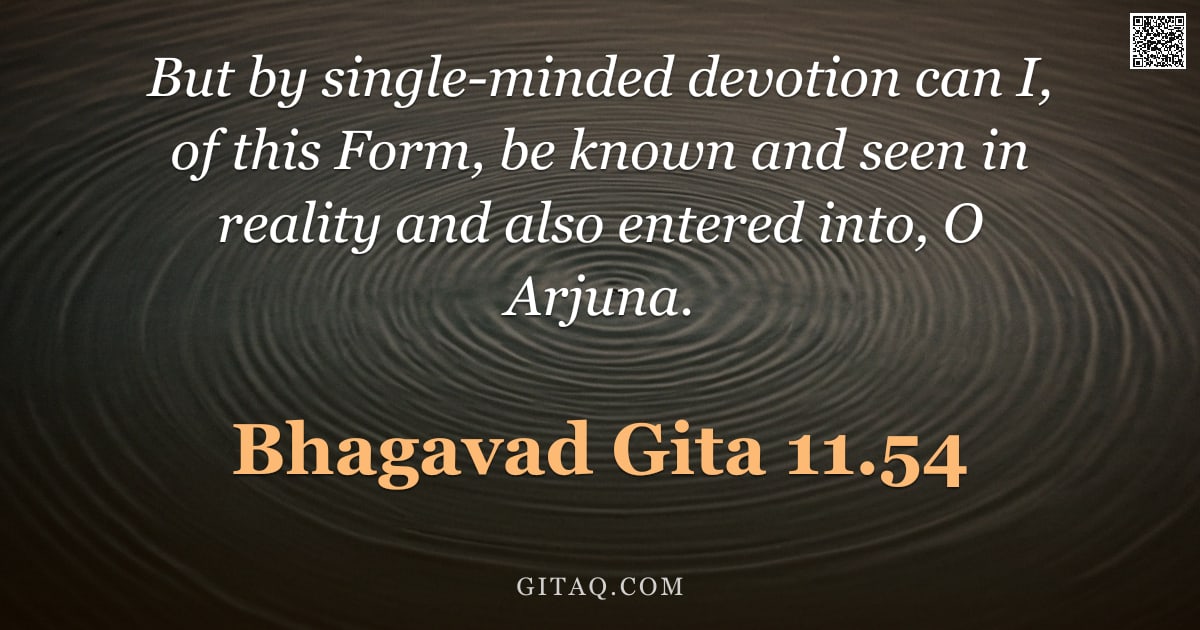
भक्त्या त्वनन्यया शक्य अहमेवंविधोऽर्जुन | ज्ञातुं द्रष्टुं च तत्त्वेन प्रवेष्टुं च परन्तप ||११-५४||
bhaktyā tvananyayā śakya ahamevaṃvidho.arjuna . jñātuṃ draṣṭuṃ ca tattvena praveṣṭuṃ ca parantapa ||11-54||
What Does This Verse Mean?
In this verse, Lord Krishna tells Arjuna that while his divine Cosmic Form is vast and difficult to perceive through ordinary means or intellectual study alone, it can be truly known, seen in reality, and even entered into solely through exclusive devotion. The key teaching here is that single-minded love (Bhakti) acts as the unique bridge between a finite human being and the infinite Divine. Krishna emphasizes that no amount of ritual sacrifice, philosophical knowledge, or severe austerity can achieve this union without the element of loving surrender.
The Teaching Behind It
This verse is the definitive conclusion of the Bhakti Yoga (path of devotion) strand within the Gita's teachings. It establishes that while Karma Yoga (action) purifies the mind and Jnana Yoga (knowledge) clarifies reality, only Bhakti provides the direct means to 'enter into' or merge with the Divine nature. The concept developed is that exclusive love transcends all other spiritual practices as the sole key to realizing God's true form.
Word by Word
Classical Commentary
Where This Happens
This verse occurs at the climax of Chapter 11 on the battlefield of Kurukshetra, immediately after Krishna reveals his terrifying yet magnificent Universal Form (Vishvarupa) that contains all past, present, and future. Arjuna is overwhelmed by fear and awe upon seeing this infinite vision filled with countless mouths, eyes, and weapons, causing him to plead for a return to the familiar human form of Krishna. Speaking from within this Cosmic display yet addressing his friend as 'Parantapa' (Scorcher of Foes), Krishna reassures Arjuna that while the visual spectacle was meant to prove His divinity, true communion requires a different path.
Living It Out Today
Consider a professional facing an impossible deadline or ethical dilemma where logic and past experience offer no solution; they feel trapped by the complexity of the situation. Instead of trying to 'figure it out' through sheer willpower (jnana) or performing rituals for success, this verse suggests surrendering the specific outcome with total trust in a higher purpose. By focusing single-mindedly on integrity and service rather than fear of failure, one finds clarity and enters into a state of flow where the solution reveals itself naturally.
Explained for Children
Imagine you have a super-distant star that is so bright it hurts to look at directly with your eyes; you might need special glasses just to see its light. Lord Krishna explains something similar about his cosmic form: it is too big and powerful for us to fully understand or reach on our own. However, if we use the 'special glasses' of pure love and trust in God—just like a child trusts their parent completely—we can finally see Him clearly and feel close enough to join hands with him.
Daily Reflection
You often feel like an outsider looking through a window, wondering if you can truly reach the Divine or understand its deepest reality. Krishna assures you today that the barrier is not distance but distraction; when you anchor your entire being in one-pointed love, the veil lifts completely. You are invited to move beyond just seeing Him with eyes and start living within His embrace.
A Practice for Today
Close your eyes and visualize Krishna not as a distant figure, but as the very essence of what you are seeking right now. Quietly repeat the intention: 'I offer my single-minded devotion to know You in truth.' Let this singular focus dissolve all distractions until your heart feels ready to enter into that divine presence.
Key Teachings
- The Power of Ekāgra Bhakti
Only a heart undivided by worldly desires can truly access the Infinite. This verse establishes that exclusive devotion is not just an emotion, but the essential methodology for spiritual realization. - Knowing vs. Seeing in Reality
Intellectual knowledge of God is distinct from seeing Him 'tattvena' or in His true essence as a living reality. Devotion transforms abstract understanding into an experiential, tangible union with the Divine. - Entering the Divine Form
The ultimate goal of bhakti is not merely observation but 'praveṣṭuṃ'—entering into and becoming one with the Cosmic Reality. This implies a total surrender where the devotee's identity merges with the will and presence of Krishna.
Themes
Related Verses
Read This Next
- 2.47 — Read this next to understand the foundational discipline of action without attachment that prepares the mind for such deep surrender.
- 3.30 — This verse complements 11.54 by instructing on offering all actions and thoughts exclusively to Krishna, a key aspect of single-minded devotion.
- 12.15 — Read this to see the qualities of a true devotee who embodies the very love that allows one to know God as described in 11.54.
Recommended Reading
GitaQ earns from qualifying purchases as an Amazon Associate.