Bhagavad Gita 11.48
Vishvarupa Darshana Yoga · English Translation
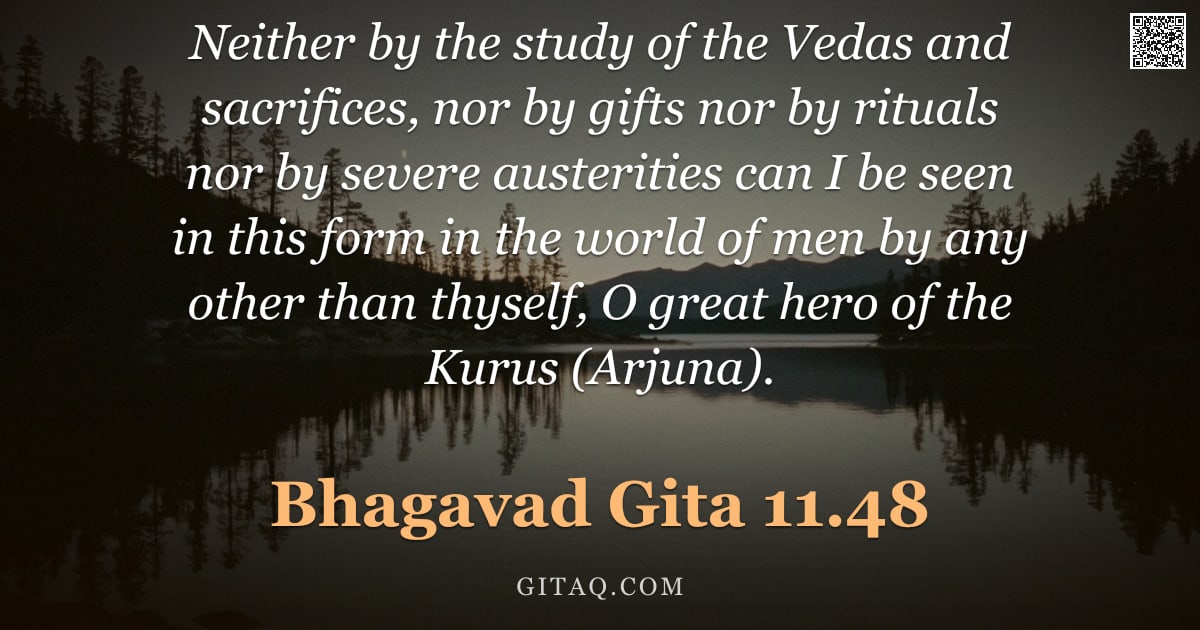
न वेदयज्ञाध्ययनैर्न दानैर्- न च क्रियाभिर्न तपोभिरुग्रैः | एवंरूपः शक्य अहं नृलोके द्रष्टुं त्वदन्येन कुरुप्रवीर ||११-४८||
na vedayajñādhyayanairna dānaira- na ca kriyābhirna tapobhirugraiḥ . evaṃrūpaḥ śakya ahaṃ nṛloke draṣṭuṃ tvadanyena kurupravīra ||11-48||
What Does This Verse Mean?
In this verse, Lord Krishna tells Arjuna that his terrifying and magnificent Cosmic Form cannot be perceived through standard religious practices like studying scriptures, performing sacrifices, giving charity, or doing severe austerities. He emphasizes that even the most dedicated humans have never seen him in this way except for Arjuna himself. The key teaching is that while these spiritual activities are valuable, they alone are insufficient to grant the direct vision of God's true nature without His divine grace and pure devotion.
The Teaching Behind It
This verse is central to Bhakti Yoga (the path of devotion), illustrating the concept that divine realization requires God's self-revelation rather than mere human effort. It clarifies the limitations of Karma Yoga (rituals and austerities) when undertaken without surrender, showing that while action purifies the mind, only grace grants direct knowledge of the Absolute.
Word by Word
Classical Commentary
Where This Happens
This verse occurs in Chapter 11 immediately after the terrifying revelation of Vishvarupa (the Cosmic Form), where Krishna displays his infinite, time-consuming form containing all beings. At that moment, Arjuna is overwhelmed with fear and awe, having just witnessed the universe's destruction within God's body. Speaking to a shaken but devoted warrior, Lord Krishna explains why this specific vision was granted only to him, acknowledging the intensity of their personal bond amidst the impending war at Kurukshetra.
Living It Out Today
Consider a professional team trying to solve an impossible crisis where all standard protocols and hard work have failed. The lesson here is that persistence alone isn't always enough; sometimes, we must surrender our ego and seek guidance from a higher perspective or wisdom beyond our own calculations. Just as Arjuna could not see the Cosmic Form through effort but only through grace, recognizing when to pause, let go of control, and trust in something greater can resolve situations that logic cannot fix.
Explained for Children
Imagine you want to see your best friend who has put on a very special superhero costume; no matter how many times you try looking in mirrors or do hard exercises, you still can't see them until they decide to take the mask off for you. Krishna is saying that trying really hard with good deeds and studying books isn't enough to see his cosmic form, just like practicing alone won't reveal a hidden friend. The only way Arjuna got to see this amazing vision was because Krishna chose him out of love and friendship.
Daily Reflection
You may feel overwhelmed by the vastness of your spiritual journey or the complexity of the universe you seek to understand. Today, remember that even the most dedicated study and severe discipline are insufficient without Divine will; it is a unique relationship with God that unlocks this vision for Arjuna alone. Let go of the pressure to 'earn' this realization through force, and instead rest in the quiet confidence that your sincere heart makes you ready to receive what cannot be forced.
A Practice for Today
Sit quietly and acknowledge that your own efforts, no matter how rigorous or scholarly, are not the final key to seeing the Divine's infinite nature. Offer a moment of surrender today, trusting that grace reveals what human striving alone cannot achieve.
Key Teachings
- The Limits of Ritual
Krishna clarifies that external acts like sacrifices (yajnas), donations, and austerities are necessary but insufficient on their own for realizing the Cosmic Form. This teaching shifts focus from mechanical performance to internal receptivity. - The Role of Divine Grace
No human being other than Arjuna could perceive this specific vision, highlighting that the revelation requires God's personal grace rather than just merit. It establishes that the ultimate truth is a gift bestowed out of love and unique connection. - The Uniqueness of Devotion
While knowledge (Vedas) and action are noble, they cannot force the Divine to manifest in one's eyes; only Bhakti creates that capacity. This verse underscores that a personal relationship with God transcends all other spiritual disciplines.
Themes
Related Verses
Read This Next
- 2.47 — Read this next to recall Krishna's earlier instruction on focusing on action rather than clinging to results or rituals.
- 3.30 — Continue the theme of surrender by reading where Krishna asks Arjuna to dedicate all actions and knowledge entirely to Him.
- 12.15 — Conclude with this verse on Bhakti, as it describes the qualities of a devotee who is dear to God, complementing the unique relationship Arjuna shares with Krishna.
Recommended Reading
GitaQ earns from qualifying purchases as an Amazon Associate.