Bhagavad Gita 11.40
Vishvarupa Darshana Yoga · English Translation
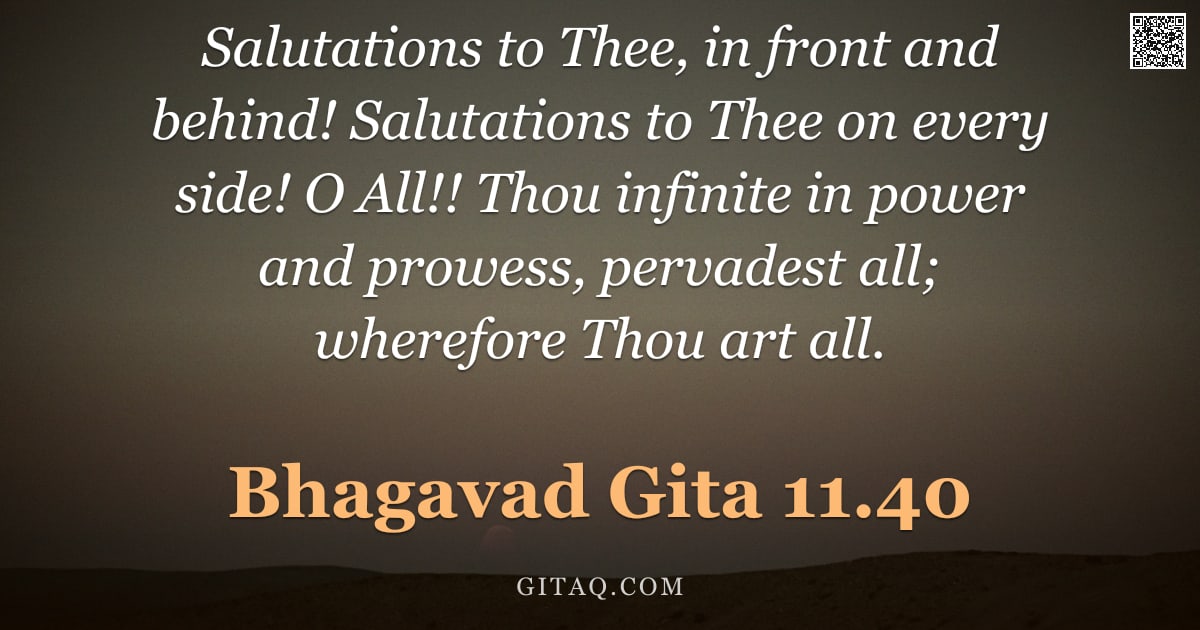
नमः पुरस्तादथ पृष्ठतस्ते नमोऽस्तु ते सर्वत एव सर्व | अनन्तवीर्यामितविक्रमस्त्वं सर्वं समाप्नोषि ततोऽसि सर्वः ||११-४०||
namaḥ purastādatha pṛṣṭhataste namo.astu te sarvata eva sarva . anantavīryāmitavikramastvaṃ sarvaṃ samāpnoṣi tato.asi sarvaḥ ||11-40||
What Does This Verse Mean?
In this verse, Arjuna is overwhelmed by the vision of Lord Krishna's Cosmic Form and offers him complete reverence from every direction—front, back, and all sides. He acknowledges that the Divine has infinite power and strength, pervading everything in existence because it truly is 'All' or the source of all things. This teaching highlights the concept of total surrender, where one realizes there is no place to hide from the omnipresent nature of the Creator.
The Teaching Behind It
This verse belongs primarily to Bhakti Yoga through Arjuna's act of surrender (prapatti) but deeply supports Jnana Yoga by articulating the non-dual reality that Brahman is 'Sarvam' (All). It develops the concept of omnipresence, teaching that the Divine is not a distant entity in the sky but the very substance and energy permeating every atom of existence.
Word by Word
Classical Commentary
Where This Happens
This verse occurs in Chapter 11 during the Vishvarupa Darshana Yoga, immediately after Krishna reveals his terrifying and magnificent universal form containing all gods, warriors, time, and destruction. Arjuna, initially terrified by this vision of infinite power that includes both creation and dissolution, is now overwhelmed with awe and fear. He speaks these words as a humble devotee offering prostration to the Supreme Being he just witnessed, realizing his own insignificance in comparison.
Living It Out Today
When facing an anxiety-inducing situation where you feel trapped or surrounded by problems from all sides—such as a looming deadline at work with no clear exit—you can apply this teaching by shifting your perspective. Instead of looking only at the threat ahead, recognize that support and resources (the 'infinite power') are also behind you and surrounding you in every direction. By acknowledging that you are part of something larger than yourself, you reduce isolation and find the courage to move forward with a sense of being held.
Explained for Children
Imagine if you could see your best friend's hug wrapping around the whole world at once, holding everything in front and behind them. That is what Arjuna sees when he looks at Krishna; it feels like a giant, loving light that surrounds us completely because God is everywhere inside and outside of us. Since this love has no limits, we say hello to it from every single angle, knowing it holds the whole universe together.
Daily Reflection
You often feel small or limited by the boundaries around you, yet Arjuna's vision reminds us that the Divine has no front or back for itself—it surrounds everything completely. When you realize you are never separate from this infinite consciousness, fear dissolves into a profound sense of safety and wholeness. Today, try to walk through your day feeling held by this all-pervading light rather than walking alone against it.
A Practice for Today
Close your eyes and visualize yourself standing at the center of an infinite, radiant presence that extends endlessly behind you and before you. Breathe deeply, acknowledging that this boundless power is not distant but resides within every atom of your being right now.
Key Teachings
- The Omnipresence of the Divine
God is not confined to a specific direction or location but exists simultaneously in front, behind, and on every side. This teaching shatters our illusion of separation by revealing that we are always within the embrace of the Infinite. - Boundless Power and Prowess
The Cosmic Form possesses infinite energy (anantavīrya) and unstoppable momentum, yet it is also the source from which all actions arise. Recognizing this shifts our focus from trying to control outcomes through limited effort to aligning with a power that sustains all existence. - The Identity of All Things
Since the Divine pervades everything, it is accurate to say 'Thou art all,' indicating that there is nothing outside of this ultimate reality. This realization invites us to see the sacred in every being and object, dissolving the duality between the worshiper and the worshipped.
Themes
Related Verses
Read This Next
- 2.47 — To transition from the vision of the Cosmic Form back to the practical application of performing duty without attachment.
- 3.30 — To understand how to offer all actions and results as a sacrifice, deepening the devotion mentioned in this verse.
- 12.15 — To learn about the qualities of a devotee who is dear to Krishna after witnessing His infinite nature.
Recommended Reading
GitaQ earns from qualifying purchases as an Amazon Associate.