Bhagavad Gita 11.39
Vishvarupa Darshana Yoga · English Translation
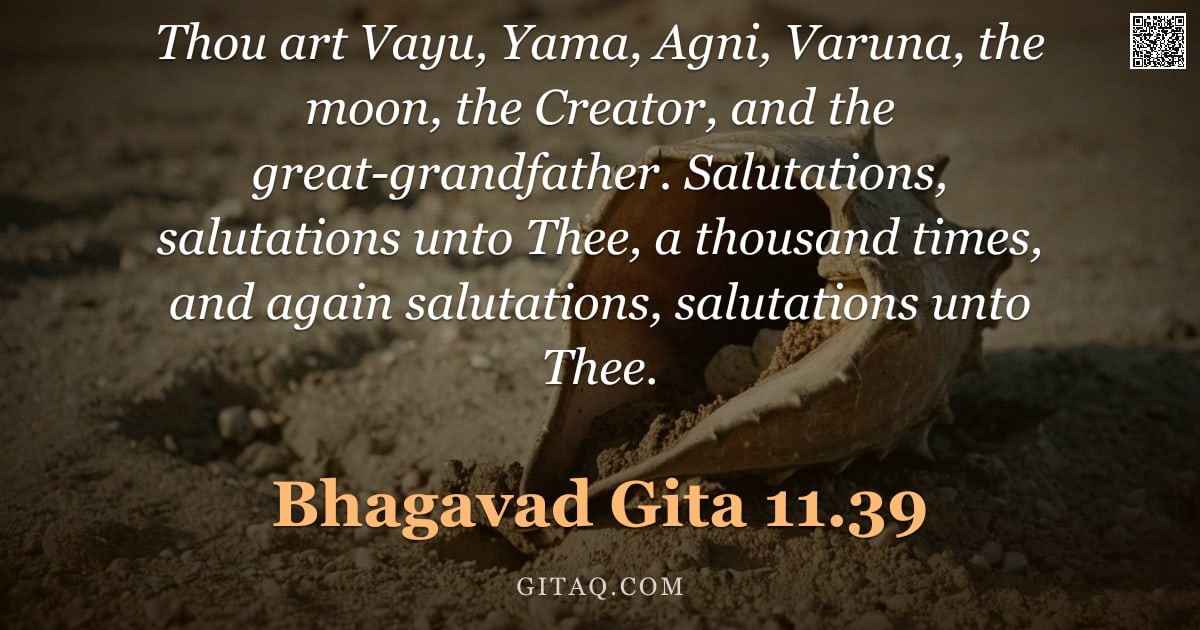
वायुर्यमोऽग्निर्वरुणः शशाङ्कः प्रजापतिस्त्वं प्रपितामहश्च | नमो नमस्तेऽस्तु सहस्रकृत्वः पुनश्च भूयोऽपि नमो नमस्ते ||११-३९||
vāyuryamo.agnirvaruṇaḥ śaśāṅkaḥ prajāpatistvaṃ prapitāmahaśca . namo namaste.astu sahasrakṛtvaḥ punaśca bhūyo.api namo namaste ||11-39||
What Does This Verse Mean?
In this verse, Arjuna addresses Lord Krishna with profound reverence, recognizing the Divine as the source of all natural forces and cosmic beings, including wind, fire, death itself (Yama), rain gods, and ancestors. By listing these diverse entities, the teaching reveals that God is not a distant ruler but the very essence present in every aspect of creation. Arjuna's repeated salutations emphasize total surrender, acknowledging Krishna as both the beginning and the end of all existence.
The Teaching Behind It
This verse is a cornerstone of Bhakti Yoga (the path of devotion) and Advaita Vedanta (non-dualism), illustrating the concept that the One Absolute Reality manifests as all diverse names and forms. It develops the teaching that God is not separate from creation but is the underlying substrate, energy, and consciousness behind every deity and natural element.
Word by Word
Classical Commentary
Where This Happens
This verse occurs during Chapter 11, immediately after Arjuna has witnessed Krishna's terrifying and magnificent Cosmic Form (Vishvarupa), which contains all universes, gods, time, death, and creation. Standing on the battlefield of Kurukshetra just before a great war that will wipe out his own kin, Arjuna is overwhelmed by fear, awe, and humility upon seeing the Divine as both the creator and the destroyer. He shifts from being a hesitant warrior to a devotee who realizes he has been fighting against a cosmic reality far greater than himself.
Living It Out Today
When facing an overwhelming professional crisis or a complex family decision where no single solution seems right, remember that you are not alone in managing every variable; trust the larger process of life. Instead of trying to control every outcome like a micro-manager, approach the situation with the humility of Arjuna, acknowledging your limitations while surrendering the results to something greater than yourself. This shifts your mindset from anxiety-driven action to purposeful participation, allowing you to act with clarity rather than fear.
Explained for Children
Imagine if you could see your teacher holding up a giant mirror that showed them inside every single thing around us—the wind blowing outside, the fire in the stove, even the moon at night. That is what Arjuna sees when he looks at Krishna; everything in nature and history is actually just one big part of God's family. It teaches us to say 'hello' with love a thousand times because we are surrounded by something amazing that holds the whole world together.
Daily Reflection
You often look at nature and see distinct entities like the wind or fire, yet today Arjuna teaches us to see One Reality behind every form. When you feel overwhelmed by life's forces, remember that even Yama (death) and Varuna (the waters) are merely different expressions of your own Divine Self. This shifts your fear into a sacred trust, knowing that the very breath in your lungs is God breathing through you.
A Practice for Today
Close your eyes and visualize the wind, fire, moon, and rain not as separate forces, but as living faces of a single Divine presence moving within you right now. Silently offer gratitude for these elemental powers that sustain life, acknowledging them all as manifestations of Your beloved Lord.
Key Teachings
- Divine Immanence
The Lord declares Himself to be Vayu and Agni simultaneously, proving He resides within every element of creation rather than standing apart from it. This teaches that no part of the universe is devoid of God's presence. - Transcending Duality
By identifying with both life-giving forces like Varuna and destructive ones like Yama, the vision dissolves our fear of death or natural calamities. It reveals that what we perceive as separate opposites are unified aspects of a singular Truth. - Total Surrender
The repetition of 'Namo namaste' signifies an offering of the entire self, acknowledging that every role from creator to ancestor is held by one Source. This attitude transforms daily existence into continuous worship and total reliance on the Divine.
Themes
Related Verses
Read This Next
- 2.47 — To understand the practical application of seeing God in action without attachment to results.
- 3.30 — To learn how to dedicate all actions, including those driven by natural forces, as an offering to the Divine.
- 12.15 — To discover the qualities of a devotee who finds peace in seeing God present everywhere and is beloved by Him.
Recommended Reading
GitaQ earns from qualifying purchases as an Amazon Associate.