Bhagavad Gita 11.12
Vishvarupa Darshana Yoga · English Translation
दिवि सूर्यसहस्रस्य भवेद्युगपदुत्थिता | यदि भाः सदृशी सा स्याद्भासस्तस्य महात्मनः ||११-१२||
divi sūryasahasrasya bhavedyugapadutthitā . yadi bhāḥ sadṛśī sā syādbhāsastasya mahātmanaḥ ||11-12||
What Does This Verse Mean?
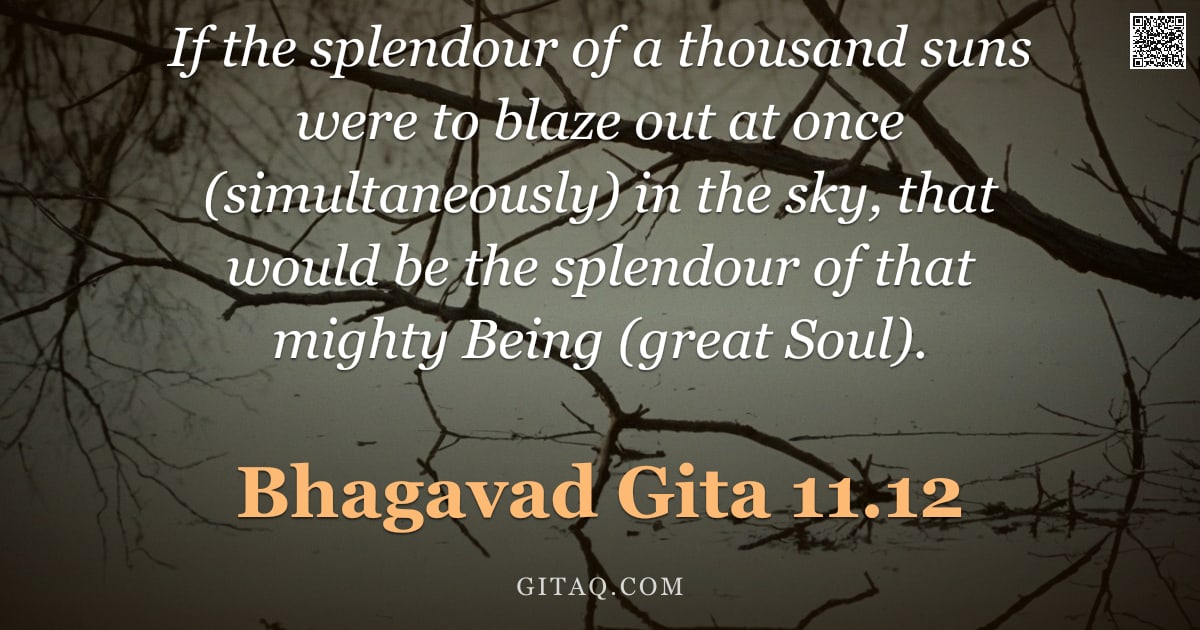
In this verse, Lord Krishna is describing the terrifying and magnificent Cosmic Form to Arjuna on the battlefield of Kurukshetra. He states that even if a thousand suns were to rise in the sky all at once with their combined brilliance, it would still only be equal to the glow emanating from His divine body. This teaching reveals the infinite power and overwhelming nature of the Supreme Being, which is beyond human comprehension.
The Teaching Behind It
This verse belongs primarily to Jnana Yoga (the path of knowledge) as it reveals the ultimate nature of reality through direct perception. It develops the concept that the individual self is insignificant compared to the Infinite Self, illustrating how the finite cannot contain or fully describe the infinite divine presence.
Word by Word
Classical Commentary
Where This Happens
This verse occurs during Chapter 11, known as Vishvarupa Darshana Yoga, where Krishna grants Arjuna divine vision after a request for clarification. The scene takes place on the battlefield of Kurukshetra just before the great war begins, following Arjuna's refusal to fight his own relatives due to confusion and grief. Upon seeing this terrifying form filled with infinite universes and devouring time, Arjuna is overwhelmed by fear and awe, realizing that he has been speaking to a deity far greater than any human teacher.
Living It Out Today
When facing an overwhelming professional crisis or a complex family conflict where you feel small and helpless, remember this verse as a reminder of perspective. Just as the single sun's light outshines all others in Krishna's form, there is often a deeper truth or solution to your problem that transcends immediate panic. Instead of trying to solve every aspect of a massive challenge alone with limited human vision, trust in a higher guidance and let go of the need for total control.
Explained for Children
Imagine trying to describe a super-bright flashlight by holding up one candle next to it; even if you hold thousands of candles together, they would still look dim compared to that single light. Krishna told Arjuna something similar: the universe he saw was so incredibly bright and powerful that not even a thousand suns shining all at once could match its glow. It is like trying to explain how big the ocean is using only one drop of water; you simply cannot see it with normal eyes.
Daily Reflection
In moments where life feels small or dimmed by worry, remember that you are sustained by a radiance far greater than any single sun could provide. This verse invites you to trust in the sheer magnitude of the Divine presence within and around you today. Even when things seem uncertain, rest knowing that your innermost nature is as vast and luminous as this cosmic vision.
A Practice for Today
Close your eyes and imagine the blinding radiance of a thousand suns rising simultaneously, dissolving all shadows within you. Allow this overwhelming light to reveal that your true self is not separate from this infinite brilliance but an expression of it.
Key Teachings
- The Limitations of Human Perception
Arjuna uses the metaphor of a thousand suns to convey that the Divine form cannot be grasped by ordinary senses or logic. It teaches us that reality is far more expansive than our limited mental frameworks can comprehend. - The Nature of Infinite Splendor
True spiritual power does not manifest as a single point but as an all-encompassing, simultaneous radiance that permeates everything. This teaches the seeker to look beyond individual phenomena to see the unified source behind them. - Divine Majesty and Human Awe
Confrontation with such overwhelming glory naturally induces a sense of awe, humility, and surrender in the observer. It serves as a reminder that the ultimate reality is both terrifyingly powerful and intimately close.
Themes
Related Verses
Read This Next
- 2.47 — To ground the overwhelming vision with practical guidance on duty and detachment.
- 3.30 — To learn how to dedicate all actions, including this awe-inspiring perception, to the Divine.
- 12.15 — To transition from the vision of form back to the qualities of a devotee who finds peace in the Supreme.
Recommended Reading
GitaQ earns from qualifying purchases as an Amazon Associate.