Bhagavad Gita 10.8
Vibhuti Yoga · English Translation
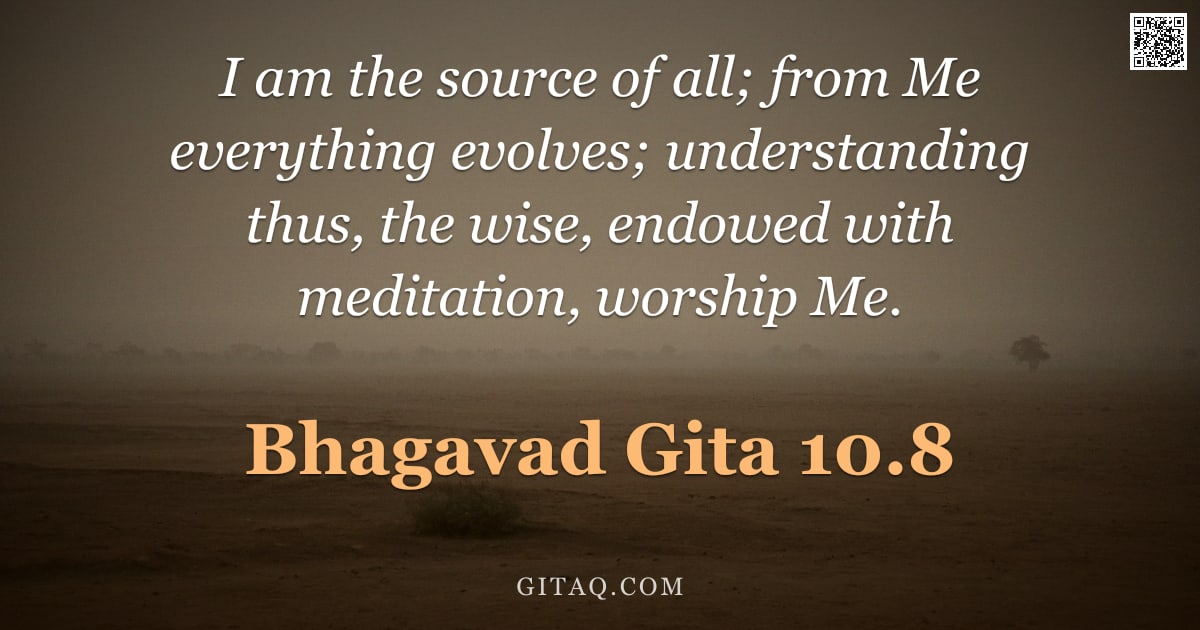
अहं सर्वस्य प्रभवो मत्तः सर्वं प्रवर्तते | इति मत्वा भजन्ते मां बुधा भावसमन्विताः ||१०-८||
ahaṃ sarvasya prabhavo mattaḥ sarvaṃ pravartate . iti matvā bhajante māṃ budhā bhāvasamanvitāḥ ||10-8||
What Does This Verse Mean?
In this verse, Lord Krishna tells Arjuna that He is the ultimate source of everything in existence and that all creation flows from Him. When people truly understand this truth through wisdom and devotion, they offer their worship to Him with a purified heart. The core teaching is that recognizing God as the originator changes one's perspective on life, turning every action into an act of reverence.
The Teaching Behind It
This verse synthesizes Jnana Yoga (the path of knowledge) with Bhakti Yoga (the path of devotion), establishing that true wisdom inevitably leads to surrender. It develops the concept of 'Isvara' or the Supreme Being as the singular cause of all effects, bridging the gap between impersonal cosmic principles and personal divine love.
Word by Word
Classical Commentary
Where This Happens
This verse occurs during Chapter 10, known as Vibhuti Yoga, on the battlefield of Kurukshetra just before the great war begins. Krishna has finished describing his divine manifestations and is now revealing that He is not just a manifestation but the very source of all existence. Arjuna, who was previously overwhelmed by grief and confusion about fighting kin, is beginning to recognize Krishna's supreme divinity through these teachings.
Living It Out Today
Imagine you are facing a high-pressure decision at work where the outcome feels uncertain. Instead of viewing yourself as an isolated individual struggling against odds, apply this verse by recognizing that your ability to make decisions and the resources available to you come from a larger source. By approaching the problem with gratitude for these capabilities rather than anxiety about failure, you shift from fear-based action to wise, focused effort.
Explained for Children
Imagine you are drawing a picture, but before you even pick up your pencil, all the colors and ideas in your mind come from a special box inside you. Krishna is saying that He is like that amazing source for everything in the universe—stars, trees, animals, and people—all come from Him! When we realize this, like understanding where our love comes from, we start to treat everyone with kindness because we see them as part of His wonderful family.
Daily Reflection
Today, take a moment to pause before reacting to any challenge or opportunity and remember that you are never truly alone. The source of your very life breathes through every thought and action, turning ordinary moments into sacred encounters with the Divine. When you realize this truth, worry dissolves because you see yourself as part of an eternal flow rather than a struggling isolated self.
A Practice for Today
Sit quietly and visualize yourself as a single drop of water, realizing you are not separate from the vast ocean that holds you. Silently repeat to your heart: 'All my actions flow from this Source; I am an expression of its infinite potential.' Rest in the peace of knowing that everything arising within you is supported by the Divine.
Key Teachings
- The Non-Dual Source
Krishna establishes that He is not merely one god among many, but the singular origin (prabhava) from which all existence springs. This teaches us to look beyond the diversity of forms to find the unified consciousness behind them. - The Flow of Creation
Everything evolves and functions through divine will; nothing exists independently outside of this cosmic connection. By seeing our lives as a continuous flow from God, we understand that every event is an opportunity for engagement with the Divine. - Worship Through Wisdom
True devotion (bhakti) arises not just from emotion but from intellectual clarity and understanding of our true nature. The wise who realize this source engage in worship as a natural, joyful response to the recognition of their own divinity.
Themes
Related Verses
Read This Next
- 2.47 — This verse clarifies how to perform actions without attachment after understanding the source is Krishna.
- 3.30 — It provides a practical method for dedicating all activities and results back to the Divine as an offering.
- 12.15 — This verse describes the qualities of those who have realized this connection and become dear to Krishna, completing the devotional picture.
Recommended Reading
GitaQ earns from qualifying purchases as an Amazon Associate.