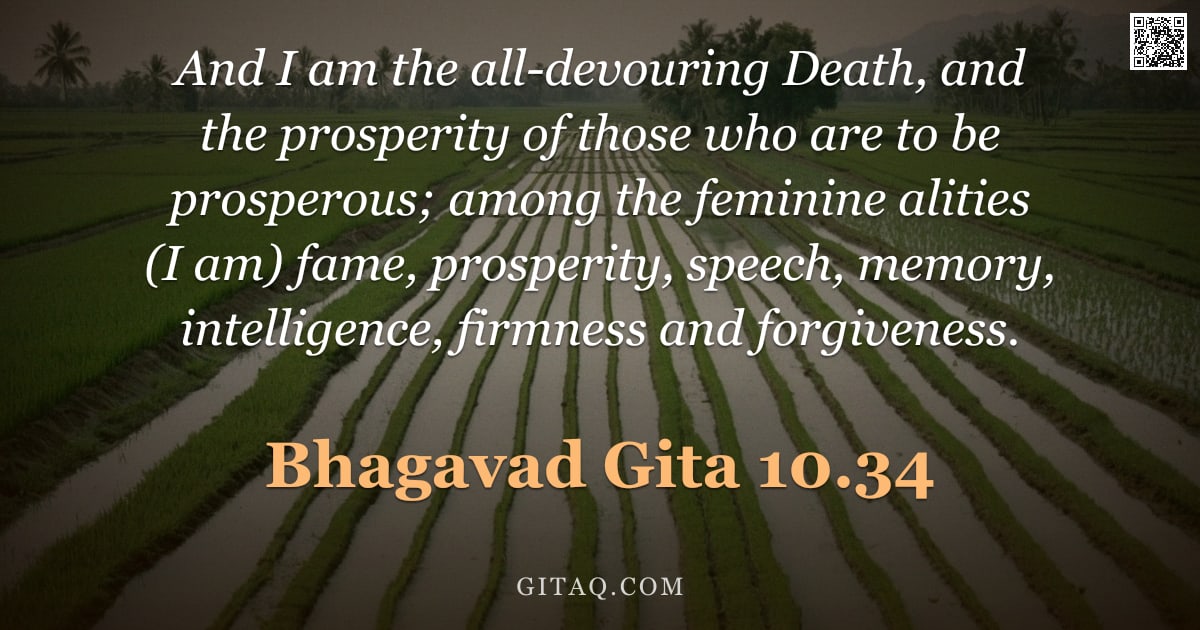
Bhagavad Gita 10.34
Vibhuti Yoga · English Translation
मृत्युः सर्वहरश्चाहमुद्भवश्च भविष्यताम् | कीर्तिः श्रीर्वाक्च नारीणां स्मृतिर्मेधा धृतिः क्षमा ||१०-३४||
mṛtyuḥ sarvaharaścāhamudbhavaśca bhaviṣyatām . kīrtiḥ śrīrvākca nārīṇāṃ smṛtirmedhā dhṛtiḥ kṣamā ||10-34||
What Does This Verse Mean?
In this verse, Lord Krishna tells Arjuna that He is the underlying essence behind all powerful and positive forces in existence. He explains that even Death itself is a manifestation of His divine will, as He eventually takes away everything to allow for renewal. Furthermore, He identifies with the most admirable qualities found within women, such as fame, wisdom, speech, patience, and forgiveness. The core teaching is that by recognizing these natural attributes, one can see God in every aspect of life.
The Teaching Behind It
This verse belongs to the teaching of Bhakti Yoga (the yoga of devotion) integrated with Sankhya philosophy's understanding of the material world. It develops the concept that Brahman (the Absolute Reality) is not separate from creation but permeates all dualities, including life and death, as well as abstract virtues like intelligence and forgiveness.
Word by Word
Classical Commentary
Where This Happens
This verse occurs during the 'Vibhuti Yoga' chapter of the Bhagavad Gita, set on the battlefield of Kurukshetra just before the great war begins. Lord Krishna is speaking to Arjuna, who has dropped his bow in despair and confusion about fighting his own relatives. After describing His infinite glories through various natural phenomena like the sun, moon, and mountains, Krishna now addresses the concept of Death itself as a divine force.
Living It Out Today
When facing an inevitable change or loss at work, such as a project cancellation that feels like 'death' for your efforts, remember this verse to see it not as a failure but as a necessary transition allowing new opportunities. In family life during difficult times of grief, find comfort in knowing that even the finality of death is part of a larger divine plan designed for renewal and balance. When making hard decisions involving forgiveness or patience with a loved one who has wronged you, recognize these virtues not just as human traits but as manifestations of higher intelligence guiding your actions.
Explained for Children
Imagine a giant box where all the best things come from inside. Krishna tells us He is like that box for everything amazing! Even when someone passes away or flowers wilt (which looks sad), it's actually Him showing how new life begins again, just like spring follows winter. When you see someone being super brave, speaking kindly, remembering their lessons well, or forgiving a friend who made a mistake, Krishna says those are His special gifts living inside them.
Daily Reflection
Today, consider how even the most daunting forces like death are actually expressions of divine protection, clearing away what is no longer needed for you to grow. You may find that the very traits you value—your ability to speak wisely or your capacity to forgive—are not just human efforts but reflections of the Divine within you. When you face a difficult transition or feel overwhelmed by change, remember that this same presence is guiding you through it with grace.
A Practice for Today
Close your eyes and visualize Death not as an end, but as the great remover that makes space for new life to emerge; breathe deeply acknowledging this cycle of release and renewal within you. Then shift your awareness inward to identify where fame or speech resides in your daily interactions, inviting those qualities to be guided by a higher intelligence.
Key Teachings
- Death as Liberation
The Lord reveals that death (mṛtyu) is actually the 'all-devourer' who clears away limitations, acting not as a punishment but as a necessary removal for spiritual progress. This teaches us to view endings with trust rather than fear, seeing them as divine acts of preservation and transition. - The Source of Human Virtues
Fame (kīrti), speech (vāk), memory (smṛti), intelligence (medhā), firmness (dhṛti), and forgiveness (kṣamā) are not isolated human achievements but direct manifestations of the Divine in action. Recognizing these qualities as God's presence allows us to cultivate them with humility, knowing they flow from a source greater than our own ego. - Divine Presence in Feminine Archetypes
By listing attributes like fame and forgiveness alongside the feminine form (nārīṇām), the verse honors these qualities as essential, dynamic forces of creation and sustenance. It invites us to see the sacredness in both masculine and feminine energies that govern our inner world and social interactions.
Themes
Related Verses
Read This Next
- 2.47 — This verse complements the theme by teaching us to perform our duties without attachment, acknowledging death and results are not entirely in our control.
- 3.30 — It expands on surrendering all actions to the Divine, which aligns with seeing intelligence and firmness as gifts from God rather than personal achievements.
- 12.15 — This verse describes the qualities of a devotee who is dear to Krishna, highlighting forgiveness (kṣamā) and other virtues mentioned in 10.34 as essential for spiritual connection.
Recommended Reading
GitaQ earns from qualifying purchases as an Amazon Associate.