Bhagavad Gita 10.25
Vibhuti Yoga · English Translation
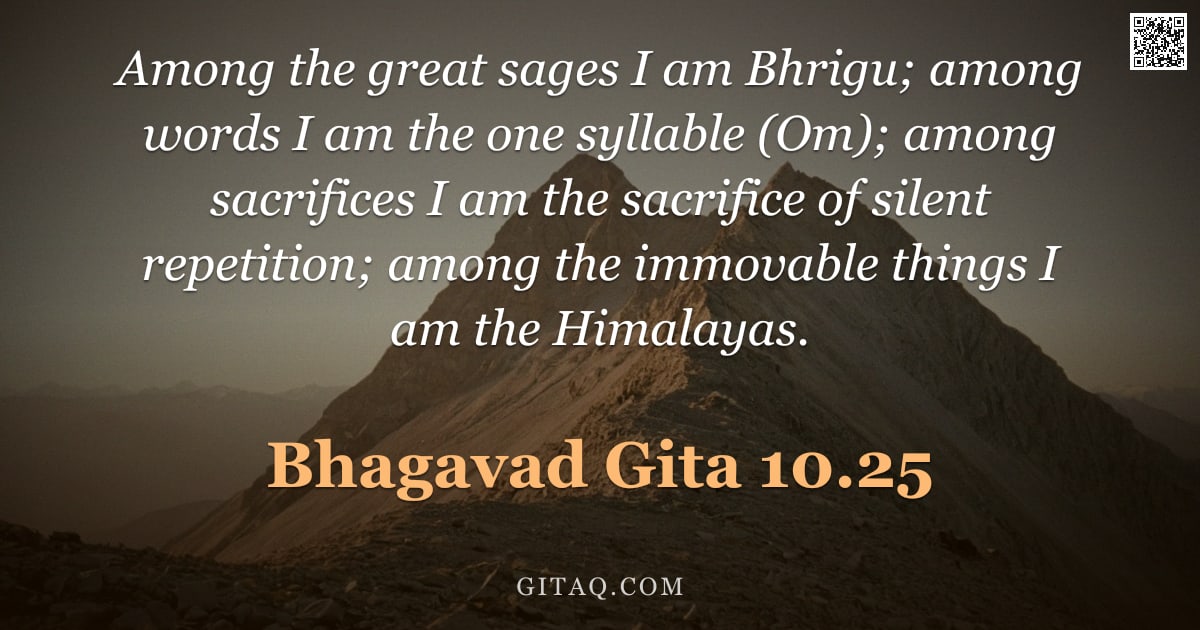
महर्षीणां भृगुरहं गिरामस्म्येकमक्षरम् | यज्ञानां जपयज्ञोऽस्मि स्थावराणां हिमालयः ||१०-२५||
maharṣīṇāṃ bhṛgurahaṃ girāmasmyekamakṣaram . yajñānāṃ japayajño.asmi sthāvarāṇāṃ himālayaḥ ||10-25||
What Does This Verse Mean?
In this verse, Lord Krishna is explaining His divine presence to Arjuna by identifying the most significant examples within different categories of existence. He states that among great sages, he is Bhrigu; among words, he is the primordial sound 'Om'; among sacrifices, he is silent meditation (Japa); and among mountains, he is the Himalayas. The core teaching is that the Divine is not distant but is the most powerful, purest, or foundational essence in every aspect of life.
The Teaching Behind It
This verse is central to the concept of Ishvara-varna-upasana within Bhakti Yoga, teaching that devotion can be cultivated by recognizing the Divine in all manifestations. It also supports Jnana Yoga by revealing the non-dual truth (Advaita) where one essence pervades diverse forms, helping the seeker see unity behind multiplicity.
Word by Word
Classical Commentary
Where This Happens
This verse occurs during Chapter 10 on the battlefield of Kurukshetra, where Arjuna has just accepted his duty and asked Krishna for a deeper understanding. Lord Krishna responds by describing His 'Vibhuti' or divine glories, moving from general cosmological descriptions to specific examples in nature and human achievement. At this moment, Arjuna is overwhelmed with awe as he realizes that the war, the sages fighting alongside him, and even the very ground beneath his chariot are infused with Krishna's presence.
Living It Out Today
When facing a high-stakes decision at work where everyone expects perfection, remember that you do not need to be perfect yourself; instead, focus on doing your part with complete sincerity. Just as the Himalayas stand firm regardless of weather or time, anchor your actions in steady effort and quiet dedication (like silent prayer or meditation) rather than seeking loud recognition. This approach transforms a stressful deadline into an opportunity for inner strength.
Explained for Children
Imagine if a giant flashlight shone through different colors; no matter which color you see, it's all coming from one bright light source inside. Lord Krishna tells us that He is like that special inner brightness found everywhere. Just as the Himalayas are the biggest and strongest mountains, or 'Om' is the most important sound we can make, Krishna says He is the best part of everything—from our deepest thoughts to the highest peaks.
Daily Reflection
In our busy lives, we often seek God only in grand gestures or distant places, but today Krishna reminds us that He is present even within the simplest repetition of a word and the quiet strength of nature. You do not need to travel far to find divinity; it resides right now in your ability to speak truthfully and in the steady peace you can cultivate when life feels chaotic. By honoring the sacred syllable 'Om' or simply sitting quietly, you align yourself with that eternal foundation which holds everything together.
A Practice for Today
Close your eyes and silently chant 'Om' with every breath, recognizing it as the divine pulse that sustains all speech and thought. Visualize yourself standing upon a vast mountain range like the Himalayas; feel your roots grounding you in stillness while allowing your consciousness to rise toward the infinite.
Key Teachings
- The Essence of Sound
Just as all meaningful speech stems from a single source, Krishna identifies Himself as Om, the primal vibration underlying all language and thought. This teaches us that every word we speak carries divine potential if spoken with awareness and reverence. - The Power of Silent Practice
Among various forms of ritual sacrifice, the Lord chooses 'japa-yajna,' or silent repetition, as a supreme offering. This highlights that true devotion is not just about external grandeur but about the internal discipline and focus maintained in silence. - Divine Immutability
By selecting the Himalayas among immovable things, Krishna emphasizes His role as the unshakable foundation of existence. Just as mountains stand firm against storms, our spiritual practice should aim to build an inner stability that remains untouched by external turbulence.
Themes
Related Verses
Read This Next
- 2.47 — Connects to the theme of steady action without attachment mentioned through the stability of the mountain imagery.
- 3.30 — Expands on the concept of offering all actions and sacrifices as worship, deepening the understanding of japa-yajna.
- 12.15 — Illustrates how one who is steady like a mountain (like Krishna in this verse) becomes dear to Him through equanimity and peace.
Recommended Reading
GitaQ earns from qualifying purchases as an Amazon Associate.