Bhagavad Gita 10.11
Vibhuti Yoga · English Translation
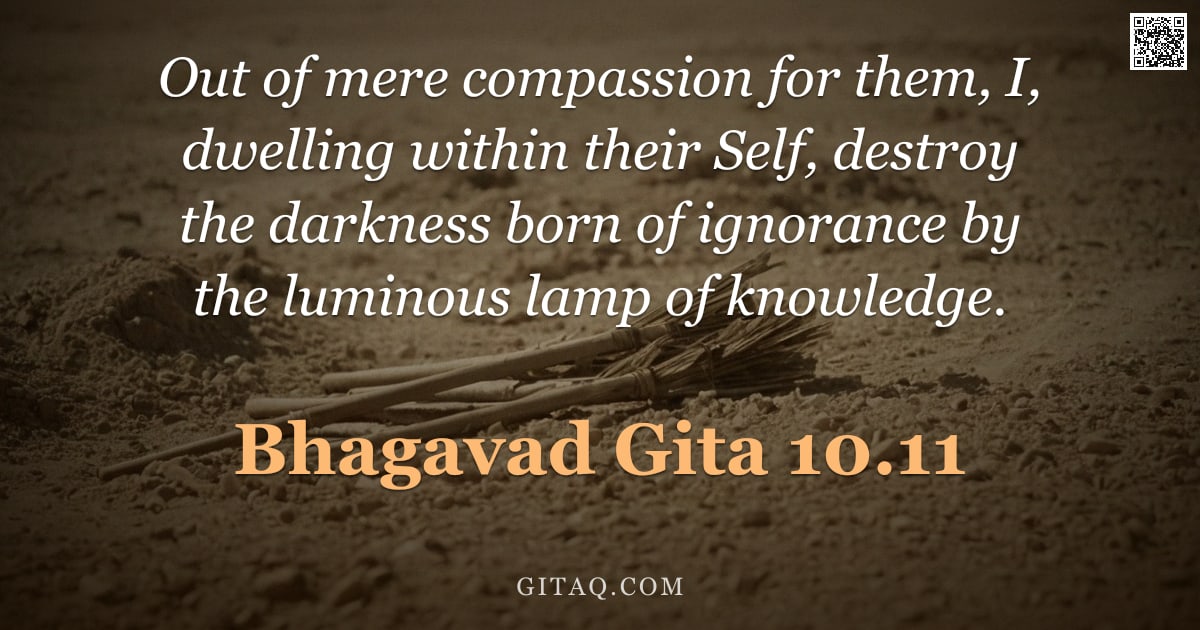
तेषामेवानुकम्पार्थमहमज्ञानजं तमः | नाशयाम्यात्मभावस्थो ज्ञानदीपेन भास्वता ||१०-११||
teṣāmevānukampārthamahamajñānajaṃ tamaḥ . nāśayāmyātmabhāvastho jñānadīpena bhāsvatā ||10-11||
What Does This Verse Mean?
In this verse, Lord Krishna tells Arjuna that he enters the heart of those who surrender to him out of pure compassion. He promises to remove the darkness of ignorance that clouds their vision and prevents them from seeing the truth about themselves and reality. This divine intervention is described as a powerful lamp of knowledge lighting up the inner self. The core teaching is that spiritual awakening comes not just through human effort, but through God's grace acting within us when we seek Him sincerely.
The Teaching Behind It
This verse synthesizes the principles of Bhakti Yoga and Jnana Yoga, illustrating how devotion (surrender) triggers divine grace which manifests as wisdom. It teaches that while human effort is required to turn inward, the ultimate removal of Avidya (ignorance) is an act of God's internal presence within the self. The concept developed here is that true knowledge is not merely intellectual acquisition but a transformative spiritual awakening initiated by compassion.
Word by Word
Classical Commentary
Where This Happens
This verse appears in Chapter 10 during the dialogue between Lord Krishna and Prince Arjuna on the battlefield of Kurukshetra, just after Krishna has revealed his cosmic form to a terrified Arjuna. Following this overwhelming revelation, Arjuna is still struggling with deep confusion about how such an infinite being could be limited or identified as one specific friend. The listener, Arjuna, feels humbled and desperate for clarity on the nature of God and his own place in the universe. Krishna speaks to him now not just as a commander-in-chief, but as a compassionate teacher who has entered into the very heart of his disciple.
Living It Out Today
Consider a professional facing an ethical dilemma at work where everyone else is pressuring them to cut corners for profit. They feel paralyzed by fear and confusion, unable to see a clear path forward despite their own experience. By turning inward with prayer or deep meditation—essentially asking for divine guidance—they may suddenly find a surge of clarity that cuts through the noise. This moment represents 'the lamp of knowledge' illuminating the right course of action, replacing anxiety with confident purpose.
Explained for Children
Imagine you are in a really dark room where you can't see anything and feel scared because everything looks confusing. Now, imagine your best friend walks in holding a bright flashlight that pushes all the shadows away so you can finally see clearly and feel safe again. Krishna says he does exactly this for us: when we ask him with an open heart, he comes inside our minds to turn on a special light of understanding. This helps us stop being confused by problems and start seeing things as they really are.
Daily Reflection
Today, remember that when you feel lost in the shadows of ignorance, you are not walking alone; the Divine has already taken up residence within your very heart. That inner presence acts as a compassionate friend who gently illuminates your path with wisdom whenever you turn inward to seek clarity. Instead of struggling against the darkness through sheer willpower, simply open yourself to this radiant light that is eager to guide you home.
A Practice for Today
Close your eyes and visualize an inner light kindled within the deepest chamber of your heart, where you reside alongside the Divine presence that never leaves you. Invite this luminous lamp to dissolve any fog of confusion or self-doubt, trusting that it is a direct expression of divine compassion rather than human effort.
Key Teachings
- The Indwelling Compassion
God does not remain a distant observer but actively dwells within the individual self (Atman) as a friend and witness. This intimate presence is motivated solely by mercy, ready to intervene when we seek liberation from our own limitations. - Ignorance as Darkness
The root of human suffering is identified not as sin or punishment, but as a darkness born of spiritual ignorance (ajñana). This lack of true knowledge obscures the reality of one's divine nature and creates unnecessary fear. - Knowledge as Illumination
The remedy for this existential fog is not ritualistic action but the 'luminous lamp' of spiritual wisdom. This transformative insight burns away confusion, revealing the self-evident truth that was always present.
Themes
Related Verses
Read This Next
Recommended Reading
GitaQ earns from qualifying purchases as an Amazon Associate.