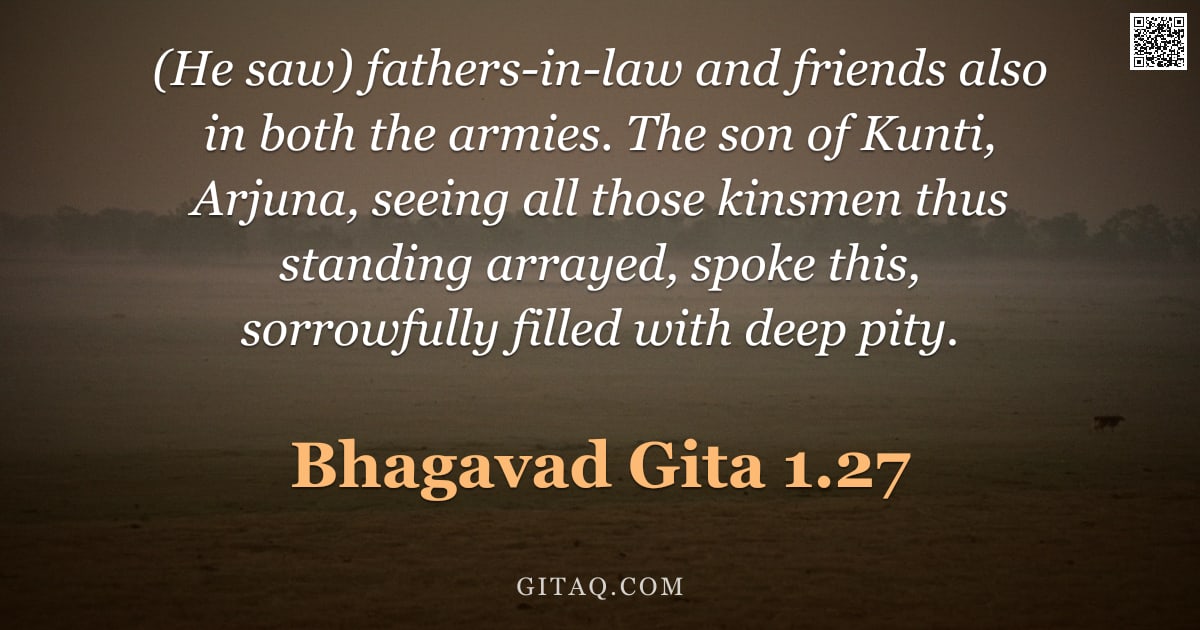
Bhagavad Gita 1.27
Arjuna Vishada Yoga · English Translation
श्वशुरान्सुहृदश्चैव सेनयोरुभयोरपि | तान्समीक्ष्य स कौन्तेयः सर्वान्बन्धूनवस्थितान् ||१-२७||
śvaśurānsuhṛdaścaiva senayorubhayorapi . tānsamīkṣya sa kaunteyaḥ sarvānbandhūnavasthitān ||1-27||
What Does This Verse Mean?
In this verse, Arjuna looks across the battlefield of Kurukshetra and sees his own relatives standing on both sides: fathers-in-law, friends, and elders from the opposing army. Overwhelmed by deep pity at the thought of killing these beloved people, he is struck with sorrow and confusion about how to proceed. This moment marks the peak of Arjuna's despair as he realizes that victory would require destroying his own kinship circle.
The Teaching Behind It
This verse initiates the core teaching of Karma Yoga and Sankhya philosophy within the Gita by exposing the conflict between attachment (raga) and duty (dharma). It sets up the necessary psychological crisis where Arjuna must transition from acting out of personal affection to understanding his role as a warrior without ego. This realization is the prerequisite for Lord Krishna's subsequent teachings on the immortality of the soul.
Word by Word
Where This Happens
This verse occurs at the climax of Chapter 1 as Prince Duryodhana has finished pointing out the warriors on both sides, prompting him to ask for a final count. Arjuna is now looking across the vast field where his cousins (the Kauravas) and their allies are arrayed against his own side (the Pandavas). Having just witnessed the sheer scale of the coming conflict involving everyone he loves, Arjuna feels an immediate physical collapse into sorrow before Duryodhana's army even charges.
Living It Out Today
Consider a professional manager who must make the difficult decision to downsize their team during a company crisis. They may face intense internal conflict when seeing friends and mentors they have mentored for years on both sides of the potential layoffs, feeling paralyzed by empathy despite knowing it is necessary for survival. Like Arjuna, one might initially feel that any action taken will result in personal loss or emotional devastation.
Explained for Children
Imagine you are playing a game where two teams face off, but then you realize half your teammates and some of your best friends from school have been put on both sides. Suddenly, winning the game means hurting people you love very much, which makes you feel really sad and stop wanting to play. Arjuna felt exactly this way when he saw his own family members standing ready to fight against each other.
Daily Reflection
Arjuna's heart breaks not because he fears death in battle, but because the sight of his kinsmen transforms abstract duty into personal loss; you too may find that your greatest challenges arise when your responsibilities collide with those you hold dearest. This moment invites you to pause and ask where your own attachments are clouding your clarity or causing unnecessary suffering today. Instead of avoiding these painful connections, try viewing them through a lens of compassion for the shared human condition.
A Practice for Today
Close your eyes and visualize standing on that battlefield of Kurukshetra, seeing the faces of loved ones arrayed on both sides as Arjuna did. Take a deep breath to acknowledge how these relationships define our earthly attachments before seeking the higher vision of unity.
Key Teachings
- The Paradox of Duty
Dharma often demands action that feels unnatural or cruel when it opposes our deepest emotional bonds. The warrior must learn to act without being paralyzed by the immediate pain of severing human ties. - Universal Kinship
The verse highlights how blood relations and social alliances span across opposing sides, blurring lines between friend and foe in a moment of crisis. True wisdom sees beyond these temporary divisions to the shared soul residing within everyone present. - Pitiable Compassion
Arjuna's sorrow stems from 'kripaya' (pity), revealing that even noble intentions can be rooted in attachment rather than pure duty. We must distinguish between compassionate action driven by clarity and the paralysis caused by emotional entanglement.
Themes
Related Verses
Read This Next
- 2.47 — This verse provides Krishna's direct answer to Arjuna's despair, teaching the principle of acting without attachment to results.
- 3.30 — It reinforces the call for selfless action and surrendering all works to the Divine, moving beyond personal grief.
- 12.15 — This verse describes the qualities of a devotee who is dear to Krishna because they are free from envy toward friends or enemies alike.
Recommended Reading
GitaQ earns from qualifying purchases as an Amazon Associate.